The Short Answer
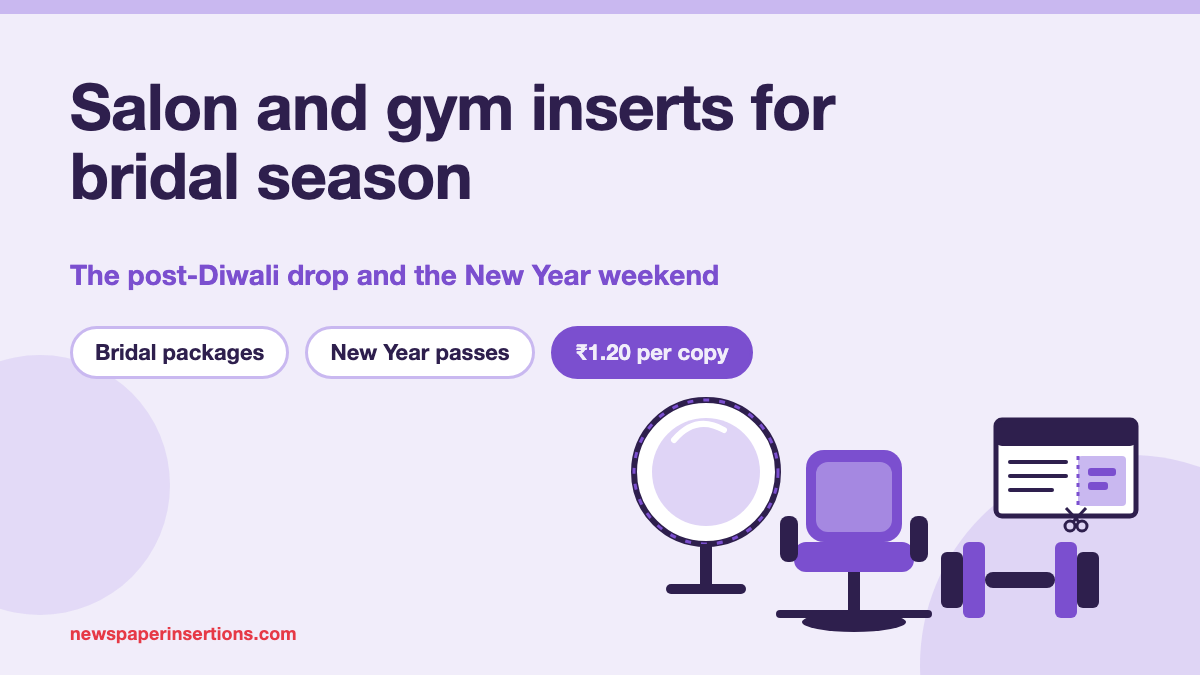
A salon, spa or gym sells to the households within two to five kilometres of its door, again and again, and both of its big seasons are decided at home: the bridal and family grooming bookings in the weeks after Diwali, and the New Year membership in the first week of January. Print a priced offer with a deadline and a coupon, drop A5 copies into the nearest pin codes on the right weekend, and count redemptions. At ₹1.20 per copy, 50,000 copies cost ₹60,000 plus GST.
Key Takeaways
- Personal services are a repeat, short-radius, offer-led purchase. A salon draws walk-in trade from 2 to 3 km, a gym from 3 to 5 km, and both sell best when the household can compare a printed price and a date at the breakfast table.
- The season has two peaks in 2026 and 2027: bridal and wedding-guest grooming from Dev Uthani Ekadashi on Friday 20 November through the muhurat dates, with a pause for Kharmas and a second run after Makar Sankranti, and the New Year resolution week that opens on Friday 1 January 2027.
- The bridal drop belongs on Saturday 14 November 2026, the New Year drop on Saturday 2 or Sunday 3 January 2027, and a second bridal drop on Saturday 9 January 2027 for the post-Sankranti dates.
- The sheet that fills chairs and treadmills is a priced, dated offer: the package or membership price, what it includes, the last date it holds, a tear-off coupon or trial pass, a WhatsApp booking line and the address with a landmark and hours.
- Fifty thousand A5 copies cost ₹60,000 plus GST. On the general 0.5 to 2 percent response band we observe for coupon-led offers, that is 250 to 1,000 redemptions, or ₹60 to ₹240 per new customer, before repeat visits and memberships are counted.
Why do salons, spas and gyms suit newspaper inserts?
Most of this blog's category guides deal with a purchase a household makes once in years. Personal services sit at the other end, and three traits make them a natural fit for the insert.
The sale happens in person, within a short radius. Our wedding-season post puts salons with clinics, tailors and sweet shops among the trades that draw from 2 to 3 km, and our pin-code targeting guide lists gyms among the businesses whose customers travel under 5 km to buy. A salon's entire walk-in trade, and a gym's entire membership, live in a handful of pin codes, and a pin code is exactly the unit a newspaper vendor network delivers to.
The offer is the product. A ₹999 bridal trial, a joining fee waived until 15 January, a couple's spa package at a stated price: these are offers a household can compare, cut out and carry. Our A2 versus A4 versus A5 guide names salon and gym offers among the redemption-driven, date-driven uses that suit A5, and our coupon inserts guide explains why coupon-led inserts sit at the top of the response range we see.
The customer comes back. A gym member pays every month, a bridal client books a trial, the wedding-day service and often the family's grooming as well, and a satisfied spa visitor returns every few weeks. Our cost per lead calculation guide explains why the first bill understates the return for any business whose customers return, and personal services are the clearest case of it.
Across the campaigns we have run since 2020 across 30+ cities, the personal-services sheets that paid for themselves shared two traits. They carried one priced offer with a date on it, and they went into the pin codes within walking or short-ride distance of the door. The whole-city drop for a single salon is the most common waste we see in this category, and we say so again in the mistakes section below.
When should a salon, spa or gym drop the insert?
The grooming and fitness calendar has two peaks and a quiet middle, and each needs a different drop.
The bridal and wedding-guest season. In North and West India the wedding season opens around Dev Uthani Ekadashi, Friday 20 November in 2026, roughly a dozen days after Diwali, and the first run of dates continues until Kharmas begins around 16 December. The bride books her salon four to six weeks before the date, usually after a trial, and the guests and the groom's family book in the fortnight before. The bridal-package drop therefore belongs on Saturday 14 or Sunday 15 November 2026, the first weekend after Diwali, when households are reading the paper together and the November and early-December dates are being planned. Our wedding-season post covers the full muhurat calendar and the categories that move with it.
The Kharmas pause and the January dates. From roughly 16 December to 14 January most Hindu families in the North and West avoid weddings, and the same post notes that these quiet weeks are when families shop for the January and February dates. A second bridal drop on Saturday 9 January 2027, just before Makar Sankranti reopens the calendar on Thursday 14 January, catches that planning. In the South and East, where the calendar differs, the second drop follows the local muhurat clusters.
The New Year resolution week. Our Christmas to Republic Day window guide notes that gyms, yoga studios and diet clinics see enquiries spike in the first week of January, and recommends a drop on Saturday 2 or Sunday 3 January 2027, while the resolution is fresh. New Year falls on a Friday in 2027, so the weekend papers land in a household that has just made the resolution and not yet acted on it. A gym that drops on 2 January with a joining fee waived until 15 January gives that household a reason and a deadline.
The post-Diwali Saturdays. If you are reading this before Diwali, Sunday 8 November 2026, the honest advice is not to compete for the pre-Diwali grooming rush, which is already booked and whose insert space is the most crowded of the year. Our festival-season planning guide points property, vehicles and furniture to the post-festival Saturdays of 14 and 21 November, and for a salon the 14 November drop does double duty: it catches the wedding-season planning and the first clean weekend after the festival load.
Check the load and the lead time. Our guide to how many inserts share your newspaper delivery day explains how to ask the vendor network about the other inserts booked for the same morning, and our seven-day campaign timeline shows the minimum lead each step needs. A Saturday 14 November drop needs the artwork approved in the first days of November.
Which pin codes should a salon, spa or gym cover?
The 50,000-copy minimum is large for a business with a 3 km catchment, so the run has to be built outward from the door, and it will usually cover more households than one outlet needs.
- Start at the door and work outward. Rank the pin codes within 2 to 3 km of a salon, or 3 to 5 km of a gym, by household density and by the roads a customer actually uses to reach you. In a dense metro locality, 3 km around one outlet can hold more than 50,000 newspaper-reading households, so fill the run from the nearest pin codes and stop. In a tier-2 city the ring may need to widen to 5 km to reach the minimum, which is still a short ride. Our minimum order guide explains how the floor is counted per run.
- A chain splits the run by branch. A salon or gym chain with four to eight outlets in one city should give each branch its own ring and its own address panel on the sheet, so the booking lands at the branch nearest the reader. Our franchise and multi-city campaign guide covers keeping one artwork and localising the address.
- A single outlet can share the run. A salon and a gym, or a gym and a nutrition store in the same building, can split a 50,000-copy A4 run side by side. Our guide to shared and co-branded insert runs explains how two small advertisers get below the minimum without losing the pin-code precision. A pet groomer can pair the same way with a vet clinic; our insert guide for vets, pet shops and groomers covers that category.
- Add the office pin codes for corporate memberships. A gym or spa that sells corporate wellness memberships can reserve 5,000 to 10,000 copies for the pin codes with offices and co-working spaces within its ring, with a bulk-membership panel on the sheet. Our B2B and trade audiences guide covers how the paper that reaches the home also reaches the business owner.
Edition choice follows the person who books. For bridal and family grooming that is most often a woman reading the regional-language daily, which is why a salon in Jaipur, Lucknow or Indore belongs in the Hindi dailies, and one in Ahmedabad or Surat in the Gujarati dailies. A premium spa or a boutique fitness studio in a high-income locality of Mumbai, Delhi, Bangalore or Pune is the exception that belongs in the English edition. Our English versus vernacular guide covers how to split a run between the two, and our Hindi dailies guide covers choosing between Jagran, Bhaskar, Amar Ujala and Hindustan.
What should the sheet carry?
The sheets that fill appointment books and membership desks are priced offers with a deadline, not mood boards. In order of size:
- The offer and its last date, largest. "Bridal package ₹14,999, book by 30 November." "Joining fee waived until 15 January." A grooming or fitness sheet without a date is a brand reminder the household admires and forgets.
- What the package includes, line by line. For a bridal package: the trial, the day-of service, the number of family members covered, home visit or in-salon. For a gym: the monthly price after the offer, the contract length, the timings, women's-only hours if any, the number of trainers and whether a diet plan is included. The itemised list is what lets the household compare you with the salon or gym down the road, and it is also what stops the enquiry turning into an argument at the counter.
- Two or three entry prices for the walk-in trade. A haircut, a facial and a threading price, or a monthly and a quarterly membership. The entry prices bring in the customer who is not a bride and not yet a member.
- The coupon or trial pass. A tear-off strip with the offer, a code and the expiry date, or a "one free session, show this sheet" pass for a gym. Our coupon inserts guide covers the design rules that get a coupon cut out rather than binned.
- The booking line. A WhatsApp number for appointments and trial bookings, printed separately from the counter phone so the enquiry is not lost in the busiest fortnight of the year.
- The address with a landmark, hours and parking. A salon on the first floor above a bank needs to say so. A gym needs its opening hour, because the January joiner wants to know whether a 6 am session exists.
- A photograph of the premises, not a stock model. A clean picture of your own chairs or your own floor does more for a short-radius business than any borrowed image, because the reader may already have walked past it.
Three legal lines belong on the sheet, and keep it out of trouble.
- Discount conditions. The Central Consumer Protection Authority's 2022 guidelines on misleading advertisements require the conditions attached to any "up to", "free" or limited-period offer to be stated with the offer, and treat an offer the business cannot honour in reasonable quantity as a bait advertisement. "Joining fee waived for the first 100 members" needs the number to be real, and a package price needs the slots to exist.
- No treatment or cure claims. The Drugs and Magic Remedies (Objectionable Advertisements) Act, 1954 prohibits advertising any treatment as a cure or remedy for the conditions in its schedule, which lists obesity, the form and structure of the female bust and the stature of persons among them. A slimming centre, a weight-loss programme or a beauty clinic may advertise its service and its price; it may not promise to cure obesity or guarantee a result. Our healthcare marketing guide covers the same Act for clinics, and the same caution applies to a gym's "lose 10 kg in 30 days" line, which is also a claim the Advertising Standards Council of India's code requires to be substantiated.
- No borrowed before-and-after pictures. A result photograph is a claim. If it is not your own client, with consent, it does not belong on the sheet.
Our guide to designing an insert people keep covers the layout rules; for a salon or gym sheet the test is whether the reader can find the price in three seconds, the date in five, and the coupon with one tear.
Which format and paper suit a grooming or fitness sheet?
- A5 at ₹1.20 per copy is the natural format for this category. The offer is short, the coupon is the point, and a half-sheet is kept in a handbag or on a fridge door through the offer period. Our A2 versus A4 versus A5 guide names salon and gym offers among the uses A5 was made for. See the A5 insertion service page for the specification.
- Glossy A4 at ₹1.50 per copy suits the bridal-package catalogue, where three or four packages need to be pictured and itemised, and a premium spa's menu. See the A4 insertion service page, and our glossy A4 guide for jewellery and premium retail for why premium services justify the stock.
- A2 newsprint at ₹2.00 per copy rarely fits. A salon does not need a sixty-line price list, and newsprint does not flatter a photograph of a treatment room. The exception is a large gym or sports complex opening with a long list of facilities and timings, where our store opening insert guide applies.
Our GSM and paper types guide explains why A4 and A5 inserts run on 90 to 130 GSM glossy art paper while A2 runs on newsprint, and what heavier stock adds to the rate.
What does a salon or gym campaign cost, and what response can it bring?
The all-inclusive rates on our pricing page cover printing, insertion and transport: A2 at ₹2.00, A4 at ₹1.50 and A5 at ₹1.20 per copy, with a 50,000-copy minimum per run and GST extra. One A5 drop of 50,000 copies therefore costs ₹60,000 plus GST, a glossy A4 bridal catalogue of 50,000 copies costs ₹75,000 plus GST, and the two-season plan, a bridal A5 in November and a New Year A5 in January, costs ₹1,20,000 plus GST.
No response benchmark for salons, spas or gyms is published in India, and we do not have one to offer. What we can offer is the general band we observe across campaigns with a clear, dated offer: 0.5 to 2 percent of inserted copies produce a direct response, and coupon-led offers for frequent purchases sit towards the top of it. For this category the response is a redeemed coupon, a booked trial or a membership enquiry, so the planning scenarios for one 50,000-copy A5 drop are:
| Response | New customers from the sheet | Cost per new customer |
|---|---|---|
| 0.5 percent | 250 | ₹240 |
| 1 percent | 500 | ₹120 |
| 2 percent | 1,000 | ₹60 |
Scenarios on the agency's general 0.5 to 2 percent response band; not a category benchmark. For the ₹75,000 glossy A4 catalogue the same three scenarios give ₹300, ₹150 and ₹75 per new customer.
Cost per new customer is the wrong number to stop at. A gym member who joins in January and stays six months at ₹1,500 a month is worth ₹9,000 to the gym; a bridal client books a trial, the wedding day and often the mother and sisters; and a spa visitor who liked the first visit returns every few weeks. Measured against the first visit, a ₹120 acquisition looks expensive next to a social-media click. Measured against the year's revenue from that customer, it is one of the cheapest a short-radius business can buy, which is the arithmetic our cost per lead calculation guide walks through.
How do you measure response to a grooming or fitness insert?
Personal services can measure an insert more exactly than most advertisers, because every new customer is booked by name and the first visit happens at your own counter.
- Count the coupons. A tear-off coupon with a code is the cleanest measure. Print a different code on the sheet for each pin-code cluster, or for the home ring and the office pin codes, so the two can be compared. Our coupon inserts guide covers tracking redemptions by area and what redemption rate to plan around.
- Count the trial passes and "show this sheet" visits. Where there is no coupon, a till code when the customer shows the sheet costs nothing to set up, and a gym's free-session pass is a coupon by another name.
- Route bookings through one WhatsApp line. A dedicated number for appointments and trials gives a clean count and a list to message before the next season. Our missed call and WhatsApp response guide covers setting the line up so no enquiry waits unanswered in the busiest fortnight.
- Put a QR code on the sheet. A QR that opens the booking form on WhatsApp tells you which pin codes scanned and when. Our QR tracking guide covers attributing the scan to the insert rather than to a search.
- Compare the season with last year's. The simplest honest measure: new members joined in January against last January, and bridal bookings taken in the four weeks after Diwali against the same weeks last year, branch by branch. Any lift above the year's normal growth belongs to the campaign.
- Ask for the distribution certificate. Confirm the copies went into the pin codes that were booked before the coupons are read. Our guide to the newspaper insert distribution certificate explains what it should show.
What goes wrong with salon, spa and gym inserts?
The failures we see in this category are specific to it.
- The whole-city drop. Fifty thousand copies spread across a metro for a single salon are a rounding error in every pin code. The same copies into the 3 km ring are a visible queue of coupons. This is the most common waste in the category, and the easiest to avoid.
- "We are open" without an offer. A pretty sheet with the logo, the address and no price, no date and no coupon. It is a brand reminder, and a short-radius business does not need one; it needs a reason to walk in this week.
- A result promise instead of a service price. "Lose 10 kg in 30 days" or "fairness guaranteed" is a claim the business cannot substantiate and, for the scheduled conditions, one the law prohibits. Sell the sessions, the trainer and the price.
- A discount with no conditions. "Up to 50 percent off" with no stated conditions and no end date is a CCPA 2022 problem and a counter argument waiting to happen.
- Dropping on 1 January. The resolution is made on the night of 31 December and acted on over the weekend. A Friday 1 January drop lands in a holiday morning household; Saturday 2 or Sunday 3 January lands in a household with a free weekend and a plan.
- An offer the premises cannot absorb. A gym with sixty members' worth of floor space that prints a free-week pass across 50,000 households fills up by Tuesday and turns the rest away. Match the offer to the capacity, and print a deadline that protects it.
- One season a year. A salon that drops once in November misses the January dates and the April to June window; a gym that drops once in January misses the post-monsoon restart. Budget for the calendar, not for one weekend.
Our common newspaper insertion mistakes guide covers the errors shared across categories; the seven above are the ones personal services add.
Salon, spa and gym insert checklist
- Pick the drop: Saturday 14 or Sunday 15 November 2026 for the bridal and wedding-guest package, Saturday 2 or Sunday 3 January 2027 for the New Year membership, Saturday 9 January 2027 for the post-Sankranti bridal dates.
- Fill the run from the pin codes within 2 to 3 km of a salon or 3 to 5 km of a gym outward, split a chain's run by branch, and reserve a few thousand copies for office pin codes if you sell corporate memberships.
- Print the offer and its last date largest, the package itemised, two or three entry prices, a tear-off coupon or trial pass with a code, a WhatsApp booking line, and the address with a landmark, hours and parking.
- State every discount's conditions, make no treatment or cure claims, and use only your own photographs.
- Choose A5 for the offer card, glossy A4 for the bridal catalogue; use A2 only for a large facility opening.
- Confirm the chairs, slots or floor space can absorb the offer before the artwork is approved.
- Count coupons by code, trials by pass, bookings by line, and the season against last year's, then message the list before the next season.
Current rates for your city are on our pricing page, and city pages such as Agra, Chandigarh and Hyderabad list the editions and localities we cover.
Planning a bridal-season or New Year offer for your salon or gym?
Get a free quote with the pin codes within 2 to 5 km of each branch, the regional-language editions that reach the household that books, and the cost per copy for an A5 offer card or a glossy A4 package catalogue. We respond within two hours.
Get Free Quote