The Short Answer
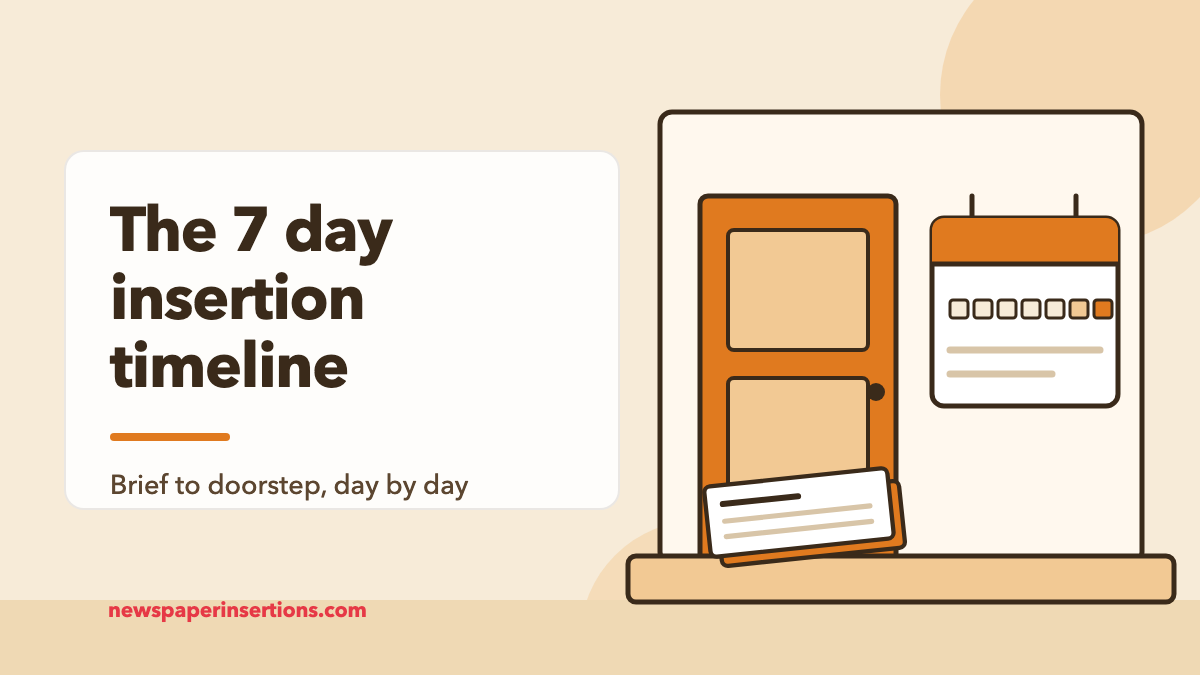
A newspaper insertion campaign can go from brief to doorstep in seven calendar days, but only if day one starts with the offer already decided. Days 1 to 2 cover brief, areas and booking, days 3 to 4 artwork and approval, days 5 to 6 printing and transport, day 7 insertion and delivery. Anything unsettled adds days.
Key Takeaways
- Seven days is the compressed timeline, not the comfortable one. It holds for a single city, a standard A5 or A4 newsprint insert, a weekday or Saturday drop, and an offer agreed before day one.
- Work backwards from the drop date. The drop date is fixed by the newspaper's circulation calendar; every other date on the plan is negotiable and should be set from it.
- Artwork approval is the checkpoint the whole schedule hangs on. Our standard planning allowance is 7 to 8 working days from approved artwork to doorstep for metro Sunday drops, which is why the compressed plan needs approval on day 4.
- Copy quantity, areas and paper stock must be locked before printing starts. Changing any of the three on day 5 restarts the print leg, not just the design leg.
- Rates do not change with speed: A2 at ₹2.00, A4 at ₹1.50 and A5 at ₹1.20 per copy all-inclusive, 50,000-copy minimum, GST extra. A rushed brief costs you options, not rupees.
- Budget 10 to 14 days instead of 7 for peak Sunday editions, festival weeks, glossy art paper, multi-city launches, or any campaign where the creative is not yet written.
Most first-time advertisers think of an insert the way they think of a social post: approve it, and it goes out. An insertion is a physical supply chain. Sheets have to be printed, cut, counted, boxed, trucked to the right city, split by vendor round, and hand-inserted into newspapers during the night shift before circulation. Every one of those is a real process with a queue in front of it.
This planner sets out what happens on each of those seven days, which checkpoint decides whether the schedule holds, and when seven days is simply the wrong plan.
Why does an insertion campaign need a timeline at all?
Because the single most useful planning habit is to work backwards. The drop date is the only date you do not control: newspapers circulate on their own calendar, and a Sunday edition in a metro fills its insert capacity days ahead. Fix the drop date first, then place every other task where it has to be.
Across 500+ campaigns run since 2020 across 30+ Indian cities, the schedules that fail almost never fail at the printing press. They fail at artwork approval, when a fourth round of revisions lands two days before the consignment has to leave the city.
What does the 7-day plan actually look like, day by day?
This is the compressed plan: one city, a standard newsprint A5 or A4 insert, 50,000 to 100,000 copies, and a weekday or Saturday drop.
Day 1: brief, areas, and quantity
Settle three things before anything else moves: the offer, the areas, and the copy count. The offer is the hardest of the three because it is the one people keep reopening. Write it as a single sentence on day 1 and treat it as signed.
Area selection is where insertions earn their cost advantage, because distribution runs on vendor rounds rather than on whole editions. Pick pin codes and localities, not "the city". Our guide to hyperlocal pin-code targeting sets out how to draw the catchment properly, and the pricing page carries current city-wise rates so the copy count and the budget can be reconciled the same day.
Day 2: newspaper selection and booking
With areas fixed, edition selection follows. Ask for the certified circulation of the specific edition and the specific centre you are buying, not a national masthead figure. Book on day 2 rather than day 5, because the constraint on a good drop date is space, not price.
This is also the day to decide language. The right vernacular daily often outperforms a larger English daily in the same locality at a lower rate, a trade-off worked through in English vs vernacular dailies.
Day 3: artwork, first draft
Design starts on day 3, not day 1, because the designer needs the final offer, the format, the areas and the language to design against. A first draft produced before those are settled is a draft you will throw away.
Get the mechanical decisions right at the outset: correct trim size, 3 mm bleed, a safe margin that keeps text away from the trim, CMYK at 300 dpi, and outlined fonts in the print-ready PDF. The insert artwork checklist covers the full specification, and getting it right on day 3 is what keeps day 4 to one round of changes.
Day 4: approval and print-ready files
Day 4 is the checkpoint the whole plan depends on. Artwork has to be approved, not "nearly approved", and the print-ready file has to reach the press by end of day.
Approval means the legal line, the phone number, the QR destination, the address and the offer terms have all been read by whoever is accountable for them. A wrong phone number discovered on day 6 is a reprint, and a reprint is a missed drop date. Print a test QR scan from an actual phone before approving, not from the design file.
Day 5: printing and quality check
Printing 50,000 A4 sheets is not the slow part. Drying, cutting, counting into bundles, and checking colour consistency across the run are. Ask for a physical sample from the run rather than a photograph, and check the fold if the sheet is folded.
Paper choice is settled long before this day, and changing it here restarts the leg. Glossy art paper also behaves differently on press and in transport than newsprint, which is why the GSM and paper types guide matters at the briefing stage rather than the printing stage.
Day 6: transport and delivery to the centre
The consignment moves to the distribution centre for the target city. The length of this leg is the single biggest reason two campaigns briefed on the same day do not have the same timeline: a local print run reaching a local centre is a few hours, while a run printed in one city for delivery in another is a day or more, plus a buffer for the things that delay trucks.
Consignments have to arrive with time to spare, because the insertion shift does not wait. A load that reaches the centre after the night shift has begun misses that day's papers entirely.
Day 7: insertion and doorstep
Inserts are placed into newspapers at the vendor or centre level overnight, and the papers go out on the normal morning round. By the time most households wake up, the campaign has already happened. How newspaper distribution actually works walks through the vendor network that makes this possible.
Ask for the distribution certificate and area-wise delivery reporting as part of the booking, not as a favour afterwards. Our how it works page sets out what each stage produces.
What is the realistic timeline if you are not in a hurry?
Ten to fourteen days, and the extra week buys real things.
| Stage | Compressed (7 days) | Comfortable (10 to 14 days) |
|---|---|---|
| Brief, areas, quantity | Day 1 | Days 1 to 2 |
| Edition booking | Day 2 | Days 2 to 3 |
| Artwork drafts | Day 3 | Days 3 to 6, two review rounds |
| Approval, print-ready files | Day 4 | Day 7 |
| Printing and quality check | Day 5 | Days 8 to 10 |
| Transport to the centre | Day 6 | Days 11 to 12 |
| Insertion and doorstep | Day 7 | Day 13 or 14 |
Calendar days for a single-city campaign on standard newsprint. Metro Sunday drops, festival weeks and multi-city campaigns need the longer plan.
The extra days go almost entirely into creative review and into choosing the drop date rather than accepting it. That is not administrative padding. Response across our campaigns for offers with a clear call to action typically lands between 0.5% and 2% of copies inserted, and where you fall in that band is decided by the offer and the sheet, both of which improve with one more review round. Designing an insert people keep covers what that review should actually be looking at.
When does 7 days stop being enough?
Add days, or move the drop date, when any of these apply:
- Peak Sunday editions and festival weeks. Insert capacity on the best dates is booked out ahead, and during festival season the whole calendar compresses. Festival season insertion planning covers the dates that move each year.
- Glossy art paper or unusual formats. Premium stock and non-standard sizes add press and finishing time, and a folded glossy A4 is not a same-week job.
- Multi-city drops. Several cities mean several print runs, several consignments and several centres, each with its own transport leg. Franchise and multi-city campaigns sets out how to coordinate them.
- The creative does not exist yet. If the offer is still being argued about on day 1, the plan has not started. This is the most common cause of a missed drop date we see.
- Regulated categories. Anything needing a compliance read, a disclaimer or an approval from outside the marketing team needs that review scheduled, not assumed.
What does speed cost?
Not the rate. A2 inserts run at ₹2.00 per copy, A4 at ₹1.50 and A5 at ₹1.20, all-inclusive of printing, insertion and transport, with a 50,000-copy minimum and GST extra, whether you brief seven days out or thirty.
What a rushed brief costs you is choice. Late briefs lose the best drop dates first, then the best editions, then the review round that would have sharpened the offer. The budget is identical; the campaign is weaker. That is the real argument for briefing early, and it is worth more than any discount, as the guide to what actually drives insertion pricing explains.
How do you keep the plan from slipping?
Four habits do most of the work:
- Name one approver. Schedules slip when three people can each ask for a change and none of them can sign off.
- Lock the drop date in writing on day 1. Everything else is scheduled backwards from it.
- Cap revisions at two rounds and diarise them. Put the review meetings in the calendar on day 1, with a named attendee, rather than sending a file and waiting.
- Get the response mechanism ready before artwork, not after. The QR destination, the tracking number and the landing page should exist on day 3 so the sheet can carry them. Setting these up properly is covered in tracking insert response with QR codes.
One more that costs nothing: plan the next drop while the first one is at the press. One insert announces, two or three over a month convert, and the second drop is far easier to schedule when the first one is still fresh.
The bottom line
Seven days from brief to doorstep is achievable and routine, provided day 1 begins with a settled offer and ends with settled areas, and day 4 ends with approved artwork. Miss the day 4 checkpoint and the plan does not shorten elsewhere, because printing, transport and the night insertion shift cannot be compressed. Work backwards from the drop date, name one approver, and treat 10 to 14 days as the default whenever the drop matters more than the deadline.
Have a drop date in mind?
Tell us the date and the areas. We respond within two hours with editions, copy counts, and the working-back schedule for your city.
Get Free Quote