The Short Answer
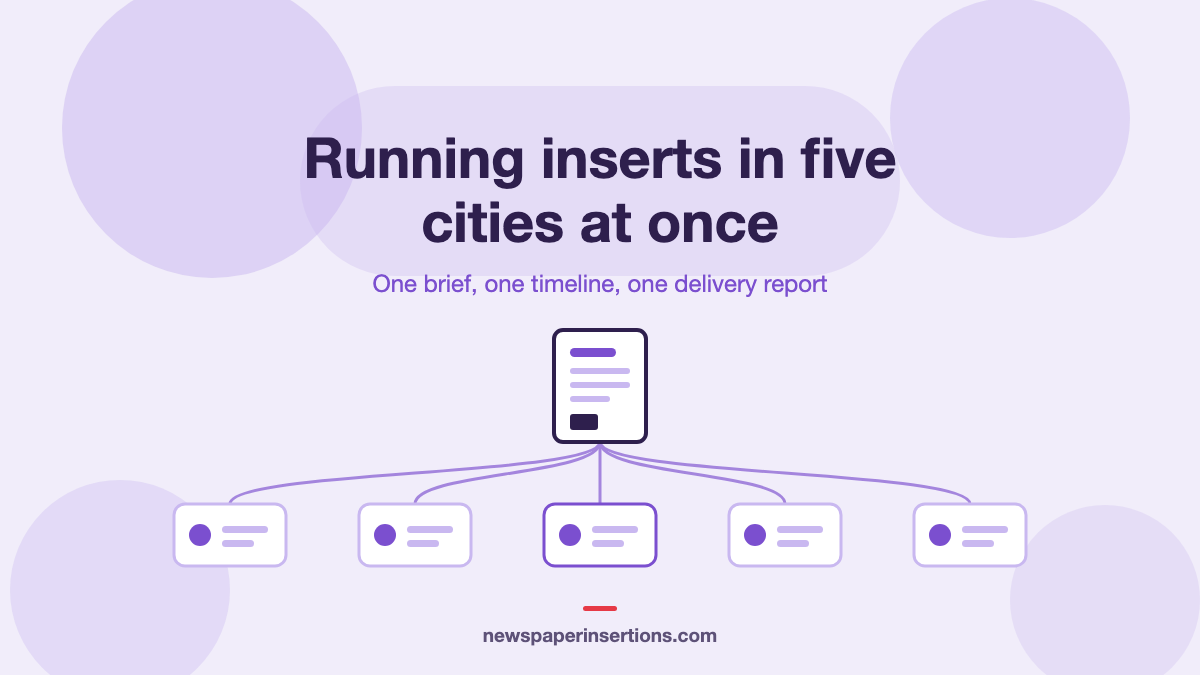
A five-city insert campaign is not five times harder than a one-city campaign, but it fails in different places. The 50,000-copy minimum applies per city, so five cities start at 2,50,000 copies, and the real work is artwork approvals, per-city tracking and a printing decision that depends on how far the sheets have to travel.
Key Takeaways
- The 50,000-copy floor is per city, because both the press make-ready and the transport run are per city. Five cities start at 2,50,000 copies, or ₹3,00,000 in A5 at ₹1.20 per copy before GST.
- Print centrally for glossy A4 and A5, locally for A2 newsprint. Freight cost scales with paper weight and sheet size, and A2 newsprint is the format where trucking sheets across the country stops making sense.
- Give every city its own QR code and phone number. A single national number turns five experiments into one undifferentiated number and destroys the only real advantage of running five cities at once.
- In franchise campaigns the delay is almost never printing or distribution. It is artwork approval across franchisees, which is why the approval deadline belongs in the schedule as a hard date with a default.
- Budget 12 to 15 working days for five cities, against 7 to 8 for one. The extra time is approvals and freight, not press capacity.
Most businesses arrive at multi-city insertions the same way. One city worked, somebody asks whether it can be repeated across the region, and a campaign that was a single conversation with a single approver becomes a spreadsheet. The media buying is the easy part: insertion is bought city by city anyway, so five cities is five bookings rather than one complicated one.
What actually gets harder is everything around the buy. Five sets of artwork approvals, five distribution maps, five drop dates that may not want to be the same date, five sets of tracking, and, in a franchise structure, five people who each believe their city is the exception. This guide is about that coordination problem, written from the side of the table that has to make the sheets land.
What actually changes when you go from one city to five?
Less than people expect in the media buy, more than they expect in the schedule.
Newspaper insertion is arranged and priced by area and by edition, in lots. A campaign in one city is already a set of bookings against chosen vendor rounds, as our guide to how newspaper distribution works in Indian cities describes. Adding a second city does not complicate the first one. It adds a parallel booking with its own newspaper choice, its own areas and its own date.
Three things do change in kind rather than degree. The first is that you now have a critical path made of other people’s decisions, because artwork has to be approved by more than one person. The second is that printing becomes a question rather than an assumption, because sheets may have to travel. The third is that measurement either becomes genuinely useful or becomes useless, depending on one decision you make before printing.
How many copies does a five-city campaign need at minimum?
2,50,000
minimum copies across five cities
50,000-copy floor applied per city
₹3,00,000
that run in A5 glossy, before GST
A5 at ₹1.20 per copy, all-inclusive
12 to 15
working days from brief to first doorstep
Against 7 to 8 working days for one city
Two lakh fifty thousand, and this surprises people who assumed the minimum was per campaign. The 50,000-copy floor exists because the two largest fixed costs in an insertion, the press make-ready and the vehicle that moves sheets to the newspaper’s distribution points, are incurred per print run and per city drop. Our post on why 50,000 is the minimum works through the economics. Splitting 50,000 copies across five cities at 10,000 each does not avoid those fixed costs. It multiplies them by five while spreading them over the same number of sheets, which is exactly the situation the floor exists to prevent.
| Format | Rate per copy | 5 cities x 50,000 | Cost before GST |
|---|---|---|---|
| A5 glossy, 90 GSM | ₹1.20 | 2,50,000 copies | ₹3,00,000 |
| A4 glossy, 90 GSM | ₹1.50 | 2,50,000 copies | ₹3,75,000 |
| A2 newsprint | ₹2.00 | 2,50,000 copies | ₹5,00,000 |
Rates include printing, insertion and transport; GST extra. City-wise rates vary, so treat these as published all-inclusive rates rather than a quote.
Current numbers for each market are on our pricing page, and the cities page shows where we hold coverage.
Should you print centrally or in each city?
Centrally for glossy A4 and A5. Locally for A2 newsprint. The deciding variable is freight, and freight is decided by weight and bulk.
Central printing means one press, one make-ready, one colour standard and one quality check, then sheets trucked to five cities. You get consistency, which matters when the whole point of a franchise campaign is that the brand looks identical everywhere. Local printing means five presses near five drop points, no freight, faster turnaround, and five separate opportunities for the colour to drift and the stock to be substituted.
The trade-off resolves differently by format because of the paper. A2 newsprint sheets are large and, in volume, heavy and bulky relative to their value; the cost and time of moving 50,000 A2 sheets several hundred kilometres can rival the saving from a single make-ready. A5 glossy at 90 GSM is compact, travels well, and is the format where central printing almost always wins. A4 sits between the two and usually follows the distance: nearby cities from one press, distant ones locally. Our guide to GSM and paper types covers what each stock is and how it behaves.
If you do print locally, the one control worth insisting on is a physical proof from each press against the same reference, approved before the full run. Five presses working from the same file will still produce five slightly different reds. A brand team that has never seen that happen is usually the one that discovers it after the drop.
Should all five cities drop on the same morning?
Usually not, and the instinct to synchronise is worth examining. A single national drop date feels like a campaign launch and is occasionally the right answer, typically when the insert is tied to a fixed public event: a sale that starts on a date, a festival, a product launch with national press. The rest of the time, staggering across two or three weekends is better for two independent reasons.
The first is local: the best day is not the same everywhere. Regional papers, local holidays and city-specific shopping patterns all shift the answer, and festival calendars differ by state. Our posts on the best days for insertions and festival season planning cover the pattern and the seasonal spikes.
The second is that a stagger buys you information. Drop two cities first, read the response over the following 72 hours, then drop the remaining three with whatever you learned about the offer, the headline or the response mechanism. On a synchronised plan, every city carries the same untested assumption at the same time, and if the offer is weak you find out five times simultaneously.
Against that, staggering costs elapsed time and asks somebody to stay engaged for three weeks rather than one. That is a real cost in a franchise structure where attention is the scarce resource. The practical compromise we see work is two waves: a lead wave of one or two cities, then the rest a week later.
What has to change per city, and what must not?
Keep one master artwork and change as little as possible, but be deliberate about the few things that must change. Change per city:
- The response mechanism. A unique QR code and a unique phone number per city. This is the single most important item on the list.
- The address and outlet list. Obvious, and still the most common proofing error in multi-city franchise work, because the file gets duplicated and one city keeps another city’s address block.
- The language of the edition. If you are inserting into a vernacular daily in one market and an English daily in another, the insert should match the paper it travels in. Our guide to English versus vernacular dailies sets out when each is the better buy.
- Local proof points. A local landmark, a branch that has been open since a given year, or a city-specific offer where the franchisee has latitude.
Do not change: the offer itself, the headline structure, the layout system, the colour palette and the format. If each city rewrites the offer, you no longer have a campaign with five data points. You have five campaigns with one data point each, and no way to tell whether the difference in response came from the city or the creative.
Who pays in a franchise campaign, and who approves?
These are two questions and they have different answers, which is where the delays come from. Funding usually takes one of three shapes: funded centrally by the franchisor, funded by each franchisee for their own city, or paid from a shared marketing or advertising fund that franchisees contribute to. Each shape changes who can say no. A centrally funded campaign moves fastest because approval and payment sit with the same person. A franchisee-funded campaign is the slowest, because every city is effectively a separate sale with a separate budget conversation.
Approval is the real critical path. In our experience with multi-city work, the delay is almost never printing capacity or newspaper booking, both of which are predictable. It is waiting on artwork sign-off from people whose main job is running their outlet, not reviewing a PDF. Two things fix this, and they have to be set before the schedule is circulated:
- A hard approval deadline expressed as a date and time, not “by next week”.
- A stated default for what happens if a city misses it: the master artwork goes to press with the standard address block, or that city drops out of this wave and joins the next one.
Without a default, one unresponsive franchisee holds four other cities. With a default, the schedule survives.
How do you tell which city actually worked?
By deciding, before printing, that you want to know. A multi-city campaign is the only situation in print where you get a genuine comparison: same offer, same creative, different markets, roughly the same time. That comparison is worth more than the campaign itself, because it tells you where to spend next quarter. And it is destroyed completely by printing one phone number and one QR code across all five cities.
Give each city its own QR code pointing at its own landing page or its own tracked destination, and its own phone number where the volume justifies it. Then response separates by city automatically. Our guide to tracking insert response with QR codes covers how to set this up so the numbers are trustworthy, including the two errors that quietly break tracking: a code printed too small to scan and a code pointing at a homepage rather than the offer.
On the delivery side, ask for per-city documentation rather than one aggregate summary. A distribution certificate and an area-wise report for each city is the accountable record of what was booked and dispatched where. An aggregate line saying 2,50,000 copies were distributed tells you nothing about the city that underperformed, and the city that underperformed is precisely the one you need to explain.
Read the results with one caution: a city that responds poorly may have had a poor area map rather than a poor market. Before writing a market off, check which vendor rounds were actually booked against where your customers live, a mapping our guide to pin-code targeting explains.
How long does a five-city campaign take to plan?
Twelve to fifteen working days from brief to the first doorstep, against seven to eight for a single city, as set out in how it works. The extra time is not press capacity. It is the approval loop and, where central printing is used, the freight leg. A realistic sequence:
- Days 1 to 3: confirm the city list, the area map for each city, formats and copy counts. Build the artwork matrix.
- Days 3 to 7: master artwork, then per-city variants. Circulate with a hard approval deadline and a stated default.
- Days 6 to 9: book presses and insertion dates together, city by city. A press slot without a confirmed insertion date is half a booking.
- Days 9 to 12: print, proof-check each city’s sheets against the master, and move stock to the distribution points.
- Days 12 to 15: drop wave one, then wave two a week later if you staggered.
Compress this only by shortening the approval window, never the proofing step. An error caught at proof costs a reprint of one city. The same error caught after the drop costs the whole wave.
The bottom line
Multi-city insertion is a coordination problem wearing a media-buying costume. The rates do not change, the channel does not behave differently, and the distribution works the same way it does in one city. What changes is that the floor now applies five times over, the artwork has five approvers, and the measurement is either set up to tell you which city to back next quarter or it is not.
The campaigns that work do three unglamorous things: they fix an approval deadline with a default, they keep one offer across every city, and they print a different QR code in each one. The campaigns that struggle almost always got the media plan right and lost two weeks waiting for a PDF.
Planning a campaign across several cities?
Send us your city list and budget and we will map the copy counts, formats and drop dates before you commit.
Get Free Quote