The Short Answer
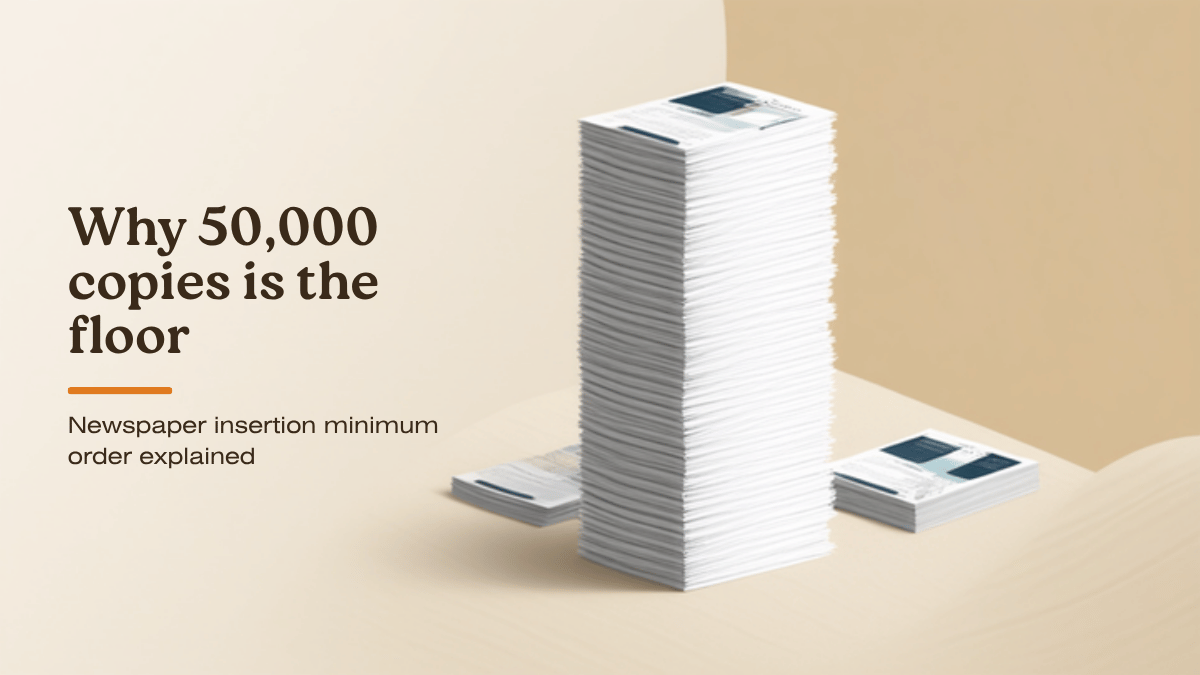
The minimum order for a newspaper insertion campaign is 50,000 copies, for every format. The floor exists because the three costs inside the per-copy rate (offset printing, newspaper insertion charges and transport) are all priced on volume, so the published rates of A2 ₹2.00, A4 ₹1.50 and A5 ₹1.20 per copy only hold at 50,000 copies and above. Smaller runs are possible, but the per-copy cost rises.
Key Takeaways
- The minimum order quantity (MOQ) is 50,000 copies for A2, A4 and A5 inserts alike. At that volume the all-inclusive rates are A2 ₹2.00, A4 ₹1.50 and A5 ₹1.20 per copy, GST extra.
- The smallest campaign you can book at the published rate is therefore 50,000 A5 copies for ₹60,000 plus GST; 50,000 A4 copies come to ₹75,000 and 50,000 A2 copies to ₹1,00,000, all before GST.
- The floor is set by economics, not policy: offset plates and make-ready are fixed costs, newspapers accept inserts in edition-sized lots, and a truck to a distribution centre costs the same whether it carries 10,000 or 50,000 sheets.
- 50,000 copies is small against the market. A single metro edition of a leading daily circulates several lakh copies a day, so 50,000 typically covers a cluster of localities, not a city.
- If your budget is tight, keep the 50,000 copies and shrink the geography or the format. Cutting copies below the floor raises the per-copy cost and usually leaves too few responses to judge the campaign.
- Across 500+ campaigns since 2020, the campaigns that underperformed most often were the ones that spread a small run thinly, not the ones that ran 50,000 copies in a tight catchment.
Almost every first enquiry we receive includes some version of the same question: can we start with 10,000 copies to test it? The honest answer is that you can print 10,000 flyers, but you cannot run a newspaper insertion campaign at the published rate with them. The minimum order is 50,000 copies, and this article explains where that number comes from, what it costs, and what to do if it feels like more than you wanted to commit.
What is the minimum order quantity for a newspaper insertion in India?
The minimum order quantity is 50,000 copies, and it applies to all three formats we run: A2 newsprint, A4 glossy and A5 glossy. At that quantity the all-inclusive rates are:
| Format | Paper | All-inclusive rate* | Cost of 50,000 copies |
|---|---|---|---|
| A2 (33cm × 53cm) | SNP newsprint, 45 GSM | ₹2.00 per copy | ₹1,00,000 |
| A4 | Glossy art paper, 90 GSM | ₹1.50 per copy | ₹75,000 |
| A5 | Glossy art paper, 90 GSM | ₹1.20 per copy | ₹60,000 |
*Rates include printing, insertion and transport. GST is extra. Higher GSM on A4 and A5 costs more. Current city-wise rates are on our pricing page.
Two clarifications, because they come up on almost every call. First, the floor is on copies, not on money: 50,000 copies of A5 at ₹60,000 is a legitimate campaign, and it is the cheapest one you can book at the published rate. Second, the floor is not a refusal. Below 50,000 copies we can still print and insert, but the per-copy rate goes up, because the fixed costs described below are being spread across fewer sheets. Current rates for every city are on our pricing page.
Why is 50,000 copies the floor?
Because every part of the per-copy rate gets cheaper with volume, and 50,000 is roughly the point at which all three parts settle at the published price. Take them one at a time.
Printing: plates and make-ready are fixed costs
Inserts are printed on offset presses, and offset has a cost structure that has not changed in decades. Before the first sellable sheet comes off the machine, the printer has made a set of plates for each colour, mounted them, run the press up to speed, matched the colour and registration, and thrown away the spoiled sheets from that setup. That is the make-ready, and it costs the same whether the run afterwards is 5,000 sheets or 50,000.
Once the press is running, the marginal cost of each extra sheet is just paper and ink, and it is small. So the average cost per sheet falls steeply as the run gets longer, then flattens. At a few thousand copies the make-ready dominates and the per-sheet cost is several times higher than the rates above. By 50,000 copies the setup has been spread thinly enough that the rate stabilises. This is the single biggest reason the floor sits where it does, and it is the same reason a printer will quote you a lower per-unit price for 100,000 visiting cards than for 500.
Insertion: newspapers work in edition-sized lots
The second cost is what the newspaper and its distribution network charge to place your sheet inside the paper. Newspapers do not insert flyers one household at a time. Copies are bundled at the printing plant or at area distribution centres, inserts are placed in bundles for chosen vendor areas, and the vendors’ delivery boys carry them out on the morning run. You can read how that chain works step by step on our how it works page, and our guide to how newspaper distribution actually works in Indian cities explains why depot handling costs are what set the floor.
The practical consequence is that insertion is arranged and priced by area and by edition, in lots. A leading daily in a metro prints several lakh copies a day; Audit Bureau of Circulations figures for the big English and vernacular editions run well into six figures. Against that scale, 50,000 copies is a modest slice that maps to a manageable cluster of vendor areas. A 10,000-copy request is too small to be handled cleanly as a distribution lot, and the handling charge per copy rises sharply to reflect that.
Transport: a vehicle costs the same half-empty
The third cost is moving printed sheets from the press to the newspaper’s distribution points, sometimes to several of them in one city. A vehicle and a crew for the drop cost roughly the same whether the load is 10,000 sheets or 50,000. Below the floor, that fixed cost again lands on fewer copies.
Is 50,000 copies actually a lot?
Not in the context of newspaper distribution. It feels large because 50,000 flyers is a big physical stack, but it is small against the number of newspapers delivered in any Indian city on a given morning.
425M
newspaper readers in India
IRS 2019 Q4, MRUC
Lakhs
of copies a day for a leading metro edition
ABC-certified circulation
50,000
copies: a cluster of localities, not a city
Minimum order
The Indian Readership Survey (IRS 2019 Q4, published by the Media Research Users Council) measured roughly 425 million newspaper readers in India, and readership is well above circulation because each copy is read by more than one person in the home. In Mumbai, a single leading edition reaches several lakh households; in a tier-2 city such as Lucknow, the leading Hindi daily alone reaches lakhs of homes across the district. Against those numbers, 50,000 copies is typically enough to cover a handful of adjoining localities properly, rather than a whole city.
That is the right way to think about the floor. It is not “50,000 strangers across the city”; it is “every newspaper-reading household in the four or five areas where my customers live”. A real estate project, a coaching centre, a hospital or a furniture showroom rarely needs more than that catchment for one drop. The A2 format exists precisely to make a 50,000-copy run cover a catchment with a big, unmissable sheet.
What does 50,000 copies cost, and what do you get for it?
At the published rates, the three formats land at ₹60,000 (A5), ₹75,000 (A4) and ₹1,00,000 (A2), before GST. The formats are compared in detail in our A2 vs A4 vs A5 guide, and we work the same arithmetic from the other direction, starting from a fixed budget, in what ₹1 lakh buys you in print. The budget arithmetic itself is straightforward.
What you get back is where the floor starts to make commercial sense. Across the campaigns we have measured since 2020, direct response for inserts with a clear offer and a clear call to action typically falls between 0.5% and 2% of copies. On 50,000 copies that is somewhere between 250 and 1,000 calls, scans, walk-ins or coupon redemptions from one morning’s drop. At ₹60,000 to ₹1,00,000 that puts the cost per response in a range most local businesses find acceptable, and in categories like real estate and education a single closed lead often pays for the entire campaign.
Run the same arithmetic on 10,000 copies and the problem shows up immediately. Even at a healthy 1% response, you get 100 responses, and because the per-copy rate is higher below the floor, you pay proportionally more for each one. Worse, 100 responses is too small a sample to tell you anything reliable about the creative, the offer or the areas. The floor is not only where the economics work; it is also the smallest run that produces a readable result.
What should you do if 50,000 copies is more than you wanted?
Keep the copies and change something else. In practice there are four levers, in the order we recommend pulling them. If even 50,000 A5 copies is more than one business can fund, there is also a fifth: share one run with a non-competing business, as explained in our guide to shared and co-branded insert runs.
- Drop to a smaller format, not a smaller run. If ₹1,00,000 for A2 is too much, 50,000 copies of A5 costs ₹60,000 plus GST and still reaches the same 50,000 households. A5 is the honest answer to “what is the cheapest way to try this”.
- Narrow the geography. Concentrate the 50,000 copies in the specific localities and pin codes where your buyers live, rather than asking for fewer copies across a wider area. A tight drop in five areas outperforms a thin drop across twenty; our guide to pin-code targeting with newspaper editions shows how those areas map onto depots and vendor rounds. Our city pages list the newspapers and areas available in each of the 30+ cities we cover.
- Choose the edition with the deepest local coverage. In most cities that is the leading vernacular daily, and because the per-copy rate is identical whichever masthead you choose, it costs nothing extra. Our guide to English vs vernacular dailies walks through that choice.
- Pick the right day. One weekend drop of 50,000 copies for retail or property usually beats two weekday drops. Our post on the best days for newspaper insertions explains why.
A 10,000-copy test costs more per copy, produces too few responses to learn from, and is almost always followed by the question of whether the channel works, which the test cannot answer. The 50,000-copy campaign, concentrated in the right areas with a trackable offer, is the test.
Does the minimum change by city, newspaper or format?
The MOQ is the same 50,000 copies in every city and for every format. The per-copy rate that applies at the floor is the published one, and higher GSM on the glossy formats costs more. Larger campaigns do get better pricing: above 50,000 copies the fixed costs keep shrinking as a share of each copy, and regular monthly or quarterly advertisers receive volume rates and priority scheduling in peak season, which our pricing page sets out.
One honest caveat: certain newspaper editions or areas can carry practical limits of their own, such as a minimum number of copies per distribution centre or a cut-off date before a festival weekend. Those are logistics constraints from the publisher’s side, and we flag them when we quote. They never lower the 50,000 floor; occasionally they mean a specific area needs a little more than its proportional share of the copies.
The bottom line
The 50,000-copy minimum is not an arbitrary rule. It is the volume at which offset printing, newspaper insertion and transport all reach the published rate, and it is also the smallest run that produces enough responses to judge a campaign. Measured against the several lakh copies a metro edition delivers every morning, it is a modest, well-targeted drop, not a mass campaign. If the budget is tight, shrink the format or the geography, never the copies. For a single small outlet, filling those 50,000 copies with the right beats matters more than the number itself, which we work through in our guide to inserts for restaurants and cloud kitchens. The floor also applies per city rather than per campaign, which is what makes a five-city plan start at 2,50,000 copies: see franchise and multi-city insert campaigns.
Want a 50,000-copy plan for your localities?
Tell us your city, target areas and format. We reply within two hours with newspaper options, area coverage and all-inclusive pricing at the published rate.
Get Free Quote