The Short Answer
Choose A2 newsprint (₹2.00 per copy) when you need mass reach and space for floor plans or catalogues. Choose glossy A4 (from ₹1.50) when the product is premium and photography sells it. Choose glossy A5 (from ₹1.20) when the message is one offer with one call to action and you want the highest reach per rupee.
Key Takeaways
- The three formats cost ₹2.00 (A2), ₹1.50 (A4) and ₹1.20 (A5) per copy all-inclusive — printing, insertion and transport, GST extra, 50,000-copy minimum.
- On a fixed ₹2,00,000 budget the format choice changes your reach from about 1,00,000 households (A2) to about 1,66,000 households (A5) — a 66% swing.
- A2 is newsprint at 45 GSM and blends into the paper; A4 and A5 are glossy art paper at 90–130 GSM and deliberately stand out from it.
- Bigger does not automatically mean better response. Across 500+ campaigns since 2020 we see the offer and the call to action moving the number far more than the sheet size.
- Format follows the job: A2 for detail and scale, A4 for brand quality, A5 for coupons, retention and volume.
Most advertisers arrive at newspaper insertions with a budget and a deadline, not a format preference. Then they discover there are three standard choices — A2, A4 and A5 — sitting at three different price points, printed on two very different paper stocks, and each good at something the others are bad at. Pick wrong and you either overspend on paper the reader never needed, or you shrink a message that needed room to breathe.
This guide compares the three formats on the things that actually decide campaign outcomes: physical specification, cost per household, what each format is good at, and how many households your budget will reach in each case. Rates quoted here are our standard all-inclusive rates; current city-wise numbers are on our pricing page.
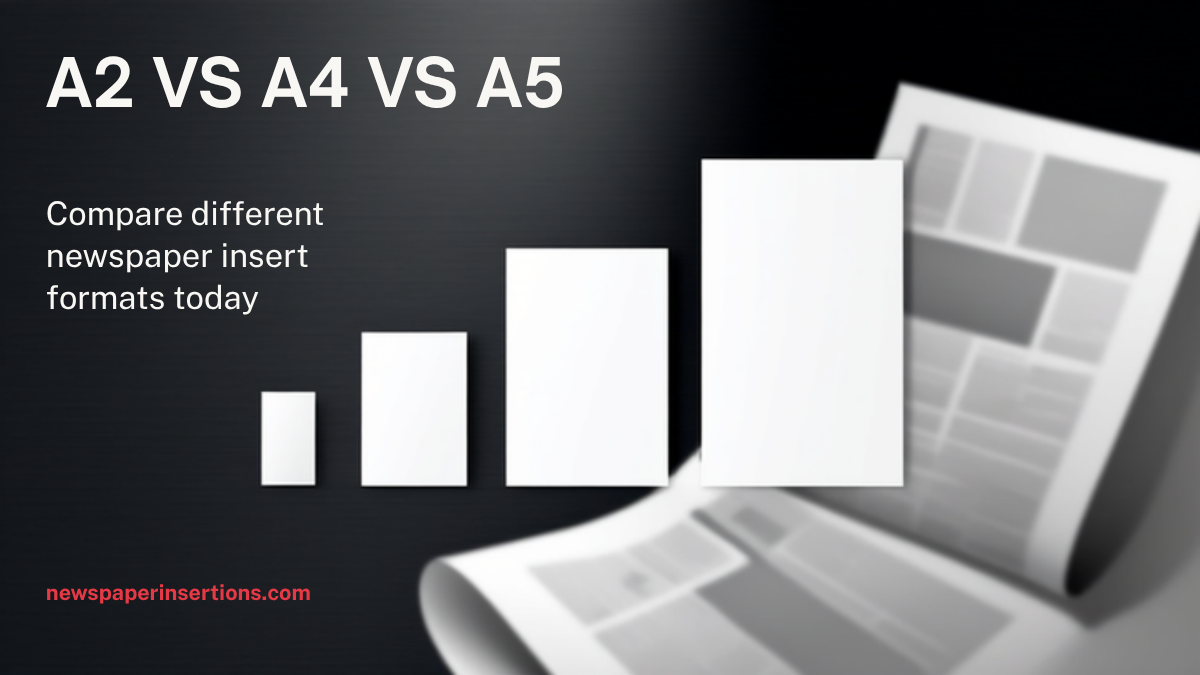
What is the actual difference between A2, A4 and A5 inserts?
The differences are physical, and they matter more than the size numbers suggest. Exact trim sizes, bleed and file requirements for each format are set out in our insert artwork checklist.
| Format | Size and fold | Paper | Rate (all-inclusive) |
|---|---|---|---|
| A2 | 33cm × 53cm, middle-folded to A3 | SNP newsprint, 45 GSM | from ₹2.00 per copy |
| A4 | 21cm × 29.7cm, flat, no fold | Glossy art paper, 90–130 GSM | from ₹1.50 per copy |
| A5 | 14.8cm × 21cm, flat, no fold | Glossy art paper, 90–130 GSM | from ₹1.20 per copy |
Rates include printing, insertion and transport. GST extra; minimum order 50,000 copies for every format. Higher GSM on the glossy formats raises the rate.
The paper stock is the real dividing line. A2 inserts are printed on the same kind of newsprint the newspaper itself uses, so they feel native — the reader handles them the way they handle an editorial page. A4 and A5 inserts are glossy art paper, which does the opposite: the change in weight and texture makes the reader notice that something different has arrived.
Neither behaviour is better in the abstract. A degree of blending in suits a long, information-dense message. Standing out suits a short, image-led one.
How much reach does each format buy for the same budget?
This is the comparison most media plans skip, and it is the one that changes decisions. Take a fixed budget of ₹2,00,000 before GST:
| Format | Rate per copy | Households reached | Cost per 1,000 households |
|---|---|---|---|
| A2 newsprint | ₹2.00 | 1,00,000 | ₹2,000 |
| A4 glossy 90 GSM | ₹1.50 | 1,33,333 | ₹1,500 |
| A5 glossy 90 GSM | ₹1.20 | 1,66,666 | ₹1,200 |
Excluding GST. Assumes a single insertion per household.
Same money, and the A5 plan puts your message into roughly 66,000 more homes than the A2 plan. Whether that trade is worth making depends entirely on what has to fit on the sheet.
A residential project launch with a location map, four floor plans, an amenities list and a price table cannot be compressed into A5 without becoming unreadable — and an unreadable insert reaching more homes is not a better campaign. A restaurant announcing “flat 20% off till Sunday, scan to order” has nothing to gain from four times the paper. Buy the reach instead.
Does a bigger insert get a better response?
Not on its own. Across 500+ insertion campaigns we have run since 2020 across 30+ Indian cities, direct response measured through QR scans, dedicated phone numbers and coupon redemptions typically lands between 0.5% and 2% of copies inserted — and that range holds across all three formats.
What consistently moves a campaign toward the top of that range is not sheet size:
- One offer, stated in the headline. Inserts that lead with a single, specific, dated offer outperform inserts that list everything a business does.
- A response mechanism the reader can use immediately — a QR code for younger readers and a phone number for older ones, printed together.
- Edition and area selection. The right vernacular daily in the right pin codes routinely beats a larger English daily covering a whole city.
- Repetition. One insertion informs; two or three over a month convert.
Format enters the picture as a constraint on the first point. A2 gives you room to make a complex offer clearly. A5 forces you to make a simple offer sharply. Both are legitimate ways to end up in the same response band; padding a weak offer onto a bigger sheet is not. What goes on the sheet matters more than its size — our guide to designing an insert people actually keep covers the headline, paper and response-mechanism decisions.
When is A2 newsprint the right choice?
Choose A2 when at least one of these is true:
- The message needs space. Floor plans, location maps, product catalogues, price lists, election manifestos, exhibition schedules — content that becomes useless when shrunk.
- You are buying awareness at scale. India still has one of the world’s largest newspaper audiences — the Indian Readership Survey 2019 (MRUC) measured roughly 425 million readers — and a single edition of a leading daily in a metro can carry your insert into several lakh households in one morning.
- The category expects it. Real estate launches and retail sale announcements have trained readers to expect a large sheet; a small glossy card can read as a lesser event.
- Cost per square centimetre matters more than paper quality. A2 is by far the cheapest way to buy printed area inside a newspaper.
The trade-off is honest: newsprint at 45 GSM will not reproduce jewellery, food photography or automotive paint the way glossy stock does, and it does not survive on a fridge door for two weeks. If your product photograph is the argument, A2 weakens it.
When does glossy A4 beat everything else?
A4 is the format to choose when the perceived quality of the paper is itself part of the message. It is the standard page size for catalogues and brochures, so the insert reads as a piece of company literature rather than a flyer, and at 90–130 GSM it stays flat, unfolded and undamaged inside the newspaper.
In our experience the categories that keep coming back to A4 are the ones where a purchase involves research and a visit: automobiles, premium and luxury residential projects, private hospitals and diagnostic chains, international and IB-curriculum schools, jewellery, and consumer electronics. These are households that will keep the sheet, show it to a spouse, and carry it to a showroom or campus. For jewellery and premium retail specifically, our glossy A4 playbook for that category covers timing, offer design and pin-code selection.
A4 also has a practical advantage nobody mentions until the campaign is live: it files. A4 fits a folder, a laptop bag and a school admission file. Prospects in long decision cycles keep it because keeping it is easy.
The cost of that quality is 20% fewer households than A5 for the same spend. Take it when the product justifies it; do not take it by default.
Why do A5 inserts get kept the longest?
Because they fit in a pocket, a purse and a wallet, and because a small glossy card reads as a voucher rather than an advertisement. Retention is the entire argument for A5.
That makes A5 the natural format for anything redemption-driven or date-driven: discount coupons, restaurant and cloud-kitchen menus, salon and gym offers, diagnostic packages, event and exhibition invitations, loyalty programme announcements, and course or admission enquiry drives. The format also forces discipline — there is only room for one offer and one call to action, which is exactly what a coupon insert should contain.
At ₹1.20 per copy it is also the cheapest way to buy a glossy insert, and the only way to run a glossy campaign at genuine scale on a small budget. For a business with ₹1,00,000 to spend, A5 is the difference between a token 50,000-copy run and a meaningful 83,000-household campaign.
Which format fits your industry?
This is the shortlist we give clients on the first call, based on what has actually worked in our campaigns:
| Business | Format we usually recommend | Why |
|---|---|---|
| Real estate launch | A2 | Floor plans, maps and price tables need the area |
| Premium or luxury housing | A4 glossy | Renders and finish quality carry the sale |
| Schools and coaching institutes | A4 or A5 | A4 for prospectus-style detail, A5 for admission-deadline offers |
| Hospitals, clinics, labs | A5 | Health-check packages are offer-and-date driven |
| Retail sale or store opening | A2 | Multiple products, prices and a large announcement |
| Restaurants and cloud kitchens | A5 | Menu-plus-coupon that stays on the fridge |
| Automobiles | A4 glossy | Photography and variant tables |
| Jewellery and fashion | A4 glossy | Product photography is the entire argument |
| Political and civic outreach | A2 | Maximum area at the lowest cost per household |
| Local services, salons, gyms | A5 | One offer, high volume, low spend |
If your project is real estate, our real estate insert campaign planner covers catchment selection and volumes in more depth, and the case for print generally is laid out in are newspaper ads still effective in India. If the campaign is a political one, A2 is the usual choice there too, but the sheet also has to carry a printer and publisher imprint: see election campaign printing and insertions.
Can you mix formats in one campaign?
Yes, and for multi-locality campaigns it is often the smartest plan. A common structure we execute: A2 in the three or four pin codes closest to the site or store, where you want maximum detail and impact, and A5 across the wider catchment, where you only need awareness and a QR code. The budget goes where the intent is highest, instead of being spread evenly over areas that do not deserve equal weight.
Mixing works because insertion distribution is area-wise, not edition-wide. You choose the newspaper, the edition and the specific localities — the mechanics are explained in our how it works guide, and the newspapers available in each market are listed by city on our cities page.
One caution from experience: run one creative concept across both formats. Two different-looking inserts in the same catchment read as two different companies.
How do you decide in under a minute?
- Does the message need more than an A4 page to be clear? If yes, A2. Stop here.
- Is the product one where paper quality changes how the brand is judged? If yes, A4 glossy.
- Otherwise, is reach the priority? Then A5 — you get the most households per rupee and the longest retention.
If two answers point in different directions, split the campaign by area rather than compromising on a middle format that serves neither purpose well.
The bottom line
A2, A4 and A5 are not good, better and best — they are three different tools at ₹2.00, ₹1.50 and ₹1.20 per household. A2 buys area, A4 buys perceived quality, A5 buys reach and retention. Decide what the sheet has to do before you decide how big it should be, and the budget question answers itself. Once the format is settled, the next free lever is timing — see which day of the week suits your category, and avoid the format and targeting mistakes that quietly waste budget.
Not sure which format your campaign needs?
Tell us your city, budget, and what has to fit on the sheet — we respond within two hours with format options, reach estimates, and exact pricing.
Get Free Quote