The Short Answer
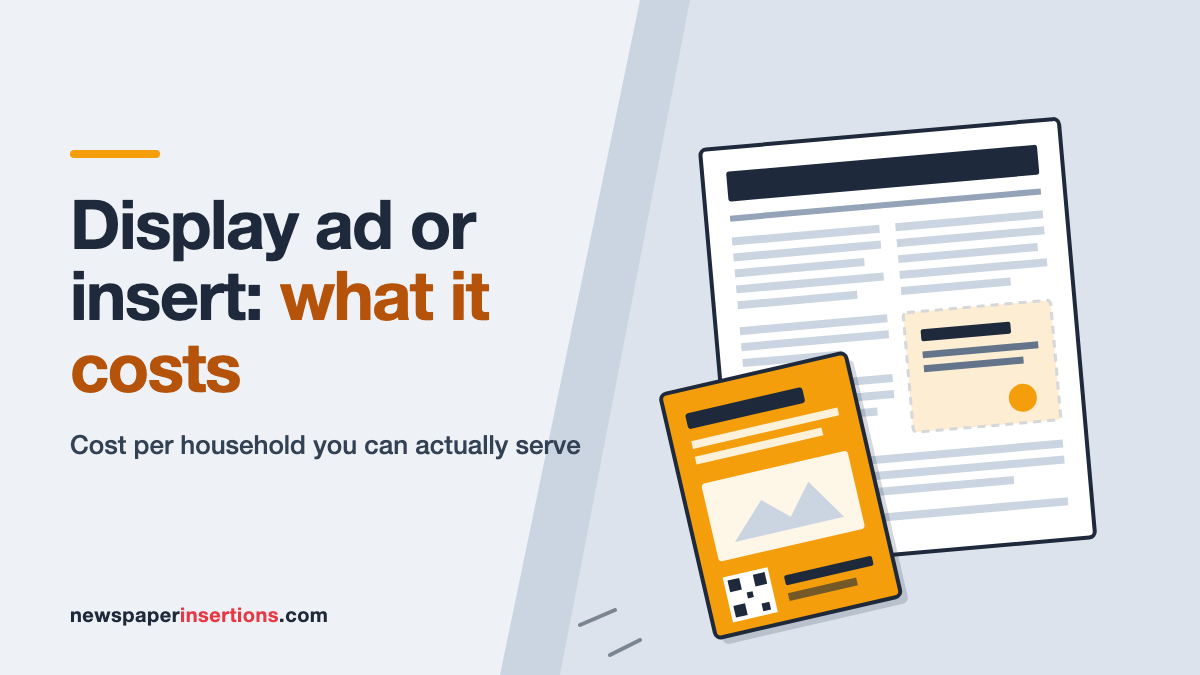
A display ad is printed on the newspaper's own page and priced per column centimetre from the edition's rate card, with extra for colour and position; you pay for the whole edition's circulation. An insert is a separate sheet priced per copy: A2 ₹2.00, A4 ₹1.50, A5 ₹1.20, printing included, GST extra, minimum 50,000 copies, delivered only to the areas you choose.
Key Takeaways
- Display ads and inserts are priced on different units. A display ad is bought by space (column centimetres) for the whole edition. An insert is bought by the copy, for chosen areas only.
- A display ad can look cheaper per copy printed, because a large edition spreads its cost over every household in the city. The number that matters is cost per household you can actually serve.
- Inserts carry their own production: our per-copy rate includes printing, insertion and transport. A display ad has no print bill, but you still pay for creative, and colour and premium positions usually cost extra.
- Tax differs too. Selling print ad space attracts 5% GST under Notification 11/2017-Central Tax (Rate); an insertion campaign is normally invoiced as a service at 18%. A registered business that claims input credit recovers either.
- Display wins for statutory notices, city-wide announcements, very fast bookings and brands whose customers are everywhere. Inserts win when the audience is local, the message is dense, or the budget is under a lakh or two.
Why are display ads and inserts priced so differently?
Because you are buying two different things.
A display ad is space on the newspaper's own pages. The paper prints it along with the news, so there is no separate print job for you. It is sold from a published rate card for each edition, usually by the column centimetre: one column wide, one centimetre deep. A typical eight-column broadsheet page is roughly 50 cm deep, so a full page works out to around 400 column centimetres. Rate cards then add premiums, commonly for colour over black and white, for a specified page such as the front page or page 3, and sometimes for particular days.
A newspaper insert is a separate printed sheet that the vendor slips inside the paper before delivery. You are not buying page space at all. You are buying a printed sheet plus its insertion into chosen copies of the paper. Our rates on the pricing page are per copy and all-inclusive: A2 on 45 GSM newsprint at ₹2.00, A4 at ₹1.50 and A5 at ₹1.20 on 90 GSM glossy art paper, covering printing, insertion and transport to the distribution point, with GST extra and a 50,000-copy minimum per city.
That single difference, space versus copies, explains almost everything else about the two price tags.
What does a newspaper display ad actually cost?
We will not quote a display rate here, because display rates change by newspaper, edition, language, day, colour and page, and any number we printed would be wrong for most readers within a season. Get the current rate card from the paper or its accredited agency. What we can give you is the formula, so you can compare like with like:
A worked illustration, with round numbers chosen only to show the arithmetic (they are not a quote for any newspaper):
| Item | Illustrative figure |
|---|---|
| Ad size | 8 columns × 12.5 cm = 100 column cm (about a quarter page) |
| Rate card (hypothetical) | ₹1,500 per column cm, colour |
| Space cost | ₹1,50,000 |
| Edition circulation (hypothetical) | 3,00,000 copies |
| Cost per copy printed | ₹0.50 |
Round numbers chosen to show the arithmetic only. Ask the newspaper or its accredited agency for the current rate card of the edition you want.
On those numbers the display ad costs half a rupee per copy, which is cheaper per copy than any insert we sell. That is real, and it is why big brands with customers in every locality still buy display space. The catch is what that half rupee buys.
What does an insertion campaign cost for the same budget?
The same ₹1,50,000 on inserts buys, before GST:
| Format | Copies for ₹1,50,000 | What the reader gets |
|---|---|---|
| A2, 45 GSM newsprint | 75,000 | A sheet about the size of a full newspaper page, printed both sides |
| A4, 90 GSM glossy | 1,00,000 | A glossy standalone flyer |
| A5, 90 GSM glossy | 1,25,000 | A small glossy card-style flyer |
All figures before 18% GST. Rates include printing, insertion and transport. Higher GSM on A4 and A5 costs more.
Fewer households than the display ad's 3,00,000, at a higher cost per copy. But each insert is a whole, separate piece of paper that the reader has to handle, printed on both sides, sent only to the localities you named. The display ad is a quarter of one page, sharing that page with news and often with other ads, in every home in the city whether you can serve it or not.
Which one is cheaper per household you can serve?
This is the comparison we recommend every advertiser make before choosing. Divide the cost by the households who could realistically become customers, not by the total print run.
Take the illustration above. Suppose you run a clinic, a coaching centre or a furniture showroom that draws customers from about one fifth of the city. Of the display ad's 3,00,000 copies, roughly 60,000 land in your catchment. The ₹1,50,000 then works out to ₹2.50 per relevant household, for a quarter page. An A2 insert to the same 60,000 homes would cost ₹1,20,000, or ₹2.00 per household, for a full sheet the size of a page, printed both sides. An A5 run of 60,000 copies would cost ₹72,000.
Flip the example and the answer flips too. A telecom brand, an FMCG launch or a city-wide sale that serves every household uses all 3,00,000 copies, and the display ad's ₹0.50 per copy is hard to beat on reach per rupee.
So the honest rule is: the more local your customer, the more inserts win on cost; the more your customer is everywhere, the more display wins. Our guide to pin-code targeting with newspaper inserts explains how inserts are restricted to chosen areas through distribution depots and vendor beats, which a display ad cannot do.
₹2.50
per relevant household for the illustrative quarter-page display ad
Hypothetical example above
₹2.00
per household for a full-page-size A2 insert to the same homes
Published rate, GST extra
₹0.50
per copy for the same display ad when every household is a customer
Hypothetical example above
What other costs hide inside each option?
The headline rate is only part of the bill. In our experience across 500+ campaigns in 30+ cities since 2020, these are the items first-time advertisers most often leave out:
- Production. A display ad has no print bill, because the newspaper prints it. An insert does, but our per-copy rate already includes printing, so the ₹1.20 to ₹2.00 is the full production-and-delivery cost. Heavier paper on A4 or A5 costs more.
- Creative. Both need artwork. A display ad needs one layout sized to the paper's column grid. An insert needs a two-sided design with bleed and print-ready files; our artwork checklist covers the specifications.
- Premiums. Colour, front page, page 3 and fixed positions on display ads usually carry a premium over the base rate. Inserts have no position premium: every insert sits loose in the paper.
- GST. Selling advertisement space in print media is taxed at a concessional 5% under Notification 11/2017-Central Tax (Rate). An insertion campaign, which includes printing on the agency's paper, is normally invoiced as a service at 18%. For a GST-registered business that claims input tax credit, both are recoverable and the difference mostly washes out. For one that cannot claim, such as most schools and clinics, it is a real cost. Our GST guide for insertion campaigns sets out who can claim, and your chartered accountant should confirm your case.
- Minimums. Display space can be bought in small sizes. Inserts have a 50,000-copy floor at our published rates, which is ₹60,000 plus GST at A5. Below that, the per-copy rate rises.
How do you verify what you paid for?
The two are verified differently, which also affects cost.
A display ad is sold against the edition's circulation, so the circulation figure is part of the price. The honest check is the Audit Bureau of Circulations (ABC) certificate for that edition and period; our guide on verifying newspaper reach with ABC and IRS explains how to read it. You can also see your ad in the paper the same morning.
An insert is sold per copy inserted, so the price is tied to a physical count. We issue an area-wise distribution certificate after every drop, and a tracked QR code or phone number on the sheet shows response separately from anything else you run.
When is a display ad the better buy?
We sell inserts, but there are jobs they are the wrong tool for:
- Statutory and public notices. Tender notices, name changes, and notices a law or regulator requires to be "published in a newspaper" need to appear on the page. An insert does not count.
- City-wide or state-wide announcements. When every household is a potential customer, display's low cost per copy and blanket reach win.
- Speed. A display ad can often be booked and printed within days with no print job. An insert needs printing and supply to distribution points first, typically about a week; see our seven-day insertion campaign timeline.
- Editorial credibility. Some categories, such as financial results or corporate announcements, benefit from sitting on the paper's own page.
When is an insertion campaign the better buy?
- Your customers live in a few localities. Clinics, schools, coaching centres, restaurants, real estate projects and local retail.
- Your message is dense. Floor plans, menus, price lists, course fees and admission forms need a page-sized canvas that a small display ad cannot give you.
- Your budget is under a lakh or two. Our breakdown of what ₹1 lakh buys in local print advertising shows that a budget that buys only a fragment of a metro display ad buys 50,000 to 83,000 targeted inserts.
- You need to measure response. Across the campaigns we have measured, inserts with a clear offer and call to action typically draw direct response from 0.5% to 2% of copies, and a separate sheet with its own QR code or number makes that easy to count.
Is newspaper print still worth either spend?
Readership context supports both. The Indian Readership Survey (IRS 2019 Q4, Media Research Users Council) recorded around 425 million newspaper readers in India, with Hindi and regional-language dailies leading the most-read list. The EY-FICCI media and entertainment reports continue to track print as a large advertising segment, strongest in regional markets. For the wider case, see our analysis of whether newspaper ads are still effective in India.
The practical choice is not print or no print. It is which of the two print products fits your customer map and your message. Many of our clients use both: a display ad for the city-wide announcement, and inserts in the four to eight pin codes where their buyers actually live. Our city pages list the newspapers and areas available in each of the 30+ cities we cover.
Comparing a display quote with inserts?
Send us the display ad quote you have, your city and the localities your customers come from. We will price the insert equivalent so you can compare cost per household side by side.
Request a quote