The Short Answer
In Indian newspaper print, ₹1 lakh buys roughly 50,000 A2 inserts at ₹2.00 per copy, about 66,000 A4 inserts at ₹1.50, or about 83,000 A5 inserts at ₹1.20, all inclusive of printing, insertion and transport with GST extra. At a 0.5% to 2% response rate that is 250 to 1,600 enquiries.
Key Takeaways
- ₹1 lakh is a real print budget in India, not a token one. It clears the 50,000-copy minimum in every format we run.
- Exact copy counts at our all-inclusive rates: 50,000 A2 copies (₹1,00,000), about 66,000 A4 copies (₹99,000), about 83,000 A5 copies (₹99,600). GST is extra on all three.
- The same ₹1 lakh does not buy a meaningful display ad. A full page in a metro edition of a large daily is quoted in lakhs, so inserts are how a micro budget reaches households at all.
- Across 500+ campaigns since 2020, inserts with a clear offer and a response mechanism land between 0.5% and 2% response. At ₹1 lakh that is roughly ₹60 to ₹400 per response.
- Concentration beats spread. A ₹1 lakh budget aimed at three or four localities outperforms the same money thinned across a whole city.
- ₹1 lakh covers printing, insertion and delivery. It does not cover GST, design, or the person answering the phone on the morning the insert lands.
Most advice about advertising budgets in India is written for people spending ten lakhs or more. The far commoner situation is a single owner with about a lakh to commit, one shot at getting it right, and no appetite for a media agency's retainer on top. This guide answers that situation literally: what ₹1 lakh buys in newspaper print, how many responses it should produce, and the handful of decisions that separate a lakh well spent from a lakh that vanishes.
What does ₹1 lakh actually buy in newspaper print?
This has a precise answer, because insertion pricing in India is quoted per copy and all inclusive rather than negotiated per campaign.
Our published rates are ₹2.00 per copy for A2, ₹1.50 per copy for A4 at 90 GSM, and ₹1.20 per copy for A5 at 90 GSM. Each includes printing, insertion into the paper and transport to the vendor network. GST is extra, and the minimum order quantity is 50,000 copies in every format.
50,000
A2 copies for ₹1,00,000
at ₹2.00 per copy, all-inclusive
66,000
A4 copies for ₹99,000
at ₹1.50 per copy, 90 GSM
83,000
A5 copies for ₹99,600
at ₹1.20 per copy, 90 GSM
| Format | Rate per copy | Copies for ₹1 lakh | Spend |
|---|---|---|---|
| A2 (45 GSM SNP sheet) | ₹2.00 | 50,000 | ₹1,00,000 |
| A4 glossy (90 GSM) | ₹1.50 | 66,000 | ₹99,000 |
| A5 glossy (90 GSM) | ₹1.20 | 83,000 | ₹99,600 |
All rates include printing, insertion and transport. GST extra. MOQ 50,000 copies. Higher GSM raises the A4 and A5 rate and reduces the copy count.
Note what that table quietly tells you: ₹1 lakh lands almost exactly on the A2 minimum. A lakh is the smallest budget that buys a full-size A2 campaign, and it is a comfortable budget in A4 and A5, where it buys well above the floor. Higher GSM raises the A4 and A5 rate, so a 130 GSM glossy A4 will buy fewer copies than the table shows. Ask for the rate at the GSM you actually want printed, not the entry rate.
For city-level numbers, our pricing page carries the current rates, and the A2, A4 and A5 service pages set out what each format is physically like in the hand.
Why can't ₹1 lakh buy a newspaper display ad?
Because display advertising and insertion advertising are priced on completely different logic.
A display ad is printed on the newspaper's own pages and sold by column centimetre against the edition's rate card. A full page in a metro edition of a large English daily is quoted in lakhs, and even a modest strip on an inside page in a major city can consume a ₹1 lakh budget on a single day, in a single paper.
An insertion is your own pre-printed flyer, placed loose inside the paper and delivered with it. You pay for paper, printing and distribution rather than for the newspaper's editorial real estate. That is why a micro budget behaves so differently across the two: ₹1 lakh is a fragment of a display buy and a complete campaign as an insertion.
There is a second difference that matters more at small budgets. A display ad runs across the whole edition, so you pay for every household in the city whether or not you can serve them. An insert is distributed through area-wise vendor rounds, so it can be restricted to chosen localities. When money is tight, the ability to not pay for the wrong half of the city is worth more than the prestige of appearing on page five. Our guide to pin-code level targeting covers how that is actually arranged.
Should you spend ₹1 lakh on reach or on format?
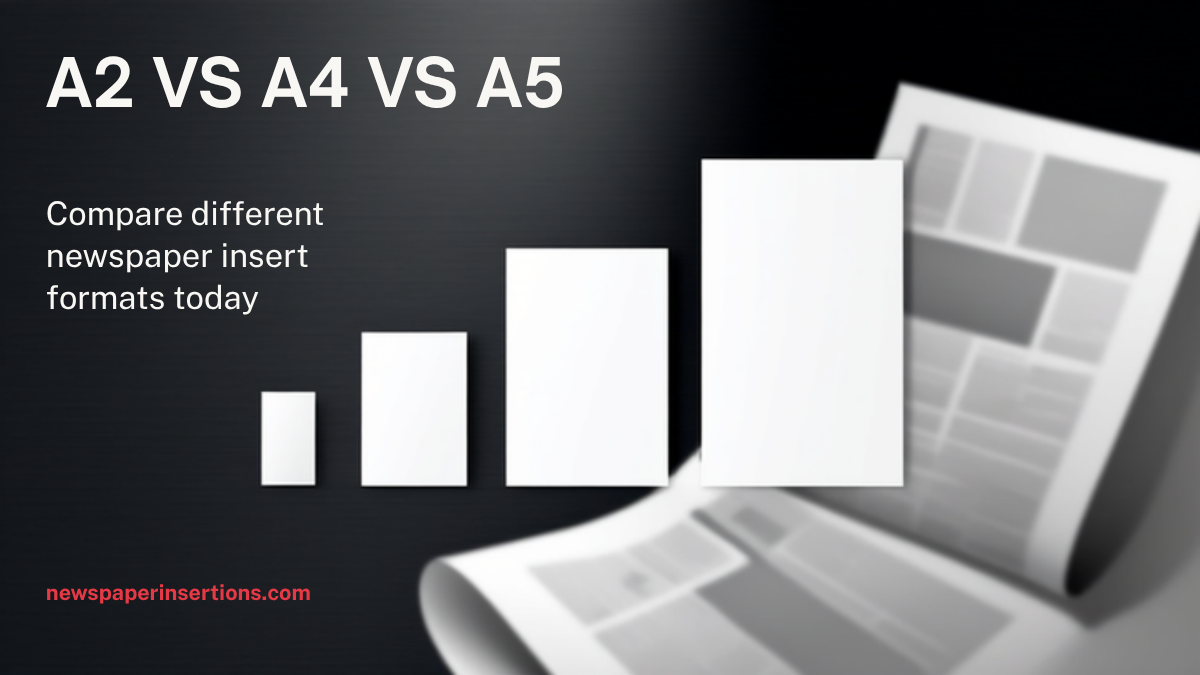
This is the real decision a micro budget forces, and it comes down to one trade: 50,000 large A2 sheets, or 83,000 compact A5 flyers, for the same money. We would answer it by what the offer needs to do.
- A5 when the message is simple and the job is volume: a discount, an opening announcement, a menu, a single service at a single price. You gain roughly 33,000 extra households over A2, which at a constant response rate is the difference between 250 and 415 enquiries at the low end.
- A4 glossy when the product is considered and paper quality is part of the pitch: jewellery, premium retail, healthcare packages, a school prospectus. The 90 GSM sheet survives being kept on a fridge or a notice board, which extends the campaign past the morning it lands.
- A2 when you need to be unmissable and have real content to carry: property launches, floor plans, a seasonal catalogue. It cannot be ignored, but it consumes the whole lakh at the bare minimum quantity, leaving no room to widen the drop.
For a first campaign on a tight budget, we usually lean towards more households rather than a larger sheet. Response volume is what teaches you which localities and which offer work, and you cannot learn that from a small sample. The format comparison goes deeper on where each size earns its cost, and GSM and paper choice explains what you actually change when you move up a paper weight.
How many responses should ₹1 lakh produce?
Across 500+ insertion campaigns we have executed across 30+ Indian cities since 2020, inserts that carry a clear offer and an easy way to respond typically land between 0.5% and 2% of the copies inserted. That range is wide because it reflects reality: the offer, the locality fit and the design move it far more than the newspaper does.
| Format | Copies | Responses at 0.5% | Responses at 2% | Cost per response |
|---|---|---|---|---|
| A2 | 50,000 | 250 | 1,000 | ₹100 to ₹400 |
| A4 | 66,000 | 330 | 1,320 | ₹75 to ₹300 |
| A5 | 83,000 | 415 | 1,660 | ₹60 to ₹240 |
Observed range across our own campaigns, not a guarantee. A weak offer can fall below 0.5%, and a response is an enquiry rather than a sale.
You will only know which number you actually hit if you can count responses, which means a unique phone number, a coupon code or a QR code printed on the insert. At this budget that is not optional. Tracking insert response properly sets out how to do it without a marketing team.
Where should a ₹1 lakh budget be spent inside a city?
Concentrated, not spread.
The instinct with a small budget is to cover as much of the city as possible so that nothing is missed. In our experience that is the single most expensive instinct a micro-budget advertiser has. Spreading 50,000 copies thinly across twelve localities buys a light, forgettable presence everywhere and a decisive presence nowhere, and it makes the results impossible to read, because no area gets enough volume to tell you anything.
Three or four localities chosen around your actual catchment behave differently. Density does some of the work for you: neighbours see the same offer, staff hear the same enquiry twice in a morning, and the follow-up effort stays within a distance you can service. It also produces a clean read. If two areas respond and two do not, you have learned where to spend the next lakh.
Pick those areas by where your customers already come from, not by where you wish they came from. If most of your walk-ins travel less than six kilometres, an insert twelve kilometres away is buying you a number, not a customer. How newspaper distribution actually works explains how vendor rounds map onto those choices, and the city pages list the editions available in each market.
What does ₹1 lakh not cover?
Being straight about this saves unpleasant surprises later.
- GST. Our rates are quoted exclusive of GST. Budget for it separately rather than discovering it at invoice.
- Design and artwork. If you do not have a designer, this is a real line item. A badly set insert wastes the whole print run, so it is the last place to economise. Our insert design guide covers what a working insert needs.
- Higher GSM. The ₹1.50 and ₹1.20 rates are 90 GSM. Heavier glossy stock costs more per copy and reduces your copy count.
- Response handling. The insert creates a spike of calls on one morning. If nobody picks up, the budget is spent and the enquiries are gone. Decide in advance who answers the phone.
- A second drop. ₹1 lakh is one campaign. Frequency has to be budgeted, not hoped for.
Is one drop of ₹1 lakh better than two of ₹50,000?
One drop, in almost every case, because the 50,000-copy minimum makes the choice for you. A ₹50,000 budget does not clear the MOQ in A2 at all, and below 50,000 copies the per-unit costing rises, so splitting the budget in half buys you meaningfully less than half the reach twice over. Our post on why the 50,000 minimum exists explains the distribution logic behind it.
If repetition matters to you, and for considered purchases it genuinely does, the honest answer is to plan a second lakh rather than to halve the first. Treat the first drop as the one that buys you information about which localities and which offer to repeat.
Timing is the free variable here. The same ₹1 lakh delivered on a well-chosen day performs better than the same money on a random Tuesday, at no extra cost. Choosing the right day is the cheapest optimisation available to a micro budget.
What does a ₹1 lakh plan look like in practice?
- Pick the format by the offer, not by what looks impressive. For most first campaigns that means A5 or A4.
- Choose three or four localities inside your actual service radius, and ask for the copy count available in each.
- Book against certified circulation for the named edition, not against a national readership figure. Readership and circulation are different numbers, and your insert travels with copies.
- Print one response mechanism on the insert: a dedicated number, a code or a QR code. One, not four.
- Pick the day deliberately, weekend or a relevant local occasion.
- Staff the phone for the two days after the drop.
- Ask for the distribution certificate and area-wise reporting before you book, not after.
- Count what came back, by area, and let that decide the next spend.
How do micro budgets usually get wasted?
The failures we see repeat are rarely about the newspaper. They are about the plan around it. Spreading too thin. No way to count responses. An offer with no deadline. Artwork set up wrongly and reprinted at the advertiser’s cost. Booking a masthead rather than an edition. We have catalogued these in detail in common insertion mistakes that waste budget, and every one of them costs more at ₹1 lakh than at ₹10 lakh, because there is no second drop to correct it.
The bottom line
₹1 lakh is a genuine print budget in India. It buys 50,000 A2 copies, about 66,000 A4 copies or about 83,000 A5 copies, delivered inside the newspaper to households you choose, at a cost per household of one to two rupees. The same money buys a fragment of a display ad and nothing addressable at all.
What decides whether that lakh works is not the newspaper. It is whether you concentrated it, whether you printed a way to count responses, and whether someone answered the phone. Get those three right and a micro budget in Indian print is still one of the cheapest ways to put a physical offer into a specific household's hands.
Working with about a lakh?
Tell us your city, your localities and your budget. We respond within two hours with copy counts, newspaper options and an all-inclusive price.
Get Free Quote