The Short Answer
Inserts get kept when they are useful after the offer is read. Give the sheet a second job — a calendar, a price list, a coupon with a real expiry, a checklist — then lead with one offer in the headline, print a QR code and a phone number together, and set the language to match the edition. Retention is designed in, not hoped for.
Key Takeaways
- The insert that survives the first thirty seconds is the one with a reason to exist tomorrow: utility, not decoration.
- One offer in the headline beats a list of everything the business does — the single most common fix we make to client artwork.
- Design for the paper you are printing on: newsprint at 45 GSM absorbs ink and softens fine detail, glossy art paper at 90–130 GSM holds photography.
- Always print both a QR code and a phone number. Different generations in the same household respond through different channels.
- Format sets the ceiling on retention: A5 gets pocketed, A4 gets filed, A2 gets read at the table and recycled.
Most inserts are thrown away in the time it takes to walk from the door to the kitchen. That is not a failure of the medium — it is a failure of the sheet to give anyone a reason to hold on to it. Across 500+ campaigns since 2020 in 30+ Indian cities, the difference between an insert that produces walk-ins for two weeks and one that produces a spike on day one is almost always a design decision, not a distribution decision.
This guide is about those decisions: what earns a second look, what earns a place on the fridge, and what quietly kills response before the reader has finished the headline. For choosing the format itself, see our A2 vs A4 vs A5 comparison; this guide assumes the format is chosen and asks what goes on it.
What makes someone keep an insert instead of binning it?
Utility. An insert is kept when it does a job after the advertisement has been read.
The reader's decision is made in a couple of seconds and it is not “is this a good offer?” — it is “will I need this later?” Every insert that survives in an Indian household answers yes to that second question in some concrete way:
- A coupon with a real expiry date — a reason to keep it until a specific day.
- A price list the household will compare against later — tuition fees, package rates, product ranges.
- A calendar or schedule — admission dates, festival timings, exhibition days, class hours. This is why education inserts that print a fee structure or exam calendar survive on the fridge for weeks.
- A checklist the reader would otherwise have to write themselves — documents to bring, tests included in a package, things to carry to a site visit.
- A map to somewhere they intend to go.
- Emergency or service numbers worth pinning up: a clinic, a plumber, a gas agency.
None of that is decoration. It is all content the reader would have to find elsewhere, which is precisely why the sheet earns its place on the fridge door or inside a file.
The corollary is uncomfortable but worth stating: an insert that is only a picture of a product and a logo has given the reader nothing to keep. It can still build awareness, but it will not still be working on day ten.
Which formats get kept the longest?
Format sets the ceiling before a single design decision is made.
| Format | Typical fate | Design implication |
|---|---|---|
| A5 glossy | Pocket, purse, wallet | One offer, one action — treat it as a voucher |
| A4 glossy | Folder, file, pinboard | Room for detail the reader will re-read |
| A2 newsprint | Read at the table, then recycled | Win in the first read — assume no second one |
A5 is the retention champion because it is physically easy to keep, which is why coupons, menus and health-check packages default to it. A4 is kept for a different reason: it files. An admission prospectus or a car brochure goes into the folder where the household keeps decisions-in-progress.
A2 is the honest exception. At 33cm × 53cm on newsprint it is a reading experience, not a keepsake — nobody pockets a folded broadsheet. So design A2 to land completely on the first read, and put anything you want kept into a corner the reader can tear off. A tear-off coupon on an A2 sheet is one of the few ways to get newsprint retention.
What should the headline actually do?
State one offer, in the language of the edition, in words a reader can act on.
The single most frequent change we make to client artwork is cutting the headline down from everything the business does to the one thing it wants the reader to do this week. A headline that says “Quality Education Since 1998 — CBSE, ICSE, State Board, Coaching, Hostel, Transport” asks the reader to work out what is on offer. A headline that says “Class 11 admissions close 14 September — book a campus visit” does not.
Three rules that hold across categories:
- One offer. If there are three offers, you have no offer. Pick the one that brings someone through the door and let the rest be body copy.
- Be specific. A number, a date or a price outperforms an adjective. “Flat ₹2,000 off” beats “great discounts”.
- Say what happens next. Visit, call, scan, book. The reader should not have to infer the action.
How should design change between newsprint and glossy?
Because the two stocks behave differently under ink, the same artwork does not perform equally on both.
A2 on 45 GSM newsprint is absorbent. Ink spreads slightly, so fine detail softens and very small or thin type loses its edges. Design accordingly: generous type sizes, strong contrast, solid blocks of colour rather than delicate gradients, and no long passages of light text reversed out of a dark background. Photographs reproduce acceptably but not richly — this is not the stock to sell a diamond ring on.
A4 and A5 on 90–130 GSM glossy art paper hold detail. Photography, brand colours and gradients reproduce cleanly, which is the entire reason to pay for the stock. If your product is jewellery, food, automotive or interiors, the photograph is the argument and glossy is where it survives. For what the two stocks are made of and what a heavier GSM changes, see our GSM and paper types guide.
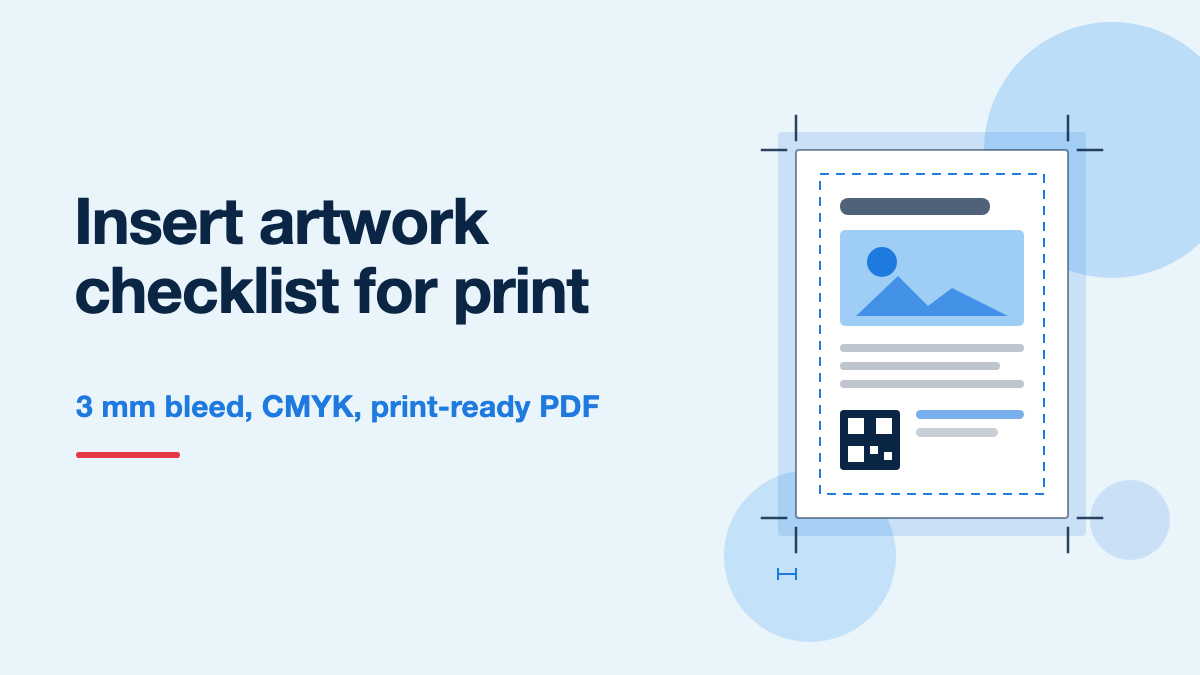
Technical prepress — bleed, margins and file formats — is a separate discipline and worth its own checklist before you send anything to press.
Where should the QR code and phone number go?
Both, together, and large enough to use.
Households do not respond through one channel. In the same family the younger reader scans and the older reader calls, and inserts that offer only one of those quietly lose the other. Print both, place them where the eye lands after the offer, and make the QR code big enough to scan from a comfortable distance — a stamp-sized code on an A2 sheet is a decoration, not a response mechanism.
- Point the QR code at a dedicated landing page or number, not the homepage. That is how the campaign becomes measurable at all — our guide to tracking insert response with QR codes covers the UTM and short-link setup.
- Use a unique phone number or coupon code per campaign, so calls can be attributed without guesswork.
Getting this right is what turns an insert from an act of faith into something you can judge. Every campaign we run also ships with distribution certificates and area-wise delivery reporting, so response can be read against what was actually delivered where — the mechanics are in our how it works guide.
Which language should the insert be in?
The language of the edition it goes into, not the language of the head office.
An insert placed in a Hindi or Marathi daily and printed in English asks the reader to do translation work at 7 a.m. The strongest-performing artwork we handle matches the edition: the headline and the offer in the language the reader chose when they subscribed, with brand names left as they are. Choosing that edition in the first place is covered in our guide to English vs vernacular dailies.
For multi-city campaigns this means versioning the artwork, not translating it word-for-word. An offer that is idiomatic in one language often lands flat rendered literally into another, and the headline is the one line worth having someone local read before it goes to press. Newspapers available in each market are listed by city on our cities page.
What design mistakes waste the most money?
These are the ones we see most often, in rough order of cost:
- No single offer. The sheet lists services instead of asking for an action.
- The response mechanism is too small. A QR code or number the reader has to hunt for.
- Wrong language for the edition. Fixable for free before printing, expensive afterwards.
- Text too small for the stock, especially fine or reversed type on newsprint.
- No expiry or date. Urgency is what converts a kept insert into a visit.
- A single insertion. One drop informs; two or three across a month convert. Budgeting for one drop is the most common planning error, not a design one — but it caps what any design can do.
How do you know whether the design worked?
Judge it against what was delivered, not against a feeling.
Across our campaigns, direct response measured through QR scans, dedicated numbers and coupon redemptions typically lands between 0.5% and 2% of copies inserted for offers with a clear call to action. Response concentrates in the first 72 hours with a tail over about two weeks — clients regularly report walk-ins arriving with a two-week-old sheet in hand, which is retention doing its work.
If a campaign lands below that band, the diagnosis is usually one of three things, in this order: the offer was not compelling, the offer was not clear, or the areas were wrong. Design faults show up as the second one. Change one variable per drop — headline, offer, or format — and the second campaign tells you something the first could not.
The bottom line
A newspaper insert is not a poster; it is a piece of paper entering a home that will be judged in seconds and kept only if it is useful. Give it one offer, a reason to survive the day, a response mechanism a person can actually use, and the language of the household it lands in. At ₹1.20–₹2.00 per copy all-inclusive, the paper is the cheap part — the design is what decides whether it works. Current rates are on our pricing page.
Want a second opinion on your artwork?
Send us your insert design before it goes to press — we respond within two hours with format, legibility and response-mechanism feedback, plus pricing for your city.
Get Free Quote