The Short Answer
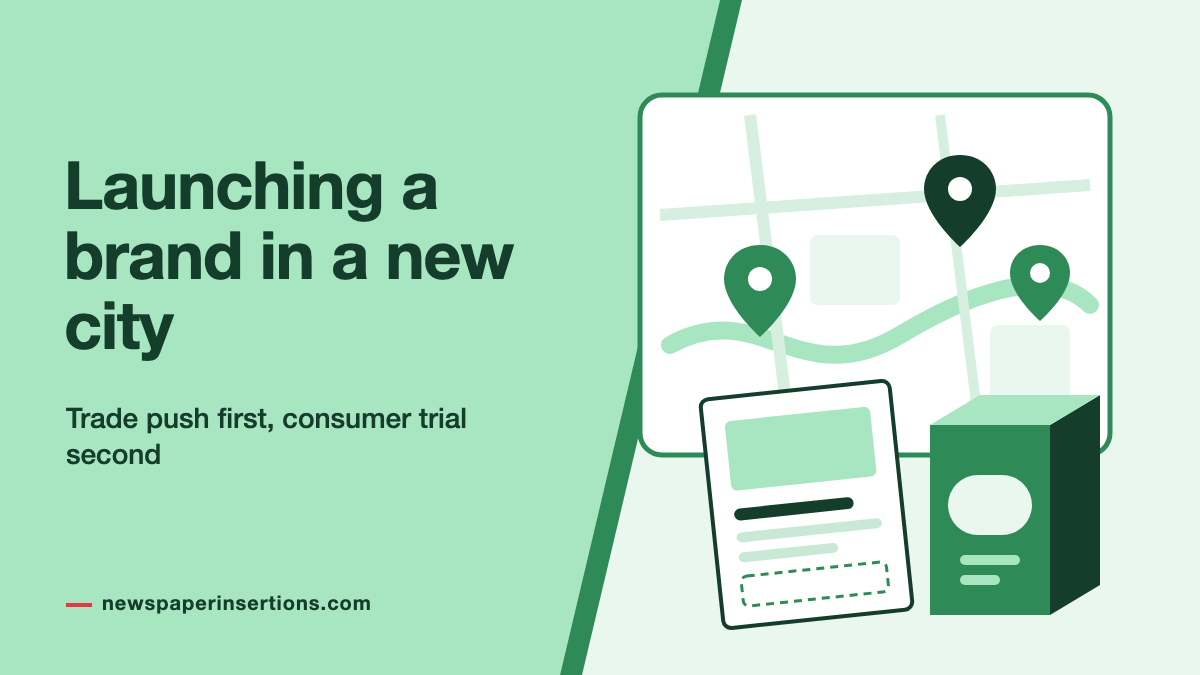
Launch a packaged brand in a new city with two insert drops, not one. First, a trade-facing insert in wholesale and market pin codes to recruit distributors and retailers. Then, once the product is actually on shelves or deliverable, a consumer trial insert in the localities those stores serve, carrying one product, one price and a trial offer.
Key Takeaways
- An FMCG or D2C launch in a new city has two audiences: the trade that must stock the product and the households that must try it. One sheet cannot talk to both.
- Sequence matters more than creative. A consumer insert that lands before the product is on the shelf wastes the drop and annoys the retailer who has no stock.
- Newspaper inserts reach homes, not job titles. Trade inserts work because shop owners, wholesalers and distributors read the paper at home, often a regional-language paper.
- Drop consumer copies only where the product can be bought: the zones around stocking retailers, or the pin codes a D2C brand or its quick-commerce partner actually delivers to.
- Rates are A2 ₹2.00, A4 ₹1.50 and A5 ₹1.20 per copy, all-inclusive of printing, insertion and transport, GST extra, minimum 50,000 copies per drop.
Why does a brand launch need two different inserts?
Because a new city is two markets at once. A packaged food, beverage, personal care or home care brand arriving in, say, Lucknow or Coimbatore first has to persuade distributors to take the range and retailers to give it shelf space. Only then does it have something for households to buy. A D2C brand selling online has the same split in a different shape: it needs delivery coverage and, often, a listing on a quick-commerce app before a household offer makes sense.
The two audiences want opposite things from a sheet of paper. A retailer wants margin, credit terms, the distributor's phone number and proof that the brand will pull customers into the shop. A household wants to know what the product is, what it costs, where to get it and why it is worth trying this week. Put both on one insert and each reader skims past the half meant for the other.
Across the 500+ insertion campaigns we have run since 2020 in 30+ Indian cities, the launches that read cleanly were the ones that separated these jobs and ran them in order.
Should the trade push or the consumer drop come first?
The trade push, always. The order we recommend is:
- Distributor appointed and stock in the city. Nothing goes out until there is a warehouse or distributor point holding product.
- Trade insert in market and wholesale pin codes. This recruits retailers, announces the launch scheme and gives the distributor's contact. Plan it two to four weeks before the consumer drop so salesmen have time to follow up.
- Retail availability confirmed. The sales team, not the marketing plan, decides when enough shops in a zone carry the product.
- Consumer trial insert, zone by zone. Drop only in the localities where a household can walk into a stocking shop, or where the D2C delivery partner serves.
- Follow-up drop. Ten to fourteen days later in the same zones, ideally with the same visual and a refreshed offer.
Those intervals are planning guidance, not measured benchmarks. The rule underneath them is firm: a consumer insert that arrives before the shelf is stocked sends shoppers into shops that say "not available", and that retailer is now less likely to stock you.
What should the trade insert say?
Write it like a business proposal on one page, in the language the trading community in that city reads. In most markets outside the metros that is the regional-language daily, which is why our guide on English versus vernacular newspapers for inserts matters even for a trade audience, and our post on writing insert copy in regional languages covers the translation side.
A trade insert should carry:
- The brand and range in one line, with pack shots of the launch SKUs and their MRP.
- The launch scheme for retailers: introductory margin, free goods on the first order, display incentive, and the validity dates.
- Distributor details: name, area covered, phone and WhatsApp number.
- A distributorship enquiry line if some areas of the city are still open.
- The consumer support coming: "Household trial campaign in your area from 1 November" tells the retailer that demand is being built, which is often the deciding argument for shelf space.
Target it with care. Insertion is sold by newspaper vendor round, so the trade drop goes to the residential localities around wholesale markets and dense retail streets, where shop owners and their families live. Our post on newspaper inserts for B2B and trade audiences explains why this works for owner-led trade and where it does not.
What should the consumer trial insert carry?
One product, one reason to try it, one place to buy it. The most common fault we see in launch creative is a range catalogue: twelve SKUs, three sub-brands and a founder's story. A first-time buyer needs far less.
- The hero product, large, with pack size and price.
- The trial offer: an introductory price, a free small pack with a larger one, or a coupon worth a fixed amount off the first purchase.
- Where to buy in this zone: for FMCG, a short list of stocking shops near the reader, which is only possible because zones are dropped separately. For D2C, a QR code to the product page or app listing with a city-specific code.
- One line of proof: an ingredient, a certification the product actually holds, or a comparison the brand can substantiate. Packaged-goods advertising in India is also subject to the ASCI code on claims, so keep it to what the label supports.
If the trial offer is a coupon redeemed at the counter, settle the mechanics with distributors before printing: who collects the coupons, how retailers are reimbursed and by when. A retailer who is not sure he will be paid will refuse the coupon at the till. Our guide to coupon inserts and redemption tracking and the post on tracking response with QR codes cover both mechanisms.
How do you choose zones in a city you have never sold in?
Start from availability, not from the map. For FMCG, ask the distributor for the list of outlets that have taken stock and group them by locality. Each cluster with enough stocking shops becomes a consumer zone. For D2C, start from serviceable pin codes and, if you rely on a quick-commerce partner, from the areas its dark stores cover.
Then layer in fit. A premium skincare or health-food launch belongs in the localities where the price point sells. A mass detergent or snack launch can go wide. The hyperlocal pin code targeting guide shows how localities map to vendor rounds, and our tier-2 city guide covers the cities where many brands now launch first. If you are choosing which city to enter, metro or tier-2 first compares the budgets.
Remember the minimum order is 50,000 copies per drop. In a large metro that may cover only a few clusters of stocking outlets, which suits a phased rollout. In a smaller city it can cover most of the stocked area in one morning.
Which format suits a product launch?
- An A5 insert at ₹1.20 per copy suits a single-SKU trial coupon, and works well for the trade insert too.
- An A4 glossy insert at ₹1.50 per copy suits personal care, beauty, premium foods and most D2C brands, where the pack shot has to look as good as it does online.
- An A2 newsprint insert at ₹2.00 per copy suits a full range launch with a price list, or a combined offer sheet from a distributor carrying several brands.
Our comparison of A2, A4 and A5 inserts goes deeper into paper and size.
What does a launch insert plan cost?
Rates are the same in every city we serve, include printing, insertion and transport, exclude GST, and start at 50,000 copies per drop.
| Drop | Typical format | Copies | Cost before GST |
|---|---|---|---|
| Trade push | A5 | 50,000 | ₹60,000 |
| Consumer trial | A4 glossy | 50,000 | ₹75,000 |
| Consumer follow-up | A4 glossy | 50,000 | ₹75,000 |
| Three-drop launch total | 1,50,000 | ₹2,10,000 |
Rates include printing, insertion and transport. GST extra. Minimum 50,000 copies per drop.
Swap the consumer drops to A2 for a range launch and the total becomes ₹2,60,000 before GST. Current rates are on the pricing page, and the GST on insertion campaigns post explains the tax line.
How do you know if the launch worked?
Measure the trade and consumer drops separately, because they answer different questions.
- Trade drop: count distributor and retailer enquiries on the dedicated number, and new outlets opened in the two to four weeks after the drop.
- Consumer drop: count coupons redeemed through distributors, QR scans by zone code, and orders on the city-specific promo code for D2C.
- The number that decides the next city: repeat orders from retailers in dropped zones against undropped ones.
For planning, clients who measured direct response reported results that usually sat between 0.5% and 2% of copies for offers with a clear call to action. That band is ours, from our campaigns, not an industry study, and it is a range to plan around rather than a promise. Our guide to calculating insertion ROI and cost per lead shows how to weigh it against margin per pack.
What goes wrong with brand launch drops?
- Consumer drop before stock. The most expensive mistake in this category, covered above.
- Dropping citywide. Copies in localities with no stocking outlet produce nothing but frustration.
- Coupon without a settlement plan. Retailers refuse what they are not sure will be reimbursed.
- One sheet for trade and consumers. It serves neither.
- English-only copy in a regional-language market. The trade reads its own language first.
- No follow-up. A single morning's paper reaches one morning's readers. Budget for the second drop from the start.
How long does it take to get a launch drop out?
About seven working days from a final brief to the doorstep for each drop, as set out in the seven-day insertion campaign timeline. The how it works page covers the steps and the distribution certificate you receive afterwards. For a launch, the longer lead time is on your side: fixing the distributor, the scheme and the coupon settlement before the first sheet is printed.
Where do these observations come from?
From our own work: 500+ insertion campaigns in 30+ Indian cities since 2020, with response counted by clients through coupons, QR codes, dedicated numbers and WhatsApp. For how many households a newspaper edition reaches, rely on the Audit Bureau of Circulations certified circulation for that centre and the Indian Readership Survey (IRS 2019, MRUC) for readership context. EY-FICCI media and entertainment reports track print advertising in India, and the Advertising Standards Council of India (ASCI) code governs claims in product advertising.
Launching a brand in a new city?
Tell us the city, the launch SKUs and where your distributor has stock. We will map the trade and consumer zones, suggest formats and quote each drop.
Plan the launch drops