The Short Answer
A coupon insert works when the offer is worth cutting out, the code and expiry are impossible to miss, and every area gets its own code so redemptions can be counted. Plan at about 0.5% of inserted copies redeeming, treat 1% as good and 2% as the top of what we see, and work out your break-even before you print.
Key Takeaways
- A coupon is the most countable response mechanism print has. Every redeemed coupon is a physical record of one household acting on your insert.
- Across 500+ insertion campaigns since 2020, the direct response clients have shared back with us usually falls between 0.5% and 2% of inserted copies. Coupon redemptions sit inside that same band, not above it.
- Design decides most of the result: one offer, a large code, a clear expiry date, and a cut line placed so the rest of the insert survives.
- Use a different code for every city, zone or drop date. One code for the whole campaign tells you how many redeemed, but not where to spend next time.
- Work out the break-even redemption count before printing. A 50,000-copy A5 drop costs ₹60,000 plus GST, so you need to know what each redemption is worth to you.
Why use a coupon instead of just a phone number?
Because a coupon turns a vague “the insert seemed to work” into a number you can count at the counter. A phone number tells you who called. A QR code tells you who scanned. A coupon tells you who walked in, bought something and handed over the piece of paper your insert put in their home.
That matters most for businesses where the sale happens in person: restaurants and cloud kitchens with a pickup counter, salons, clinics offering a first consultation, retail stores, gyms, opticians, coaching centres with a trial class, and car or bike service centres. For these categories the strongest evidence that print worked is a stack of cut-out coupons in a drawer at the end of the month.
A coupon also gives the household a reason to keep the insert. A flyer with only a brand message is read once and thrown out with the paper. A flyer with ₹150 off the next bill gets cut out, stuck on the fridge or kept in a wallet. We cover the wider idea of designing for keepability in our guide on how to design a newspaper insert people keep.
Coupons are not the only mechanism, and they work best alongside the others. Our guide to tracking insert response with QR codes explains how to run a QR code, a dedicated phone number and a coupon code together, so that calls, scans and walk-ins are all counted.
What does a good coupon insert look like?
The coupons that get redeemed share a few simple features.
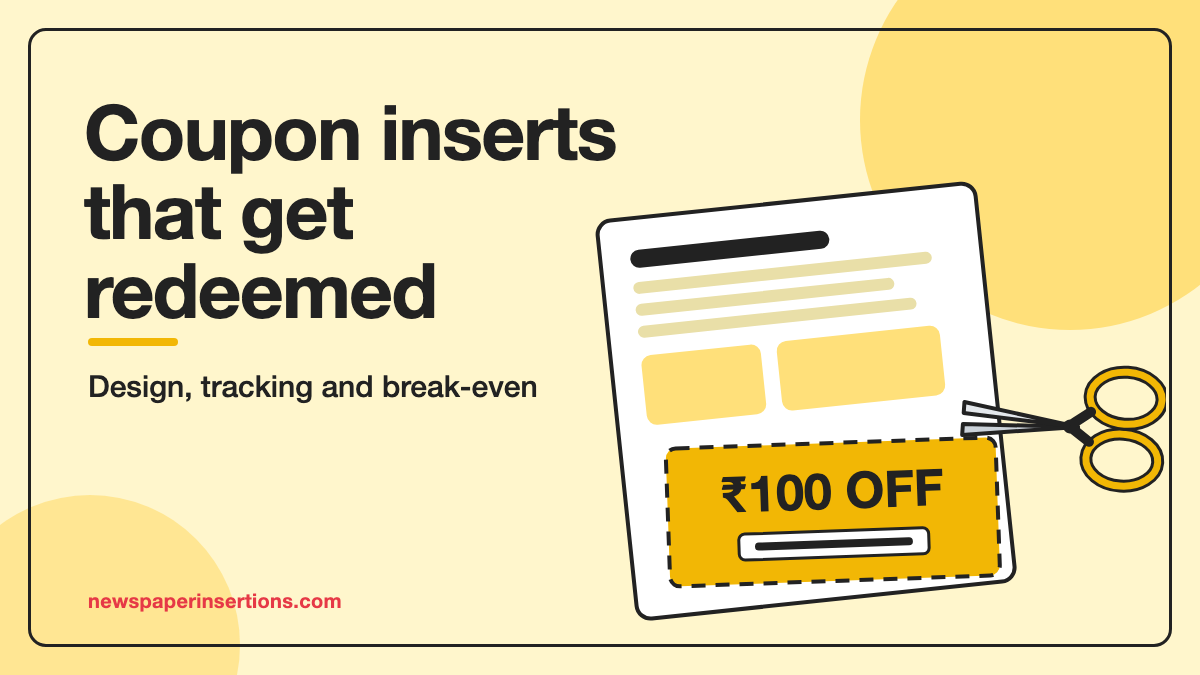
- One offer, stated in a few words. “₹150 off on bills above ₹600” or “Free eye test with any frame”. Not three offers competing for attention. If the household has to read the terms to understand the offer, the offer is too complicated.
- A code printed large. The code is what your staff will look for at the counter and what you will tally later. Print it in large, bold characters and avoid letters that look like numbers, such as O and 0, or I and 1.
- A real expiry date. A date two to three weeks after the drop gives people time to act and a reason not to put it off. “Valid till 26 October 2026” is clearer than “valid for 15 days”.
- A dashed cut line in the right place. Put the coupon along an edge or in a corner, so cutting it out does not destroy the address, map or menu on the rest of the sheet. A coupon in the middle of the page forces the household to choose between the offer and the information.
- Where to redeem. The store address, a landmark, opening hours and a phone number, printed on the coupon itself, because the coupon is the part that survives.
- Terms that are readable and honest. Minimum bill, one coupon per visit, not valid with other offers, branch list. State them in plain words at a size people can actually read.
On paper choice: a coupon on glossy art paper feels like something worth keeping and survives a wallet better. That is one reason A5 and A4 are the usual formats for coupon drops. Our A5 newspaper insertion service suits a single coupon with a short offer, and A4 inserts give room for a coupon plus a menu, price list or product range. A2 newsprint can carry a coupon too, but thin newsprint tears easily once cut. Our guide to GSM and paper types for inserts covers the trade-off in detail.
How do you track coupon redemptions by area?
Give every area its own code. Insertion can be targeted by locality and vendor round, so a single campaign can cover several zones of a city on the same morning. If each zone gets a different code, your redemption tally becomes a map of where the campaign worked.
| Zone | Copies | Coupon code |
|---|---|---|
| Zone A (localities near the store) | 20,000 | SAVE150-A |
| Zone B (mid-distance localities) | 15,000 | SAVE150-B |
| Zone C (outer localities) | 15,000 | SAVE150-C |
The print run is still one artwork with a small change in the code area, so the per-copy rate does not change. How targeting by area works is explained in our guide to hyperlocal marketing with pin code targeting.
At the counter, the process must be simple enough that busy staff actually follow it:
- Collect every coupon. Keep a box or envelope at each billing counter, emptied and counted once a day.
- Log the code in the billing system if your POS supports discount codes. Then the redemption is tied to a real bill value, not just a count.
- Decide your policy on photos. Some customers will show a photo of the coupon on their phone. Decide in advance whether you accept it, and if you do, make staff write down the code.
- Record the bill value. A redemption on a ₹2,000 bill is worth more than one on a ₹600 bill. Average bill value per redeemed coupon is the number that decides whether the campaign paid for itself.
If you prefer serial-numbered coupons, so that each copy carries a unique code, that needs variable-data printing. Not every press run supports it, and it can change the cost, so ask before you design around it.
What redemption rate should you expect?
Plan around 0.5% of inserted copies. Treat 1% as a good result and 2% as the top of the range.
These figures come from our own work. Across 500+ insertion campaigns in 30+ cities since 2020, the direct response that clients have measured and shared with us, through dedicated phone numbers, QR scans, WhatsApp messages and coupon redemptions, usually lands between 0.5% and 2% of inserted copies. Coupons fall inside the same band. We do not have a separate coupon-only benchmark that we would stand behind, and we would rather tell you that than invent one.
Where in that band a campaign lands depends on a few things we see repeatedly:
- Offer strength. A discount that is meaningful against the typical bill does better than a token amount.
- Distance. Households close to the store redeem far more often than those across the city. This is why zone codes matter.
- Category. Things people buy often, such as food, groceries and personal care, give the coupon more chances to be used than a one-time purchase.
- Clutter. On mornings when many inserts share the paper, yours competes for attention. Our post on what 2% response inserts do differently looks at the habits behind the top of the band.
Remember that the redemption count is a floor, not the full effect. Some households will see the insert, remember your name, and visit or order weeks later without the coupon. Those sales are real but uncounted.
How do you work out break-even before printing?
Start from what one redemption is worth, then divide the campaign cost by that amount. Here is a worked example using our published rates. It is arithmetic, not a client result.
- Campaign cost: 50,000 A5 inserts at ₹1.20 per copy all-inclusive = ₹60,000, plus GST.
- Average bill on a redeemed coupon: say ₹800.
- Your gross margin: say 30%, which is ₹240 per bill.
- Coupon discount: ₹100.
- Contribution per redemption: ₹240 minus ₹100 = ₹140.
- Break-even redemptions: ₹60,000 ÷ ₹140 = about 429 redemptions, or roughly 0.86% of copies.
| Redemption rate | Redemptions | Cost per redemption |
|---|---|---|
| 0.5% | 250 | ₹240 |
| 1% | 500 | ₹120 |
| 2% | 1,000 | ₹60 |
In this example the first visit alone breaks even at just under 1%. That is before counting repeat visits from customers who came back without a coupon, which is where coupon campaigns for regular-purchase categories usually earn their money. If your own break-even comes out above 2%, the offer, the margin or the format needs to change before you print, not after.
Full per-copy rates are on our pricing page: A2 ₹2.00, A4 ₹1.50 and A5 ₹1.20 per copy, including printing, insertion and transport, GST extra, with a minimum of 50,000 copies.
Which rules apply to coupon offers in India?
Offers in advertising are covered by consumer protection law. The Central Consumer Protection Authority’s Guidelines for Prevention of Misleading Advertisements, 2022, made under the Consumer Protection Act, 2019, expect advertisements to be truthful and expect conditions that affect an offer to be disclosed clearly. In practice for a coupon insert:
- Do not call something “free” if the customer must pay for something else to get it, unless that condition is stated clearly next to the offer.
- Print the real conditions (minimum bill, branches, expiry) where people will see them, not in tiny text.
- Honour the coupon at every location it names until the printed expiry date.
This is general guidance, not legal advice. Regulated categories such as financial services and healthcare have their own advertising rules on top of these, so check them before printing.
What are the common mistakes with coupon inserts?
- One code for the whole city. You get a total, but no idea which zone to repeat.
- No expiry date. Redemptions trickle in slowly and you cannot close the measurement.
- Staff not briefed. The coupon is presented, the cashier does not know what it is, and the customer leaves unhappy. Brief every counter before the drop morning.
- Coupons not collected. If the paper goes into the bin after billing, you lost the data you paid for.
- Offer too small. A discount that does not change a decision will not get cut out.
Ready to plan a coupon drop?
Tell us your city, your store locations and the offer you have in mind. We suggest zones around each location, the right format for the coupon, and drop dates, at the same per-copy rates as any other insert.
Request a quote