The Short Answer
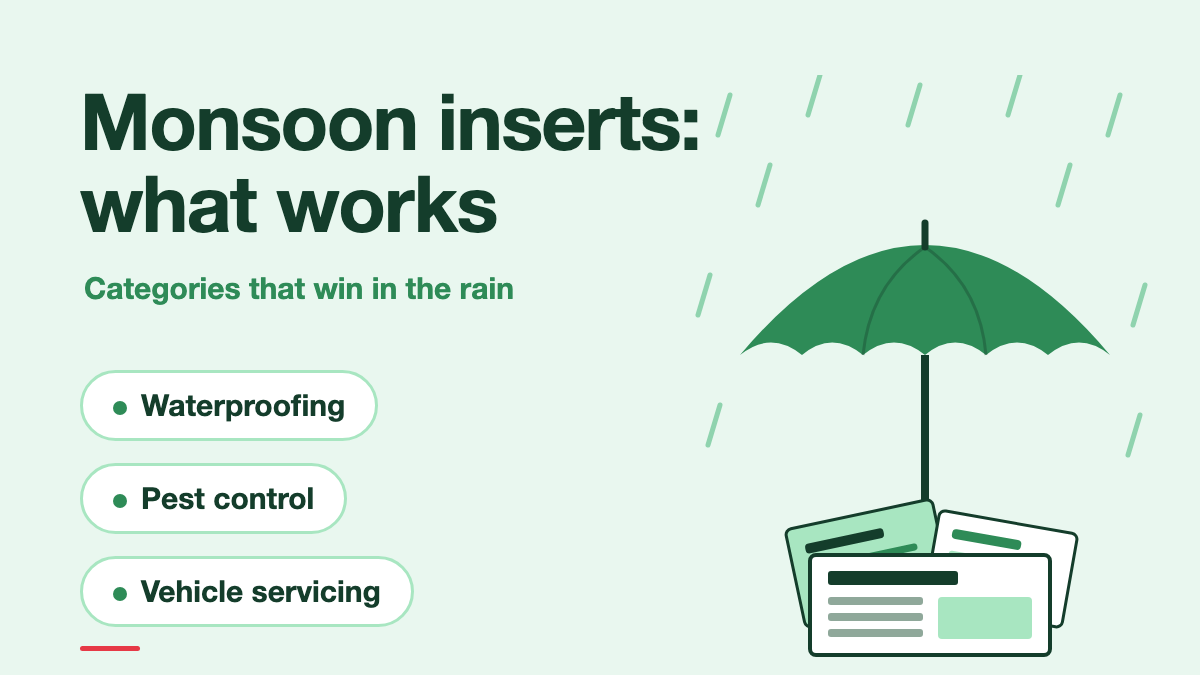
The monsoon suits categories that solve rain problems or reach people at home: waterproofing, pest control, appliance and vehicle servicing, food delivery, tuition and the August to September festival run-up. It is weaker for open-plot site visits and outdoor events. Rates do not change in the rain, so judge each drop on tracked cost per lead.
Key Takeaways
- The India Meteorological Department (IMD) defines the southwest monsoon season as June to September. July and August are the wettest months across most of the country.
- Tamil Nadu, Puducherry and parts of coastal Andhra Pradesh get most of their rain from the northeast monsoon, October to December. Chennai's monsoon plan runs on a different calendar.
- Rain creates demand. Leaking roofs, damp walls, pests, stalled vehicles and failed appliances all increase in the wet months, and the households that need help are reading the paper at home.
- The paper still arrives every morning, but a wet doorstep is a real risk for the sheet inside it. Paper stock, fold and date flexibility matter more than usual.
- Rates are the same in every season: A2 ₹2.00, A4 ₹1.50 and A5 ₹1.20 per copy all-inclusive, GST extra, minimum 50,000 copies.
Why plan a monsoon campaign separately?
Because two things change at once. What households need changes, and the conditions under which your insert reaches them change.
On demand, the monsoon is a season of problems that need fixing. Water comes in through terraces and walls. Mosquitoes, termites and cockroaches multiply. Two-wheelers and cars break down in waterlogged streets. Inverters and pumps work harder when storms bring more power cuts. Families who were out in the evenings in April spend more of July indoors.
On delivery, newspapers arrive every morning through the rains, and the vendor network that carries your insert does not stop for weather. We explain how that network works in how newspaper distribution works in Indian cities. What changes is how the sheet arrives. On a heavy-rain morning a paper can be damp at the edges, and an insert printed on the wrong stock can arrive limp or stuck to the pages around it.
A monsoon plan accounts for both.
Which categories do well with inserts in the monsoon?
In our experience across 500+ campaigns in 30+ cities since 2020, the categories below tend to suit the season. These are patterns, not guarantees, and they depend on the city and the offer.
1. Home repair and waterproofing. Terrace and wall waterproofing, roof repair, plumbing and electrical services meet the reader on the morning the problem is visible. The leak is in the room while they read. A clear "call today, inspection this week" offer with a local number fits the moment.
2. Pest control. Damp months bring more insects into homes. A pest control insert works best when it names the specific problem, for example termites or mosquitoes, and gives a simple first-visit price.
3. Appliance, inverter and vehicle servicing. Service camps for two-wheelers and cars, and checks for inverters, pumps and air conditioners, suit a season of breakdowns. Dealers and service centres can tie the insert to a dated camp so the response comes in a short window.
4. Food delivery and cloud kitchens. A rainy evening is a natural time to order in rather than step out. A restaurant or cloud kitchen insert with a direct ordering number or QR code and a monsoon menu has a clear reason to exist. Our guide to newspaper insertions for restaurants and cloud kitchens covers what those inserts should carry.
5. Tuition and coaching. By July the school year has started and parents are watching how their children settle. Tuition centres and coaching institutes that start new batches mid-year can use the season. See newspaper inserts for schools and coaching institutes for timing around the academic calendar.
6. Clinics and diagnostics. Monsoon illnesses mean more households look for a nearby clinic or lab. Keep the message to services, timings and location, and stay within the rules on medical advertising. Our guide to healthcare marketing with newspaper inserts lists what to avoid printing.
7. The festival run-up. Raksha Bandhan, Janmashtami, Ganesh Chaturthi and Onam usually fall in August and September, so the back half of the monsoon is also the start of festival buying in many cities. Jewellery, sweets, apparel and electronics retailers plan around these dates. Our festival season insertion planning guide covers drop timing.
| Category | Monsoon fit | What to put on the insert |
|---|---|---|
| Waterproofing, roofing, plumbing | Strong | The problem by name, a local number, inspection this week |
| Pest control | Strong | The pest by name and a first-visit price |
| Vehicle and appliance servicing | Strong | A dated service camp or check-up offer |
| Food delivery, cloud kitchens | Good | Direct order number or QR code, monsoon menu |
| Tuition, clinics, diagnostics | Good | Timings, location, new batches or services |
| Open-plot site visits, outdoor events | Weak | Hold for drier weeks, or print a rain date |
Patterns from The Mediaverse's campaign observations, not guarantees. City, offer and weather on the day all change the result.
Which categories should wait for drier weeks?
Some offers depend on people going out, and heavy rain works against them.
- Open-plot and under-construction site visits. A muddy approach road and a waterlogged site do not show a project well, so big site-visit pushes are often better held until after the rains. Possession-ready projects with finished access roads are less affected. Our real estate insert campaign guide covers the launch calendar.
- Outdoor events and exhibitions. A weekend event in July carries a weather risk you cannot control. If you must run one, print a rain date or an indoor venue on the insert.
- Walk-in offers that need a short trip. A one-day store sale in a city with frequent waterlogging can lose footfall to the weather. A sale that runs for a week, or one that also takes phone or WhatsApp orders, is safer.
This is not a reason to stop advertising in the monsoon. It is a reason to match the offer to what people will actually do that week.
How does rain affect the insert itself?
Paper and fold matter more in the monsoon than in any other season.
- Stock. Uncoated newsprint takes up moisture quickly and goes limp. Coated art paper at a higher GSM holds its shape better when the paper is damp, although no stock survives a soaked bundle. Our guide to GSM and paper types for newspaper inserts explains the difference. For the wettest weeks, A4 or A5 on art paper is the safer choice; A2 on newsprint is still fine on the many mornings when the paper arrives dry.
- Fold and size. A smaller, stiffer sheet is less likely to crumple or tear when a damp paper is opened. That favours A5 newspaper insertions and A4 newspaper insertions in the wettest weeks.
- Ink and finish. Test print on the actual stock before the full run. A sample handled with damp hands will show you whether the ink smudges.
When in the season should you drop?
You cannot choose dry mornings weeks in advance, but you can reduce the risk.
- Watch the forecast extremes. IMD issues district-level weather warnings a few days ahead. Agree with your agency at booking what happens if a red alert is issued for your city on the drop day, so a short shift is a plan rather than a scramble.
- Book a backup date. Fix a primary date and a backup date when you book. Having the second date ready costs nothing.
- Use the problem days. For waterproofing, pest control and servicing, the week after the first heavy spell is often the strongest, because that is when the leaks and breakdowns show up.
- Follow the regional calendar. On the west coast, including Mumbai, the heaviest rain usually falls in June and July. In much of north India the rains arrive later and are heaviest in July and August. In Chennai the wet season is October to December, so a Chennai campaign for monsoon-driven services belongs in that window, not in July. See our Chennai newspaper insertions and Mumbai newspaper insertions pages for local options.
For the choice of weekday within any week, our guide to the best days for newspaper insertions still applies.
Does a monsoon campaign cost more or less?
The per-copy rate does not change with the season. On our pricing page the rates are A2 at ₹2.00, A4 at ₹1.50 and A5 at ₹1.20 per copy, each including printing, insertion and transport, GST extra, with a minimum of 50,000 copies. A 50,000-copy A5 drop costs ₹60,000 plus GST in July, as it would in March. A 50,000-copy A4 drop costs ₹75,000 plus GST.
What can change is the result. Give each monsoon drop its own phone number, WhatsApp number or QR code, and divide the spend by the qualified leads it produced. If a waterproofing insert brought 60 qualified enquiries from a ₹75,000 drop, the cost per lead would be ₹1,250 before GST. That example is arithmetic, not a forecast, but it is the comparison that should decide whether you run again next monsoon. Our guide to tracking insert response with QR codes shows how to set it up.
What should a monsoon insert say?
Short, local and practical.
- Name the problem. "Leaking terrace?" works better than a general list of services.
- Give one action. A phone number, WhatsApp number or QR code, and one reason to use it this week.
- Show you are close. Name the localities you serve and the response time you can actually keep.
- Be honest about timing. If inspections take a week to schedule in peak monsoon, say so. A promise you cannot keep wastes the lead.
Planning a monsoon campaign?
Tell us your city, category and the weeks you are considering. We suggest drop dates with a backup, the right format and stock for wet weather, and quote at the same per-copy rates as any other month.
Request a quote