The Short Answer
Newspaper inserts work well for healthcare because clinics and hospitals draw patients from a 3 to 5 km catchment, and inserts can be delivered to exactly those pin codes for ₹1.20 to ₹1.50 per household. What fails is the creative: Indian law restricts medical advertising heavily, so cure claims, patient testimonials and superlatives must come off the artwork.
Key Takeaways
- Healthcare is a catchment business, so pin-code level insert distribution matches how patients actually choose a clinic.
- A5 glossy inserts cost ₹1.20 per copy and A4 ₹1.50 per copy all-inclusive, with a 50,000 copy minimum and GST extra.
- Three instruments shape what you may print: the Drugs and Magic Remedies (Objectionable Advertisements) Act 1954, the PCPNDT Act 1994, and the MCI Code of Ethics Regulations 2002.
- Dated health check-up camps and transparently priced diagnostic packages are the highest-response healthcare formats we see.
- The most common waste is not the printing. It is an unstaffed phone line on the morning the insert lands.
Patients do not shop for a clinic the way they shop for a phone. They pick something close, visible, and already familiar to the neighbourhood. Most single-location clinics, diagnostic labs and mid-size hospitals we work with draw the large majority of their walk-ins from a radius of a few kilometres.
That is exactly the shape a newspaper insertion fits. It is also the category where the creative gets a business into trouble fastest, because medical advertising in India is genuinely restricted. This guide covers both halves: the formats that earn their cost, and the claims that must never reach the printer.
Why do newspaper inserts suit healthcare businesses?
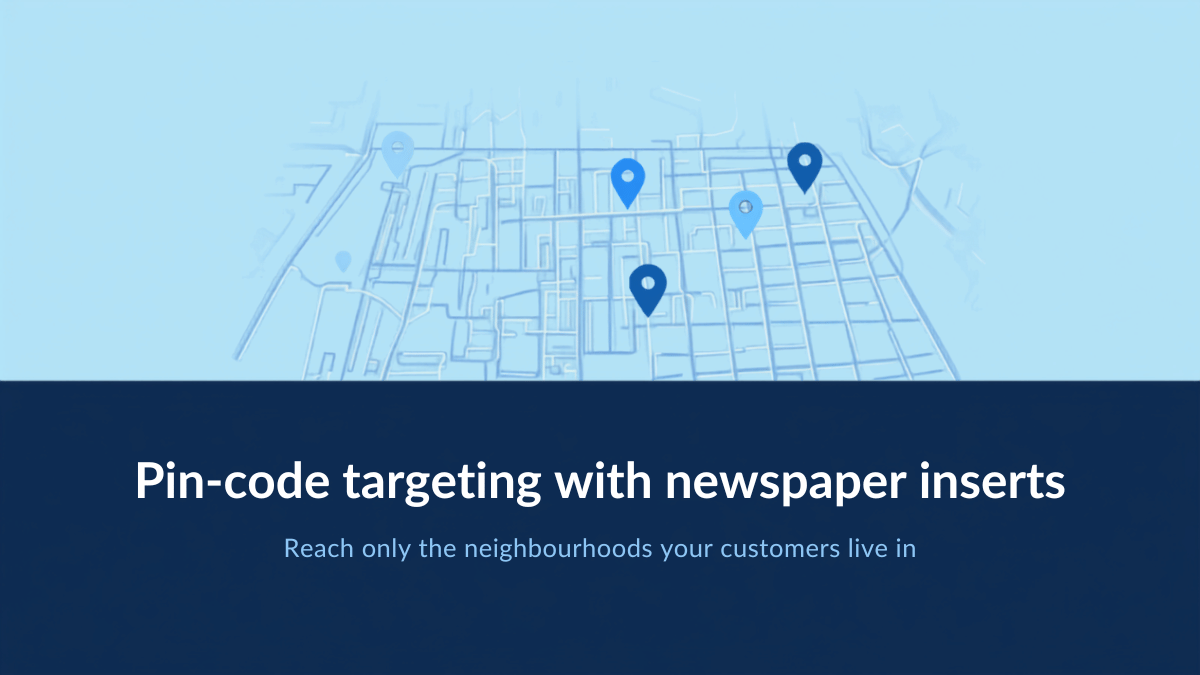
Newspapers are distributed through area-wise vendor networks, so an insert can be sent to chosen localities and pin codes rather than a whole city edition. Our pin-code targeting guide explains how that split is set up with the vendor lines.
The second reason is the household. The Indian Readership Survey (IRS 2019 Q4, published by the Media Research Users Council) recorded roughly 425 million newspaper readers in India. A health insert does not reach one person on a screen. It lands on a table where an adult child sees a knee replacement camp and mentions it to a parent.
Across our own campaigns since 2020, healthcare inserts consistently generate more phone calls than QR scans. That tells you something useful about who is reading them, and it should change how you design the sheet.
What healthcare campaigns actually work in print?
These are the formats that repeatedly earn their cost across 500+ insertion campaigns we have run in 30+ Indian cities.
- Health check-up camps. A dated, time-bound camp with a clearly printed package price is the strongest healthcare insert we run. It gives the reader a reason to act this weekend rather than someday. Sunday camps advertised in Friday or Saturday papers work better than the reverse.
- A new clinic, branch, or department. An opening is genuinely newsworthy to a locality, and it is also one of the few announcements the medical ethics code explicitly permits a practitioner to make in the press.
- Diagnostic packages with itemised pricing. A full-body panel listed test by test with a total outperforms a vague offer of affordable health packages. Readers keep the sheet on the fridge and call when they need it.
- Single-specialty messages. Dental, eye, IVF, physiotherapy, orthopaedics and dermatology each respond better as one focused insert than as a crowded page listing every department. If you have twelve departments, run twelve rotations, not one insert with twelve boxes.
- Vernacular language. Health is a trust purchase, and trust reads in the mother tongue. Our English vs vernacular guide covers how to choose the edition.
For format, most healthcare campaigns land on A5 glossy inserts for camps and offers, or A4 when a hospital wants the extra space and a more premium feel. A2 newsprint is usually overkill unless it is a large multi-speciality launch. The A2 vs A4 vs A5 guide works through the trade-off at each price point.
What does a healthcare insert campaign cost?
| Format | Typical healthcare use | All-inclusive rate* |
|---|---|---|
| A5 glossy art paper, 90 GSM | Camps, diagnostic packages, single-specialty offers | from ₹1.20 per copy |
| A4 glossy art paper, 90 GSM | Hospital launches, multi-department profiles | from ₹1.50 per copy |
| A2 newsprint | Large hospital openings, mass health drives | from ₹2.00 per copy |
*Rates include printing, insertion, and transport; GST extra; minimum order 50,000 copies. City-wise rates are on our pricing page.
In practice, a 50,000 copy A5 run works out to about ₹60,000 plus GST for a locality cluster. Current rates for all 30+ cities are on our pricing page.
Across categories we typically observe direct response between 0.5% and 2% of copies inserted where the offer and the call to action are clear. Healthcare sits inside that band, with dated camps at the higher end and general clinic awareness inserts at the lower end. Treat those as planning ranges, not guarantees. Response depends on the offer, the locality and the season far more than on the paper.
What must you avoid printing on a healthcare insert?
This is where healthcare differs from every other category we handle. Print is permanent, physical evidence. Three instruments matter most.
The Drugs and Magic Remedies (Objectionable Advertisements) Act, 1954. Section 3 prohibits advertising any drug as a treatment, cure or means of prevention for the conditions listed in the Act's schedule, which includes diabetes, cancer and sexual impotence among others. Section 5 bans advertisements for so-called magic remedies for those conditions. This is why a permanent cure for diabetes cannot go on a leaflet.
The PCPNDT Act, 1994. Section 22 prohibits any advertisement relating to pre-natal determination of sex, and liability extends to whoever publishes or distributes it. For a diagnostic or scan centre this is absolute. Do not print anything that could be read as hinting at sex determination, and expect a reputable insertion partner to refuse such artwork outright.
The MCI Code of Ethics Regulations, 2002. Clause 6.1 treats soliciting patients, directly or indirectly, as unethical for a registered medical practitioner. Clause 6.1.1 does permit a formal press announcement in defined situations, such as starting practice, changing the type of practice, changing address, temporary absence from duty, and a public declaration of charges. The National Medical Commission issued fresh professional conduct regulations in 2023 that were then kept in abeyance, so the 2002 code remains the reference most practitioners are held to.
The practical avoid list
- Guaranteed cures, claims of 100% results, or any promise of an outcome.
- Success-rate percentages you cannot substantiate on demand. IVF and oncology claims attract the most scrutiny.
- Patient testimonials, and before and after photographs. Even with consent these create ethics and privacy exposure that is not worth the marginal lift.
- Superlatives about a doctor, such as best surgeon in the city or number one hospital. These are unverifiable and invite complaints.
- Free medicines, cashbacks or gifts used as an inducement to consult.
- Prescription drug names presented to the public.
- Hidden exclusions in package pricing. If the ₹999 panel excludes the consultation, print that on the front, not in six-point type.
- A doctor's photograph combined with promotional copy, which is where the solicitation line is most often crossed.
- Stock photos of visibly foreign patients and hospitals. Local readers notice, and it reduces trust.
How do you make a healthcare insert convert?
Design decides the outcome more than distribution does. Put the phone number at the largest size on the sheet, larger than the logo, because healthcare inserts generate calls and older readers will not scan anything. Add a QR code to a WhatsApp appointment line for younger readers, and read our QR tracking guide so you can actually attribute the response.
- Print the address as landmarks, not just a plot number. Opposite the bus depot, next to the bank branch, beats a formal postal address for a walk-in business.
- Give the reader your OPD timings. A clinic insert without hours forces a phone call the reader may not make.
- State the price of the one thing you are advertising. Ambiguity in healthcare reads as risk.
- Staff the phone. Inserts land between 6 and 8 in the morning and calls start well before a 10 a.m. reception shift. Brief the front desk on the offer, the price and the dates before delivery, not after.
- Repeat before you conclude. A single insertion informs a locality that you exist; two or three rotations across a month convert.
The unstaffed phone line is the single biggest avoidable waste we see in this category. If a campaign is delivered on Saturday morning and the clinic opens on Monday, most of the response is gone. Our step-by-step process sets out how a multi-rotation schedule is planned around that.
The bottom line
Newspaper inserts fit healthcare better than most channels because the medium is geographic and the business is geographic. At ₹1.20 to ₹1.50 per household, a clinic can put a dated, priced, honest offer into every home in its catchment for the cost of a few consultations. The constraint is not the media buy. It is the discipline to write claims you can defend, to keep the artwork inside what Indian law permits, and to have a human answer the phone at eight in the morning.
Planning a clinic or hospital campaign?
Get a free quote. We respond within two hours with newspaper options, locality reach estimates, and pricing for your format.
Get Free Quote