The Short Answer
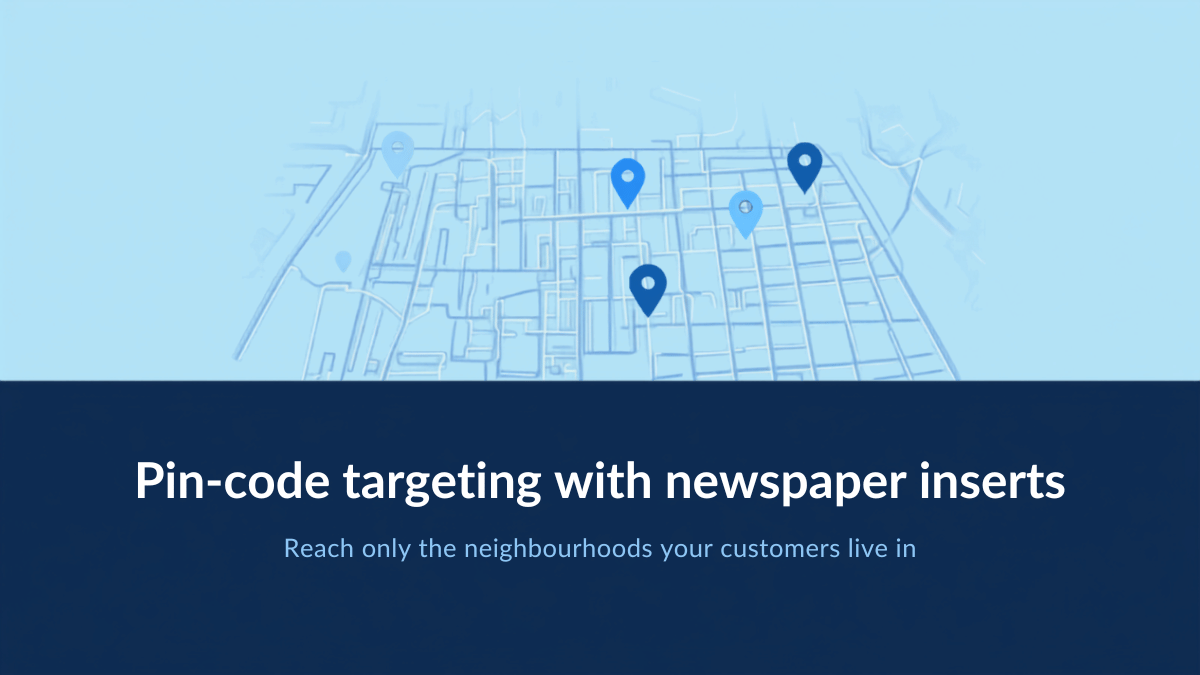
Hyperlocal marketing means advertising only to the neighbourhoods your customers actually live in. In India, newspaper inserts do this through edition and vendor-level distribution: you choose the daily, the city edition and the specific pin codes or localities, and your flyer goes only into those homes at ₹1.20 to ₹2.00 per copy, all-inclusive, 50,000 copies minimum, GST extra.
Key Takeaways
- A newspaper insert is targeted at three levels: the newspaper, its city or district edition, and the distribution depots and vendor beats that serve chosen pin codes. Full-page display ads only get the first two.
- India has roughly 19,000 six-digit PIN codes (India Post). The first digit is the postal zone, the first three digits identify the sorting district, and the last three the delivery post office. Newspapers do not distribute by PIN; they distribute by vendor beat, and a good agency maps one onto the other.
- The practical unit of targeting is the vendor beat or depot, not the individual pin code. In our campaigns a metro pin code is served by anything from one to four newspaper depots, so a single-pin-code campaign is really a small cluster of beats.
- Rates are A2 ₹2.00, A4 ₹1.50 and A5 ₹1.20 per copy, printing, insertion and transport included, GST extra, minimum 50,000 copies. That minimum comfortably covers four to eight metro pin codes with one leading daily.
- Across 500+ campaigns since 2020, the businesses that gain most from pin-code targeting are those whose customers travel under 5 km to buy: real estate projects, schools, clinics, restaurants, gyms, supermarkets and furniture showrooms.
- Digital geo-targeting and pin-code inserts are complements, not rivals. The insert reaches every household in the area; digital follows up with the ones that responded.
Ask any restaurant owner in Koramangala whether they want to advertise to all of Bangalore and the answer is no. Their customers live within a ten-minute drive. The same is true for a school in Dwarka, a diagnostic centre in Kothrud or a builder launching a project off the Hinjewadi road. Hyperlocal marketing is simply the discipline of spending money only where those customers are, and newspaper inserts remain one of the few Indian media that can be bought neighbourhood by neighbourhood.
This article explains how newspaper editions and pin codes fit together, what pin-code targeting honestly means at the vendor level, what it costs, and how to plan a campaign that reaches the right doorsteps and not the wrong ones.
What does hyperlocal marketing mean in India?
Hyperlocal marketing is advertising aimed at a small, defined geography, typically a few neighbourhoods or a radius of two to five kilometres around a business. It matters more in India than in most markets because Indian cities are dense and travel is slow. A family in Andheri rarely crosses to Chembur for a coaching class, and a Gachibowli household will not drive to LB Nagar for a dental clinic. If your advertising covers the whole city, most of the money pays for households that will never visit.
Newspapers are unusually good at this because of how they are physically delivered. According to the Indian Readership Survey (IRS 2019 Q4, published by the Media Research Users Council), around 425 million Indians read newspapers, and the overwhelming majority receive them at home before 7 a.m. That home delivery runs through a chain of city editions, distribution depots and vendors, each responsible for a defined patch. An insert can enter that chain at any level, which is what makes pin-code targeting possible. We set out the whole process on our how it works page; the sections below focus on the geography.
How do newspaper editions actually map to pin codes?
It helps to understand both systems separately, because they were built for different purposes.
The PIN system. India Post introduced the six-digit Postal Index Number in 1972. The first digit marks one of nine postal zones, the first two digits a sub-zone or postal circle, the first three the sorting district, and the last three the specific delivery post office. Mumbai pin codes begin with 400, Delhi with 110, Bangalore with 560, Pune with 411 and Hyderabad with 500. India Post lists roughly 19,000 PIN codes across the country, and each one usually corresponds to a locality small enough to walk across.
Newspaper editions. A large daily is not one product. It is printed as a set of editions, one per large city or district, each with its own local pages and its own print run. Hindi dailies such as Dainik Jagran and Dainik Bhaskar print dozens of editions across northern and central India, close to one for every major district. English dailies such as The Times of India and Hindustan Times print separate metro editions and, within a metro, often a sub-edition for satellite areas: Navi Mumbai and Thane for Mumbai, Gurugram and Noida for Delhi. The Audit Bureau of Circulations certifies circulation figures centre by centre, which is why an agency can tell you how many copies a specific edition actually prints rather than a national total.
Below the edition. Each edition is trucked before dawn to distribution depots (often called agencies or centres), and from each depot the copies are split among vendors, each of whom delivers a fixed round of homes. A single vendor's morning round is typically a few hundred copies; a depot pools many rounds. This is the layer where pin-code targeting happens. When a client asks for pin codes 411045 and 411007, we are really identifying which depots and which vendor rounds serve Baner and Aundh, and placing the insert only into those bundles.
| City | Pin codes begin with | Example localities on our lists | How an insert is narrowed |
|---|---|---|---|
| Mumbai | 400 | Andheri, Bandra, Powai, Borivali | Edition (Mumbai, Thane, Navi Mumbai), then depots by suburb |
| Delhi NCR | 110, 201, 122 | Dwarka, Rohini, Saket, Noida, Gurugram | Edition or supplement (Delhi, Noida, Gurugram), then depots |
| Bangalore | 560 | Koramangala, Whitefield, Jayanagar, Hebbal | Single city edition, depots by zone |
| Pune | 411 | Baner, Kothrud, Kharadi, Hinjewadi | Single city edition, depots by zone |
| Hyderabad | 500 | Gachibowli, Kukatpally, Secunderabad | Edition, then depots (Secunderabad is often a separate cluster) |
Pin code prefixes are the standard India Post allocations; locality lists are drawn from our own campaign coverage in each city.
You can browse the localities we cover in every city on the cities page, and the full lists for Mumbai, Delhi, Bangalore and Pune on their own pages.
Can you really target a single pin code with a newspaper insert?
Honestly: almost, but not exactly, and anyone who promises a perfect pin-code boundary is overselling.
The reason is that vendor rounds were drawn for delivery efficiency, not to match postal boundaries. A round that serves the eastern half of one pin code may also cover a few streets of the next one. In our experience across 30+ cities, a metro pin code is served by between one and four depots of any given daily, and each depot spills slightly beyond the postal line. So when we plan a pin code 560034 campaign, what we actually deliver is every copy of the chosen daily that goes to the vendor rounds serving Koramangala, which will include a small fringe of the adjoining areas.
Three practical consequences follow:
- Think in clusters, not single codes. The minimum order of 50,000 copies exists because printing and depot handling do not become economical below that (we explain the reasons in our guide to the 50,000-copy minimum). With one leading daily, 50,000 copies covers roughly four to eight metro pin codes, or a larger number in a tier-2 city where each locality takes fewer copies. That is the natural size of a hyperlocal campaign.
- Choose the daily by the area, not the other way round. Depot coverage differs by newspaper. A Hindi or Marathi daily may dominate one belt of a city while an English daily dominates the next. We compare how to make that call in our English vs vernacular dailies guide, and it is often the single most important hyperlocal decision.
- Use a fringe, do not fight it. Customers who live three streets outside your target pin code are still customers. The small spill at the edge of a vendor round is cheap reach, not waste.
We provide a depot-wise distribution certificate after every campaign, so you can see which rounds carried the insert. That is also the fairest way to compare inserts with hand-to-hand leafleting, where coverage is much harder to verify; the trade-offs are set out in newspaper insertion vs door-to-door pamphlet distribution.
How much does a pin-code-targeted insert campaign cost?
The same per-copy rate applies whether you cover a whole edition or a handful of depots. What changes is how many copies you buy and where they go.
| Format | Paper | All-inclusive rate | Cost of 50,000 copies (minimum order) |
|---|---|---|---|
| A2 (33 cm x 53 cm) | 45 GSM newsprint | ₹2.00 per copy | ₹1,00,000 |
| A4 (21 cm x 29.7 cm) | 90 GSM glossy art paper | ₹1.50 per copy | ₹75,000 |
| A5 (14.8 cm x 21 cm) | 90 GSM glossy art paper | ₹1.20 per copy | ₹60,000 |
Rates include printing, insertion and transport. GST is extra. City-wise figures are on our pricing page.
So a clinic that wants every reader of one leading daily in five pin codes around it can run a glossy A5 insert for about ₹60,000 plus GST, or a full A2 newsprint sheet for about ₹1 lakh plus GST. Put another way, ₹1,200 to ₹2,000 buys 1,000 households in the exact catchment, with the creative printed in full colour. Because you are not paying for the rest of the city, the cost per useful household is a fraction of a citywide page ad, which prices the entire edition whether or not the readers can reach your shop. Current rates for all 30+ cities are on the pricing page.
Which businesses benefit most from pin-code targeting?
The rule from our own campaign data is simple: the shorter the distance a customer travels to buy, the more pin-code targeting pays off.
- Real estate. The largest insertion category in India, and the most geographic. A project in Kharadi wants families in Kharadi, Viman Nagar and Wagholi, plus the pin codes where its likely upgraders currently rent. Our real estate insert campaign planner walks through catchment mapping in detail.
- Schools and coaching institutes. Parents choose within a bus route. Admission-season inserts do best in the six to ten pin codes the school bus actually covers.
- Clinics, hospitals and diagnostic camps. Health check-up camps and new speciality launches respond well to two to five pin codes around the facility.
- Restaurants, cloud kitchens and supermarkets. Menus and opening offers on A5 art paper in the delivery radius. Weekend editions work best because families plan meals together.
- Gyms, salons, furniture and interiors. High-ticket local services where a household needs to see the name a couple of times before visiting.
Where pin-code targeting helps less: a brand launch that needs the whole city, an e-commerce offer with no physical location, or a product for readers under 25, whom digital reaches more efficiently. Those are honest limits and we say so at the quote stage.
How does pin-code targeting compare with digital geo-targeting?
Digital platforms let you draw a radius on a map or pick postal codes, and they are excellent for follow-up. But they reach only the people who happen to be on the platform, in the right app, at the moment the ad is served, and platform location data is inferred from devices rather than from addresses. A newspaper insert reaches every subscribing household in the vendor rounds you chose, at breakfast, in a form the family can pass around and pin to the fridge. Across our campaigns, direct response from inserts with a clear offer lands between 0.5% and 2% of copies, concentrated in the first 72 hours.
The strongest hyperlocal plans use both: the insert reaches every household in the target pin codes, and a modest digital retargeting budget follows up with the people who scanned or called.
Our guide to tracking newspaper insert response with QR codes shows how to set the codes up so that you can read response pin code by pin code.
How do you plan a pin-code-targeted campaign step by step?
- Draw the catchment first. List where your last 100 customers came from, or the localities inside a realistic travel time. Convert that into pin codes; most businesses land on four to ten.
- Pick the daily for those pin codes. Ask which newspaper the target households actually subscribe to. In many Indian neighbourhoods that is a vernacular daily, not the English paper the marketing team reads.
- Match the format to the distance. A2 newsprint for mass household reach and big offers; glossy A4 or A5 where the product is premium or the message is a menu or a price list. Our A2 vs A4 vs A5 guide covers the trade-off.
- Size the run to the minimum. If the catchment needs fewer than 50,000 copies of one daily, add a second daily in the same pin codes or widen to the next ring of localities rather than dropping below the floor.
- Print one clear call to action per pin code cluster. A QR code, a phone number and a landmark address. Vary the QR code by cluster if you want to compare areas.
- Insert on the right day. Weekends for retail and real estate; weekdays for services where households act on the same day.
- Read the depot report. Check the distribution certificate against the pin codes you asked for, then compare it with where the calls and scans came from. That comparison is what makes the next campaign sharper.
The whole cycle runs in about seven to eight working days from brief to doorstep, because printing and depot logistics are physical.
What are the common mistakes in hyperlocal insert campaigns?
- Buying by newspaper brand, not by area. The biggest daily in the city is not always the biggest daily in your six pin codes.
- Confusing edition targeting with pin-code targeting. Booking a whole Noida edition when you only need Sector 50 to Sector 62 wastes most of the copies.
- Expecting a hard postal boundary. Vendor rounds spill a little. Plan for it and treat the spill as bonus reach.
- One insertion, one time. Hyperlocal works because the same households see you repeatedly. Two or three insertions over a month convert far better than one.
- No way to read response by area. Without a distinct QR code or number per cluster, you cannot learn which pin codes to keep and which to drop next time.
Want a pin-code plan for your catchment?
Send us your localities or pin codes and we will reply within two hours with the right dailies, depot coverage, copy counts and an all-inclusive quote.
Get Free Quote