The Short Answer
Newspaper insertion usually gets better response per rupee, because delivery is verifiable and the flyer arrives inside a paper the household paid for. Door-to-door pamphlet distribution wins only when you need small volumes, non-subscriber neighbourhoods, or street-level targeting tighter than a newspaper edition allows.
Key Takeaways
- Insertions ride an existing paid delivery network with route-level accountability; loose door-to-door leafleting depends entirely on how honestly individual distributors work that day.
- All-inclusive insertion rates are ₹2.00 per copy for A2 newsprint, ₹1.50 for A4 glossy and ₹1.20 for A5 glossy — printing, insertion and transport included, 50,000-copy minimum, GST extra.
- Door-to-door quotes look cheaper because they price distribution only, on top of your printing cost — and the saving evaporates if even a fifth of the bundle never reaches a door.
- Door-to-door still beats insertion below the 50,000-copy minimum, in non-newspaper-reading pockets, and for single-street or single-building targeting.
- Across 500+ insertion campaigns since 2020 in 30+ cities, direct response for offers with a clear call to action typically lands between 0.5% and 2% of copies inserted.
- Do the delivered-cost arithmetic before you compare quotes: at 20% undelivered your true cost per household rises 25%, and at 40% a “cheaper” channel costs more per delivered leaflet than the priciest A2 insertion.
Every local advertiser in India eventually asks this question. You have a printed offer, a defined catchment, and a budget. Do you put the leaflet inside the morning newspaper, or do you hire a team to walk the lanes and drop it at every door?
Both are “flyer distribution”. They are not the same product, and the difference that matters is not the printing — it is who carries your leaflet the last hundred metres, and whether anyone can prove they did.
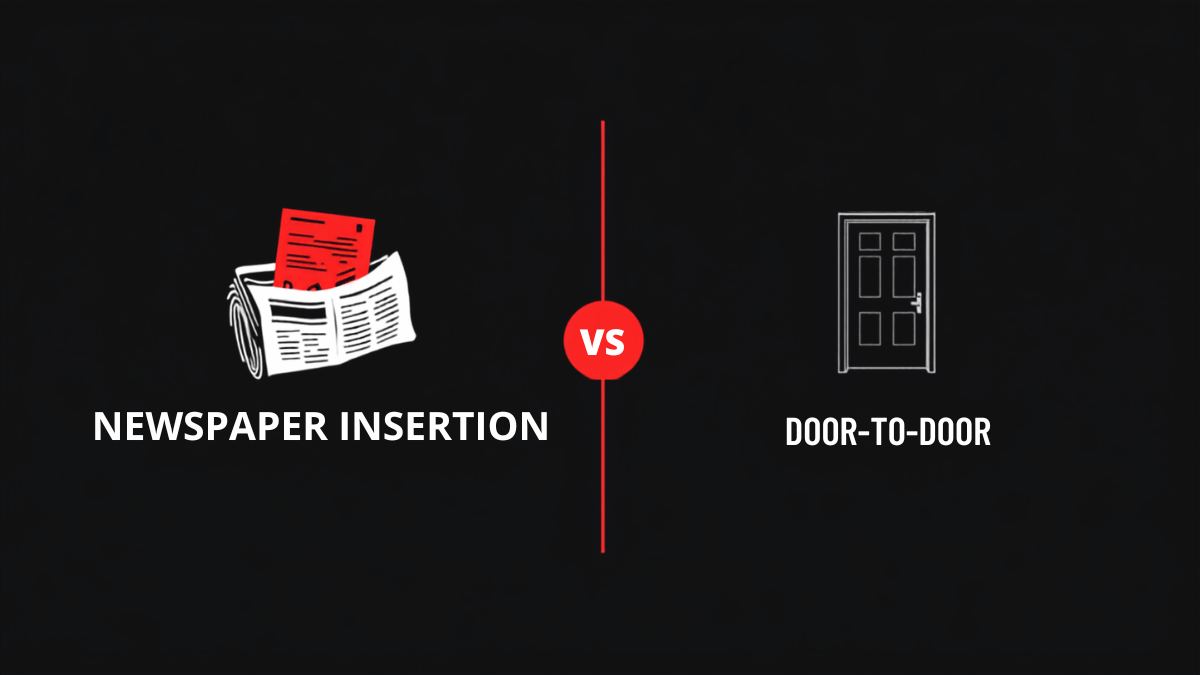
How does newspaper insertion actually differ from door-to-door distribution?
A newspaper insertion places your pre-printed flyer loose inside a newspaper before the morning delivery run. The newspaper’s own vendor network — the same people who deliver the paper to paying subscribers every day of the year — carries it to the doorstep. Our step-by-step process page walks through how a job moves from artwork to delivery.
Door-to-door pamphlet distribution hires a temporary team to walk an area and place your leaflet at doors, on gates, under wipers, or into letterboxes — usually with no relationship to the household at all.
| Factor | Newspaper insertion | Door-to-door distribution |
|---|---|---|
| Carrier | Established newspaper vendor and hawker network | Ad-hoc distribution crew hired for the job |
| Reaches | Households that subscribe to the chosen edition | Any household on the assigned route |
| Targeting unit | Newspaper edition, area, pin code | Street, building, floor |
| Minimum volume | 50,000 copies | A few thousand |
| Delivery proof | Distribution certificate, area-wise report | Supervisor’s word, sample photos |
| Arrival context | Inside a paid newspaper at breakfast | Loose at the door or gate |
| Weather risk | Low — carried with the paper | High — leaflets sit outdoors |
Which one gets a better response rate?
For most household-facing campaigns, insertion. Not because the paper is magic, but because of three structural advantages that decide response before your creative ever gets read.
- Delivery actually happens. The most common failure clients describe to us from their earlier leafleting attempts is not a weak offer — it is pamphlets that were never delivered. When a crew is paid per thousand pieces and supervised loosely, dumping bundles is the easiest way to finish early. You will rarely learn it happened; you will just see a campaign that “didn’t work”. A newspaper vendor, by contrast, runs a subscription route he depends on for his income — he is going to those exact doors tomorrow morning too.
- The household paid to receive it. A newspaper enters the home because the family chose to buy it. Your insert arrives inside that trusted object, at the reading table, at the time of day when people are actually reading. A loose pamphlet arrives uninvited, and often meets the doormat rather than a pair of hands.
- Physical condition. Inserts stay flat and dry inside a folded newspaper. Leaflets left at gates in Indian conditions face rain, dust, wind, and building staff who clear them away before residents see them — which is also why the two channels reward different paper weights and finishes.
Across the 500+ insertion campaigns we have executed since 2020, direct response for offers carrying a clear call to action typically falls between 0.5% and 2% of copies inserted, measured through QR scans, dedicated phone numbers, and coupon redemptions. Anyone quoting you a single universal response rate for door-to-door distribution is guessing — and the reason is telling: the range depends less on the offer than on whether the leaflets reached doors at all.
Is door-to-door pamphlet distribution cheaper?
50,000
copy minimum order for newspaper insertion
all formats, all cities
₹60,000
all-in cost of 50,000 A5 glossy inserts
at ₹1.20/copy incl. printing + insertion + transport, GST extra
0.5–2%
direct response on offers with a clear call to action
500+ campaigns since 2020
On the quote, yes. In effect, often not — because the two numbers are not measuring the same thing. A door-to-door vendor quotes a distribution charge per piece, and you pay your printer separately. An insertion rate is all-inclusive: printing, insertion, and transport in one number.
| Format | Typical use | All-inclusive rate* |
|---|---|---|
| A2 (33cm × 53cm, newsprint) | Mass reach: real estate, retail launches | from ₹2.00 per copy |
| A4 (glossy art paper, 90 GSM) | Premium brands, clinics, automobiles | from ₹1.50 per copy |
| A5 (glossy art paper, 90 GSM) | Coupons, event invites, local services | from ₹1.20 per copy |
*Includes printing, insertion, and transport; GST extra; minimum order 50,000 copies. City-wise numbers are on our pricing page.
Now do the arithmetic that vendors skip. Compare cost per leaflet that reaches a household, not cost per leaflet printed. A campaign of 50,000 A5 inserts at ₹1.20 all-inclusive costs ₹60,000, and the delivered base is the audited circulation you booked against. The same 50,000 leaflets distributed door-to-door might quote lower on paper — but if 20% never reach a door, your true cost per delivered piece rises by 25%, and no report exists to tell you it happened. Current rates for every city are on our pricing page.
A cheaper rate on undelivered paper is not cheaper. Price the channel by what arrives, not by what you printed.
What does undelivered paper actually cost you?
Most advertisers compare the two quotes and stop. The number that decides the campaign is the one neither quote shows you: cost per leaflet that reached a household. Undelivered paper does not just waste its own share of the budget — it inflates the cost of every leaflet that did arrive. Here is that multiplier, worked out on a ₹60,000 spend for 50,000 leaflets:
| Share never delivered | Leaflets that reach a household | True cost per delivered leaflet* |
|---|---|---|
| 0% — booked against audited circulation | 50,000 | ₹1.20 |
| 10% | 45,000 | ₹1.33 |
| 20% | 40,000 | ₹1.50 |
| 30% | 35,000 | ₹1.71 |
| 40% | 30,000 | ₹2.00 |
*Illustrative arithmetic on a ₹60,000 spend — the all-inclusive cost of 50,000 A5 inserts at ₹1.20 per copy. The point is the multiplier, not the rate: apply the same maths to whatever per-piece charge your distributor quotes, then add your printing bill on top of it.
Read the bottom row carefully. At 40% leakage, a channel that quoted well under the insertion rate is costing you ₹2.00 per delivered household — the same as A2 newsprint, the most expensive insertion format on the card, which would have arrived flat, dry, and documented. That is the whole argument in one line, and it does not depend on believing anything about newspapers.
The honest difficulty is that nobody can tell you what your leakage rate is in advance. What you can do is refuse to treat it as zero. If a distributor will not commit to a delivery report you could actually audit, price the campaign at the 20% row and see whether the quote still looks cheap.
Does newspaper insertion have a delivery problem of its own?
It does, and any agency telling you otherwise is selling. Vendors occasionally short-deliver a round. A distribution certificate is paperwork, not a camera — it records what was booked and dispatched, not a photograph of every doormat. Insertion’s advantage is not that leakage is impossible; it is that leakage is smaller, structurally discouraged, and checkable.
The structural part matters most. A newspaper vendor is walking the same route tomorrow morning, and the morning after, for subscribers who pay him monthly and complain when the paper is late. A crew hired for one day’s leafleting has no such tomorrow. The incentives point in opposite directions before anyone has been supervised.
The checkable part is the bit you should actually use. Three things we do on every campaign, and that you can insist on from any vendor:
- Book against audited circulation, not a claimed reach. Ask which edition and which ABC-audited circulation figure your booking is priced on. A reach number with no audit behind it is a marketing claim.
- Demand area-wise reporting, not a city total. A single line saying “50,000 inserted in Pune” is unfalsifiable. Locality-wise or vendor-area-wise breakdowns can be checked against the pin codes you booked — our guide to pin-code targeting explains how editions and vendor rounds map onto areas.
- Buy the paper yourself on insertion morning. Send someone to two or three newsagents in your target localities and buy that day’s edition off the counter. It costs a few hundred rupees and it is the only verification that owes nobody a favour.
None of this is exotic. It is the same discipline you would apply to any media buy, and it is available on the insertion side precisely because the channel runs on an audited, repeat-business network. On the door-to-door side, the equivalent check usually does not exist — which is the asymmetry the arithmetic above is really pricing.
When is door-to-door distribution the better choice?
It genuinely is, in four situations, and it would be dishonest to pretend otherwise:
- Your volume is small. A single restaurant covering four surrounding lanes needs 5,000 leaflets, not 50,000. Insertion minimums make no sense there — and why the 50,000-copy floor exists explains what that minimum is actually paying for.
- Your audience does not buy newspapers. In some newer apartment clusters, hostel-dense pockets, and younger rental neighbourhoods, subscription density is genuinely low. Insertion cannot reach a household that takes no paper.
- You need targeting tighter than an edition. Newspaper distribution is organised by vendor area and pin code — precise down to the vendor round, but not building-by-building. If you want exactly two residential towers, feet on the ground are the honest answer.
- You need something handed over, not dropped. Sampling, coupon booklets, and demo invites sometimes need a person at the door.
How do you decide for your own campaign?
Work through four questions in order.
- What is your minimum viable volume? Under 50,000, door-to-door or a mix. At or above, insertion becomes available and the per-household economics tilt hard in its favour.
- How newspaper-dense is your catchment? Ask for edition-wise circulation in the specific areas you care about. In most established residential localities across our 30+ cities, the answer supports insertion comfortably.
- What does the offer demand? A price-led offer that must simply arrive intact suits insertion. A sampling or demonstration exercise needs a human being.
- Can the channel prove delivery? If the answer is “trust us”, price that risk in. Every insertion campaign we run ships with distribution certificates and area-wise delivery reporting.
For most real estate, education, healthcare, and retail advertisers targeting households in a defined city catchment, that sequence ends at insertion — the same conclusion the readership and cost data reach in our analysis of whether newspaper ads still work in India. If yours is a property campaign, the catchment and volume decisions are set out in how to plan a real estate insert campaign.
Can you use both together?
Yes, and the strongest local plans often do. Insertion carries the bulk of the catchment through the newspaper base; a small door-to-door team fills the specific non-subscriber pockets your circulation data shows you are missing.
A practical split we see work: book the A5 glossy insert across the subscribing localities in a city like Bangalore or Pune, then run a short walking route through the two or three newer apartment clusters with thin subscription density. Same artwork, same offer, same tracking mechanism — with the code split by channel so you can see which one actually produced the calls.
The bottom line
Door-to-door pamphlet distribution and newspaper insertion solve the same problem with different levels of accountability. Insertion buys you a delivery network with a daily reputation to protect, an all-inclusive cost of ₹1.20–₹2.00 per household, and paperwork proving where your copies went. Door-to-door buys you flexibility below 50,000 copies and access to households the newspaper never enters.
Pick insertion when your catchment reads newspapers and your volume clears the minimum. Pick door-to-door when it does not. Use both when your circulation data shows a real gap — and measure both, so the next decision is made with numbers instead of opinions.
Want the delivered-household maths for your area?
Get a free quote — we respond within two hours with newspaper options, edition-wise reach, and format pricing.
Get Free Quote