The Short Answer
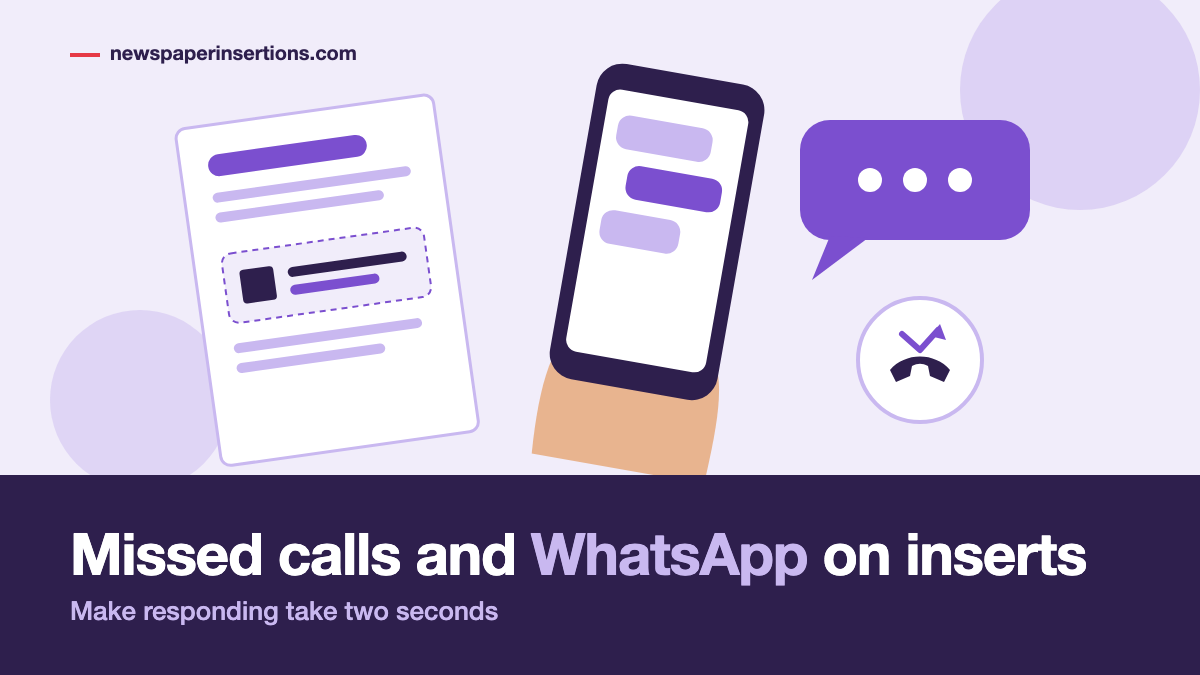
Give the reader two zero-effort ways to respond: a missed-call number that hangs up and calls them back, and a WhatsApp number with a printed keyword or a QR code that opens a pre-filled chat. Use a number only for this campaign, a separate keyword per zone, an instant auto-reply, and a person who calls or chats back within the hour.
Key Takeaways
- A missed call costs the reader nothing and takes two seconds. A WhatsApp message lets them ask a question without speaking to anyone. Both lower the effort of responding, which is what an insert needs on a busy morning.
- Neither mechanism is a result on its own. A missed call is a phone number on a list until someone calls back.
- Print a keyword such as “PIZZA-A” or “ADMISSION-NORTH”, with a separate keyword per zone, so every message tells you where it came from.
- Across 500+ insertion campaigns since 2020, the direct response clients have shared back with us usually falls between 0.5% and 2% of inserted copies. Missed calls and WhatsApp messages sit inside that band. They make responding easier; they do not replace a good offer.
- Follow-up messages are regulated. A WhatsApp reply to someone who messaged you is fine; a bulk SMS campaign to everyone who gave a missed call needs DLT-registered templates under TRAI's rules.
Why add a missed call or WhatsApp to an insert at all?
Because many readers will not make a phone call to a business they have never dealt with. A call means talking to a stranger, possibly being sold to, at 8 in the morning. A missed call or a WhatsApp message removes that friction. The reader acts in two seconds and the business does the work of following up.
That is the reason to offer a low-effort option alongside a normal phone number: it gives a way in to readers who are interested, but not interested enough to call. It matters most in categories where the reader wants information first, such as admissions, property, clinics and home services.
The mechanisms suit different readers:
| Mechanism | What the reader does | Best for |
|---|---|---|
| Missed-call number | Dials; it rings once and disconnects | Readers who want a callback, older audiences, vernacular editions, simple “send me details” offers |
| WhatsApp keyword | Sends a printed word to a number | Readers who want to ask in writing, share with family, or see photos and prices first |
| WhatsApp QR code | Scans a code that opens a pre-filled chat | Smartphone readers who will not type, younger audiences |
Most campaigns should print one phone option and one WhatsApp option, not every possible channel. Our guide to tracking insert response with QR codes covers scans, calls and walk-ins together.
How does a missed-call number work?
A missed-call service gives you a dedicated number. When someone dials it, the call rings briefly and disconnects automatically, so the caller is not charged. The system logs the caller's number and time, and can trigger an SMS or an alert to your team.
Setting one up:
- Take a number used only for this campaign. Several Indian telecom and cloud telephony providers offer missed-call numbers on monthly plans. If you use your existing business number, insert responses blend into your normal calls and cannot be counted.
- Use a separate number per city or zone if you are covering more than one. It is the simplest way to see which area responded.
- Make sure the log can be exported with the date and time, so you can match it against the drop date.
- Decide who calls back, and by when. The missed call is only an expression of interest. The lead is created when your team calls back.
On the insert, print the number large and say exactly what happens: “Give a missed call on 9XXXX XXXXX. We will call you back within 1 hour.” A promise of a callback tells the reader it is safe to dial.
How do you set up WhatsApp so every message can be traced?
The simplest setup uses the free WhatsApp Business app on a dedicated phone and number. For larger volumes, the WhatsApp Business Platform (the API, usually through a provider) adds automation and multiple agents.
For traceability, three things matter:
- A printed keyword. “Send HI to 9XXXX XXXXX” tells you nothing about where the message came from. “Send OFFER-A” tells you the zone. Use a different keyword per zone or drop date.
- A click-to-chat link behind a QR code. WhatsApp's own click-to-chat feature lets a link open a chat with your number with the message already typed. Put that link in a QR code on the insert and the reader only has to press send. The pre-filled text can carry the zone keyword, so tracking survives even if the reader never types.
- Labels and an auto-reply. The Business app lets you set a greeting message and label chats. Label every insert chat by zone, and set a greeting that answers the most common question straight away: the price list, the address, the admission dates.
How big to print a QR code and where to place it is covered in our QR guide. Place the WhatsApp option next to the offer, not hidden at the bottom of the sheet. If you use pin code targeting, as described in our guide to hyperlocal marketing with pin code targeting, match each keyword to the pin codes it was printed for.
How fast do you need to answer?
Within the hour on drop day, and ideally within minutes.
Insert response is concentrated. Most calls, messages and walk-ins come on the drop day and the next one or two days. A reader who gave a missed call at 8:30 and heard nothing by evening has often forgotten, or has already called a competitor whose insert was in the same paper. Our post on what 2% response inserts do differently shows that answering speed is one of the clearest differences between campaigns at the top and bottom of the response band.
A practical drop-day routine:
- One person assigned to the missed-call list and WhatsApp from 7 am, because the paper reaches most homes early in the morning.
- Callbacks worked in the order they arrived, every 30 to 60 minutes.
- A short script that confirms the reader saw the insert, answers the question and books the next step: a visit, a demo, a counselling slot.
- Every response marked in a sheet with zone, outcome and next step.
If you cannot staff that on a Sunday, choose a drop day you can staff. Our guide to the best days for newspaper insertions explains the trade-offs.
How do you count missed calls and WhatsApp chats as leads?
Count each unique number once, then qualify it.
- De-duplicate. One reader may give three missed calls and send a WhatsApp message. That is one response.
- Separate responses from leads. Wrong numbers, job seekers and vendors are not leads.
- Record the outcome of each callback or chat: not reachable, not interested, qualified, booked, bought.
Those counts feed directly into cost per lead and ROI. Our guide to calculating insertion ROI and cost per lead shows the arithmetic. As a reminder of what the inputs cost, our rates are A2 ₹2.00, A4 ₹1.50 and A5 ₹1.20 per copy, including printing, insertion and transport, GST extra, with a minimum of 50,000 copies. A 50,000-copy A5 drop costs ₹60,000 plus GST, so at 0.5% response it produces about 250 responses, and at 2% about 1,000. Current rates are on our pricing page.
Which rules apply to following up?
Responding to someone who contacted you is a normal part of business. Bulk promotion afterwards is regulated. This is general guidance, not legal advice:
- SMS. Under TRAI's Telecom Commercial Communications Customer Preference Regulations, 2018, commercial SMS in India must be sent through registered headers and templates on the DLT platform. If you plan to send a promotional SMS to everyone who gave a missed call, set this up with your provider first.
- Calls. A callback to someone who just gave you a missed call is a response to their request. Repeated promotional calls weeks later to people who did not ask are a different matter, and numbers registered on the national Do Not Disturb preference register should not get unsolicited promotional calls.
- WhatsApp. Meta's WhatsApp Business policy expects businesses to have the person's opt-in before sending messages the person did not start. Replying to a reader who messaged you is fine; adding everyone to a broadcast list later is where opt-in matters.
- Personal data. The Digital Personal Data Protection Act, 2023 expects personal data to be used for the purpose it was collected for. Use the numbers to follow up on the enquiry, not to build a list you sell or share.
Write the follow-up plan down before the drop, so your team knows what they can and cannot send.
What mistakes waste missed-call and WhatsApp responses?
- Printing the main business number. Insert responses vanish into normal traffic.
- One keyword for every zone. You get a total but not a map.
- No callback promise. Readers hesitate to dial a number when they do not know what happens next.
- Nobody watching the phone on drop morning. The response window is short.
- A WhatsApp number on a personal phone shared by the owner and family, where enquiries get lost among other chats.
- Blasting promotional SMS to every missed caller without DLT registration or a reason they would expect it.
What does this look like on a real insert?
A simple layout that works for most categories:
- The offer, large, at the top.
- Directly beneath it: “Missed call: 9XXXX XXXXX. We call back within 1 hour.” and “WhatsApp OFFER-A to 9XXXX XXXXX, or scan the code.”
- The address and a landmark at the bottom, for walk-ins.
Keep the response block in one place, near the offer, and make the numbers large enough to read without glasses. Our guide on how to design a newspaper insert people keep covers the wider layout. For a single offer with a response block, an A5 insert is usually enough; when you need room for a menu, course list or floor plan as well, an A4 insert gives the space.
Where do these observations come from?
From our own work: 500+ insertion campaigns in 30+ Indian cities since 2020, where clients measured response through dedicated numbers, missed calls, QR scans, WhatsApp and coupons and shared it back with us. The 0.5% to 2% band is ours, not an industry survey. For how many households a paper reaches, use the Indian Readership Survey (IRS) from MRUC and ABC certified circulation. EY-FICCI media and entertainment reports track the wider print trend.
Planning an insert with a missed-call or WhatsApp response?
Tell us your city, your zones and your offer. We will suggest the format, the copy count per zone and a drop day your team can answer on.
Request a quote