The Short Answer
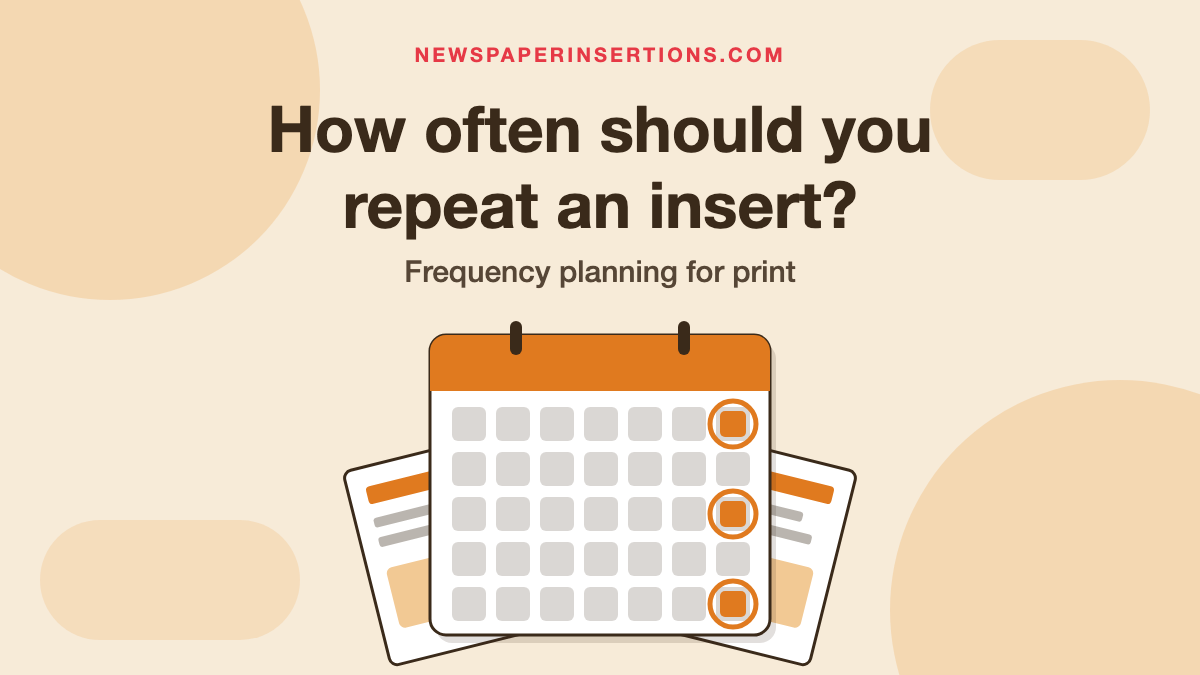
For most local offers, plan two or three drops into the same catchment, spaced two to three weeks apart, or 10 to 14 days apart for fast-moving categories like restaurants. Track every drop separately and keep repeating only while the latest drop's cost per response stays inside your target. Three A5 drops of 50,000 copies cost ₹1.8 lakh plus GST.
Key Takeaways
- One insert informs; repetition converts. Response to a single drop concentrates in the first 72 hours and tails off over about two weeks, so a second drop catches the households that noticed but did not act.
- Match the gap between drops to how long your buyer takes to decide: 10 to 14 days for food and quick retail, two to three weeks for most services, and a calendar-led sequence for admissions and property.
- Repeat the localities that responded, not the whole city. Keep the geography fixed for the first two drops so you can read the result.
- Keep the offer and the look recognisable, refresh the deadline, and change only one thing at a time between drops.
- Give each drop its own phone number, QR code or coupon code. Without per-drop tracking you cannot tell when to stop.
- Frequency has to be budgeted. The 50,000-copy minimum applies to every drop, so halving copies to afford a second one is not an option.
Almost every guide to newspaper inserts, including several of ours, ends with the same line: repeat the drop two or three times. That advice is right, but it skips the decisions that make it work. How many drops does your category need? How far apart? Into the same localities or new ones? And how do you know when the next drop has stopped earning its cost? This guide answers those questions with the numbers we plan against.
Why does one newspaper insertion rarely do the whole job?
Because a single drop only catches the households that happen to be deciding that week. Across the 500+ campaigns we have run since 2020, direct response to one insert concentrates in the first 72 hours and then runs on as a long tail of calls and walk-ins for about two weeks. After that, the sheet has usually been recycled with the paper.
Most purchases do not fit inside that window. A family choosing a coaching institute, a clinic or a new flat discusses it for weeks. A restaurant needs a household to remember it on the evening they order in, which may be ten days later. The second drop works because the first one did part of the job: the household has already seen the name, the offer and the look once, so the second insert is recognised rather than discovered.
There is also a long line of advertising research behind the idea. Herbert Krugman’s 1972 paper in the Journal of Advertising Research, “Why Three Exposures May Be Enough”, argued that a first exposure prompts curiosity, a second prompts evaluation, and a third works as a reminder. It was written about television, and it is a theory rather than a rule, but it matches what we see in print: the second and third inserts tend to convert households the first one only introduced.
How many times should you repeat an insertion?
Two or three drops into the same catchment is the right starting plan for most businesses, which is the same advice we give in our common insertion mistakes guide. The number should come from your category’s buying cycle, not from habit:
| Category | Typical number of drops | Typical gap | Why |
|---|---|---|---|
| Restaurants and cloud kitchens | 2 | 10 to 14 days | Short decision; the second drop converts households that noticed the launch |
| Retail sale or store event | 1 to 2 | Timed to the sale dates | The event sets the window; a reminder drop works just before the last weekend |
| Clinics, hospitals, diagnostics | 2 to 3 | 2 to 3 weeks | Health decisions are deferred until needed; repetition keeps the name ready |
| Schools and coaching | 3 | Set by the admission calendar | Awareness, main and closing drops against a fixed deadline |
| Real estate | 2 to 3 weekend drops for a launch | Weekends across the launch month; ready projects repeat as stock clears | Site visits are planned at the weekend over several weeks |
Planning ranges from our own campaigns, not guarantees. Treat them as the starting plan and let per-drop tracking decide the rest.
These ranges come from our own campaign experience and from the category guides we have already published. Our restaurants and cloud kitchens guide sets out the 10 to 14 day second wave, the schools and coaching guide maps the three-drop admission sequence to the deadline, and the real estate launch vs possession-ready guide covers drops that follow stock.
How long should you wait between drops?
Long enough for the first drop’s response to finish, and short enough that the household still remembers it. In practice that means:
- Not less than about 10 days for most categories. Response to the first drop is still arriving for the first two weeks. If the second drop lands on day three, you are paying to reach households that were about to respond anyway, and you cannot separate the two drops in your tracking.
- Not more than about a month for a single campaign. After four weeks, the first insert has been recycled and largely forgotten, and the second drop is close to starting again.
- Matched to the day your category buys. Repeating on the wrong day is just repetition nobody sees. Our best days for newspaper insertions guide maps the right day by category, and the same day of the week should usually carry every drop in the sequence.
Should you repeat the same area or move to a new one?
Repeat first, extend second. The whole case for frequency is that the same households see you more than once, which is why our pin-code targeting guide treats “one insertion, one time” as a mistake. A practical sequence:
- Drop one covers your full catchment and tells you which localities respond. Split the copies by locality and give each split its own tracking code.
- Drop two goes back into the same geography and the same Audit Bureau of Circulations (ABC) certified edition with the same offer, so the only thing that changed is the date and the copy counts stay comparable. Our print and digital retargeting guide makes the same point: change the area and the creative at once and you cannot say which one moved the number.
- Drop three concentrates on the localities that responded best, and moves the remaining copies into adjacent localities you have not tried.
Beat supply is finite. Each vendor round covers a fixed set of households, as we explain in how newspaper distribution works, so the options for more exposure are always the same three: add adjacent beats, add a second newspaper on another day, or repeat the same beats on a new date.
Should the creative change between drops?
Mostly no. Recognition is the point of a repeat, so keep the headline style, colours, logo and offer consistent enough that the household connects the second insert with the first. What should change:
- The deadline. Every drop needs a fresh, specific end date. A second drop carrying the first drop’s expired date does damage.
- The tracking code. A new QR code, phone extension or coupon code per drop, as set out in our QR code tracking guide.
- One message element, at most. If you want to test, change one thing: the headline, or the offer, or the format. Not all three.
The exception is a planned sequence such as school admissions, where each drop has a different job: awareness, full detail, then urgency. There the content changes on purpose, but the identity stays the same.
How do you know when to stop repeating?
Measure each drop on its own and compare them. Set a target cost per response before you start, based on what a customer is worth to you; our anatomy of a 2% response insert shows how the best-performing inserts are built and measured. Then after each drop:
- Keep going if the latest drop’s cost per response is inside your target, even if it is higher than the first drop’s.
- Move the copies if some localities keep responding and others have gone flat. Drop the flat ones and extend into neighbours.
- Change the offer if every locality has fallen together. That usually means the offer has been seen and judged, and more frequency will not fix it.
- Pause when a drop comes in above target across the board. Come back with a new reason to respond, such as a season, a new service or a new price.
In our experience, the second drop into a responsive catchment is the one most often worth buying, and the one most often skipped.
What does a frequency plan cost?
Every drop is priced the same way: all-inclusive of printing, insertion and transport, GST extra, with a 50,000-copy minimum per drop. Rates are the same in every city we cover:
| Format | 1 drop | 2 drops | 3 drops |
|---|---|---|---|
| <a href="/services/a5-newspaper-insertions">A5, ₹1.20 per copy</a> | ₹60,000 | ₹1,20,000 | ₹1,80,000 |
| <a href="/services/a4-newspaper-insertions">A4, ₹1.50 per copy</a> | ₹75,000 | ₹1,50,000 | ₹2,25,000 |
| <a href="/services/a2-newspaper-insertions">A2, ₹2.00 per copy</a> | ₹1,00,000 | ₹2,00,000 | ₹3,00,000 |
All figures at 50,000 copies per drop; printing, insertion and transport included; GST extra.
Two budgeting points follow. First, frequency has to be planned, not hoped for: as our micro-budget guide puts it, the honest answer to wanting repetition is to plan a second budget rather than halve the first, because the 50,000-copy minimum applies to every drop. Second, a smaller format can buy frequency. Three A5 drops cost less than two A2 drops, and for an offer that fits on an A5 sheet, the extra drop usually does more than the bigger sheet. Brands that run monthly or quarterly campaigns can also ask about recurring-campaign pricing on our pricing page.
What are the most common frequency mistakes?
- One big drop instead of two smaller ones. A single large insertion spread across a city is usually beaten by repeated presence in a tighter catchment.
- Judging the channel on drop one. The first drop is the one that buys you information about which localities and which offer to repeat.
- Drops too close together. Overlapping response windows make both drops harder to measure.
- Same code on every drop. If the drops share a phone number or QR code, you cannot see which one is earning its cost.
- Same-day duplication. Two newspapers in one locality on one morning is not frequency.
- Planning the second drop after the first one runs. Book the sequence together. Our 7-day campaign timeline suggests planning the next drop while the first is at the press.
Want a drop plan for your category?
Tell us your city, catchment and what you sell. We respond within two hours with a suggested number of drops, the dates we would take and exact pricing.
Get Free Quote