The Short Answer
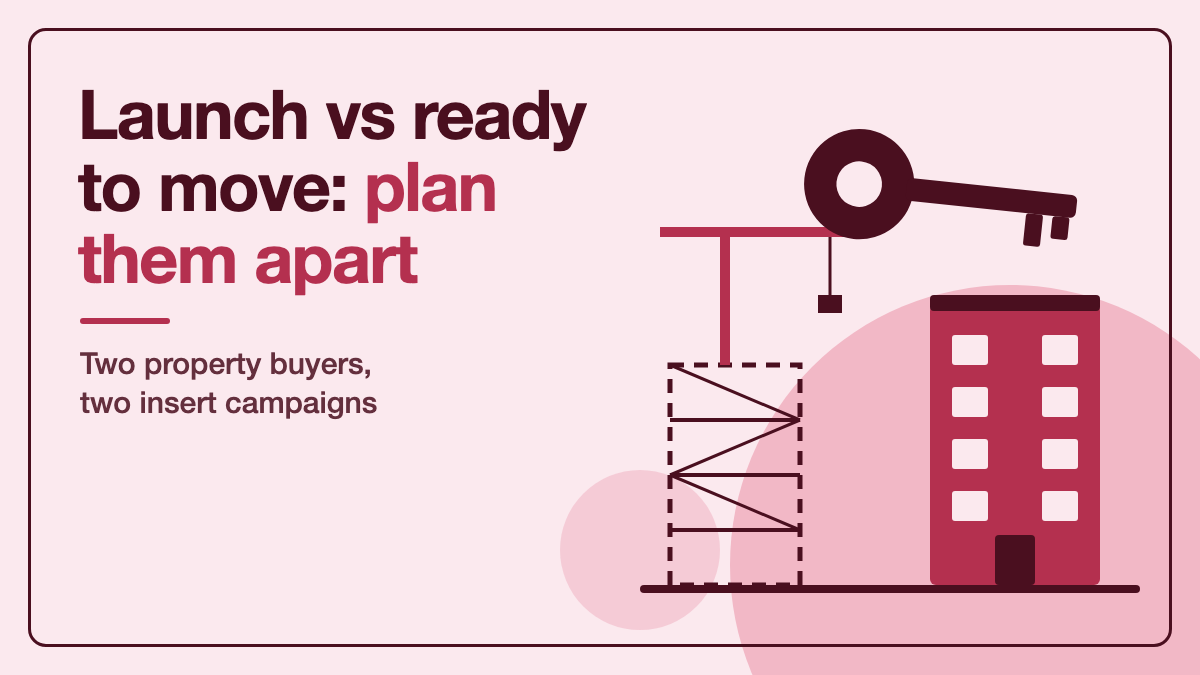
A launch insert sells a future: location, master plan, payment plan and an early price, so it needs A2 space, a wider catchment and two or three drops. A possession-ready insert sells a move-in date: finished photos, no GST on completed flats and a site visit this weekend, so it works best tightly around the site.
Key Takeaways
- Launch and possession-ready projects attract different buyers. Launch buyers are planning years ahead and compare payment plans; ready-to-move buyers are usually paying rent today and want a date they can hand in notice.
- A launch usually justifies A2 newsprint at ₹2.00 per copy for the master plan, floor plans and price table. A possession-ready push often does better on A4 glossy at ₹1.50 per copy, because real photographs of a finished flat are the argument. Minimum order is 50,000 copies, GST extra.
- The catchment changes too. Launch campaigns cast wider across upgrade localities; possession-ready campaigns concentrate on the nearest rental pockets and established colonies within a short drive.
- Two compliance facts shape the copy. RERA requires the registration number on every advertisement, and GST applies to under-construction flats but not to flats sold after the completion certificate is issued.
- Measure them differently. A launch is judged on qualified enquiries and expressions of interest over weeks; a ready-to-move push is judged on site visits and bookings within days of the drop.
Most developers run both kinds of campaign, sometimes for the same project: phase one is handing over keys while phase two is being launched next door. It is tempting to reuse the same insert with a new headline. That is usually where the money leaks, because the two campaigns answer different questions for different households.
This post sets out how the plan differs, decision by decision. If you want the general planning sequence for any property campaign first (catchment, volume, format, timing, tracking), start with our guide to planning a real estate insert campaign that fills site visits, then come back here for the launch versus ready-to-move split.
Who is the buyer at launch, and who buys a ready flat?
At launch, the buyer is buying a promise. Across the property campaigns we have run for builders since 2020, launch enquiries skew towards three groups: end users upgrading on a long horizon, investors comparing early pricing, and families who want a lower entry price in exchange for waiting. None of them needs the flat this year. They are comparing projects, payment plans and developer track records, and they will visit two or three sites before deciding.
A possession-ready buyer is solving a present problem. The most common profile we see is a household paying rent in the same part of the city, often with a home loan pre-approved, who wants to stop paying rent and EMI at the same time. Close behind are families relocating for work and buyers who have been burned by a delayed project before and now only want what they can walk into. They visit fewer sites and decide faster.
That difference drives everything else in the plan. A launch insert has to earn a place on a shortlist that will be discussed for weeks. A possession-ready insert has to trigger a visit this weekend.
What should a launch insert say, and what should a ready-to-move insert say?
A launch insert has four jobs:
- Explain the location story. Upcoming metro stations, road links and employment hubs, stated factually and only where they are approved or under construction.
- Show the plan. Master plan, configurations, carpet areas and a floor plan the family can read at the breakfast table.
- State the entry price and the payment plan. Launch buyers compare schedules: construction-linked, down-payment discounts, and what is due at booking.
- Give a reason to act now. A launch price or a limited first-phase allocation, with a real deadline.
A possession-ready insert needs almost none of that. It needs:
- Proof the flat exists. Photographs of the actual finished building and a finished sample flat, not renders.
- The move-in line. “Ready to move in” or “keys in 30 days” if it is true, and the occupancy status stated plainly.
- The money argument. No rent and EMI overlap, and no GST on a completed flat (see the compliance section below).
- One weekend invitation. Site open Saturday and Sunday with hours, a pickup point if the site is off the main road, and a dedicated number.
The common failure is a ready-to-move insert that still reads like a brochure: amenity icons, a skyline render and “possession soon”. A buyer looking for a finished home cannot tell it apart from the twelve launches in the same newspaper.
Which format suits each campaign?
Format follows how much the buyer has to read before visiting.
| Launch / under-construction | Possession-ready / ready-to-move | |
|---|---|---|
| Buyer question | “Is this worth waiting for?” | “Can we move in, and when?” |
| Best format | A2 newsprint, from ₹2.00 per copy | A4 glossy, from ₹1.50 per copy; A5 for open-house reminders, from ₹1.20 |
| Lead visual | Master plan, location map, floor plans | Real photographs of the finished building and flat |
| Headline | Location + entry price + payment plan | Ready to move + price + this weekend’s site visit |
| Typical volume per drop | 100,000 to 200,000 copies | 50,000 to 100,000 copies |
| Drop pattern | 2 to 3 weekend drops over the launch month | 1 to 2 weekend drops, repeated as stock clears |
| Main metric | Qualified enquiries and expressions of interest | Site visits and bookings |
Rates include printing, insertion and transport. GST extra. Minimum order 50,000 copies. City-wise rates are on our pricing page.
A2 earns its place at launch because a master plan and a floor plan need space to be legible, and our A2 newspaper insertions page covers sizing and stock. For a ready-to-move project the argument is visual: a glossy A4 insert makes a real photograph of a finished kitchen or balcony look like what it is. Newsprint flattens photographs, which is fine for a render and a poor choice for proof.
As a worked example on those rates: a launch running two drops of 150,000 A2 copies costs about ₹6,00,000 plus GST. A ready-to-move push running two drops of 60,000 A4 copies costs about ₹1,80,000 plus GST. The ready-to-move campaign is smaller because its catchment is smaller, not because it matters less. Current city-wise rates are on our pricing page.
Should the catchment change between launch and possession?
Yes, and this is the decision most often copied across by mistake.
A launch catchment is wide. Buyers of an under-construction project are often upgrading from established colonies several kilometres away, and investors can come from anywhere in the city. We usually build a launch catchment from the developer’s previous enquiry data, commute routes to employment hubs, and localities whose property values sit just below the project’s ticket size.
A possession-ready catchment is tight. The best-responding areas for ready-to-move stock, in what we observe, are the rental pockets and older housing within a short drive of the site: people who already know the neighbourhood, already use its schools and markets, and are paying rent nearby. Inserting the same wide launch catchment for closing stock spends most of the budget on households who were never going to move across the city for a finished flat.
Edition choice follows the catchment. A vernacular daily that dominates the nearby belt often beats a larger English paper for ready-to-move stock. Our pin-code targeting guide explains how editions and vendor rounds map onto localities, and the cities page lists coverage by market.
What do RERA and GST change in the copy?
Two rules apply differently across the two campaigns, and both belong on the page.
RERA. Under Section 3 of the Real Estate (Regulation and Development) Act, 2016, a promoter cannot advertise, market or book units in a registrable project before registering it with the state RERA authority. Section 11(2) requires every advertisement to carry the project’s RERA registration number and the authority’s website address. For a launch, that means no “pre-launch” insert goes to print until registration is in hand, and the number goes on the sheet in legible type, not in a footer close to the trim line. Check for it at artwork approval, before the file goes to press.
GST. Since April 2019, under-construction residential flats attract GST at 5% (1% for affordable housing), without input tax credit. A flat sold after the completion certificate has been issued attracts no GST. For a ready-to-move project with its certificate in hand, “no GST” is a true and meaningful line of copy, and it is one launches cannot use. Confirm the certificate status with the developer’s legal team before printing it.
When should each campaign land?
Both campaigns work best on weekends, when families read together and a site visit can be planned into the day. Our analysis of the best days for newspaper insertions covers the pattern across categories. The calendar around the weekend differs.
A launch is anchored to its registration date and, where it fits, to the traditional property-buying windows of Navratri, Dussehra, Diwali and Akshaya Tritiya. Those windows fill up in the major editions, so book early, as our festival season planning guide sets out.
A possession-ready push is anchored to the buyer’s life, not to the developer’s calendar. Rental agreements commonly run on 11-month cycles, and families with school-age children often prefer to move before the new academic session. A ready-to-move insert in the months before a session starts meets that decision at the right time. Allow 7 to 8 working days from approved artwork to doorstep for either campaign.
How should you measure a launch against a possession-ready push?
Do not judge them by the same number.
Across the 500+ insertion campaigns we have executed in 30+ Indian cities since 2020, direct response to inserts with a clear call to action typically falls between 0.5% and 2% of copies. Property sits in the lower part of that band, because a flat is the largest purchase most households make.
- For a launch, count qualified enquiries and expressions of interest, and expect them to arrive over two to four weeks as families discuss the insert and compare projects. Cost per qualified enquiry is the useful figure, and a second drop into the same catchment usually lifts it.
- For a possession-ready push, count site visits on the drop weekend and bookings in the following fortnight. The cycle is short because the buyer’s problem is immediate. If a ready-to-move drop produces calls but no visits, the insert has usually failed to prove the flat is finished, which is a creative fix, not a volume fix.
Either way, give each campaign its own phone number and a QR code with its own source tag, as our guide to tracking insert response with QR codes describes, and keep the distribution certificate and area-wise delivery report we supply so a weak area can be told apart from a weak message.
What if one project has both a ready phase and a new launch?
Run two inserts, not one. A single sheet trying to say “ready to move” and “new launch” at once confuses both audiences and lets the launch’s renders undermine the ready phase’s proof.
The pattern we recommend: one A4 glossy ready-to-move insert into the tight local catchment, and one A2 launch insert into the wider upgrade catchment, on the same or consecutive weekends, each with its own number and QR tag. The ready phase does something no render can: it lets a launch buyer walk through a finished building by the same developer. Put that on the launch insert as one line (“see our completed phase one on site”) rather than merging the two sheets.
A launch insert sells a future and a ready-to-move insert sells a date. Plan them as two campaigns, even when they share a site.
Launching a project or clearing ready stock?
Get a free quote. We respond within two hours with newspaper options, area-wise reach estimates and pricing for your city and format.
Get Free Quote