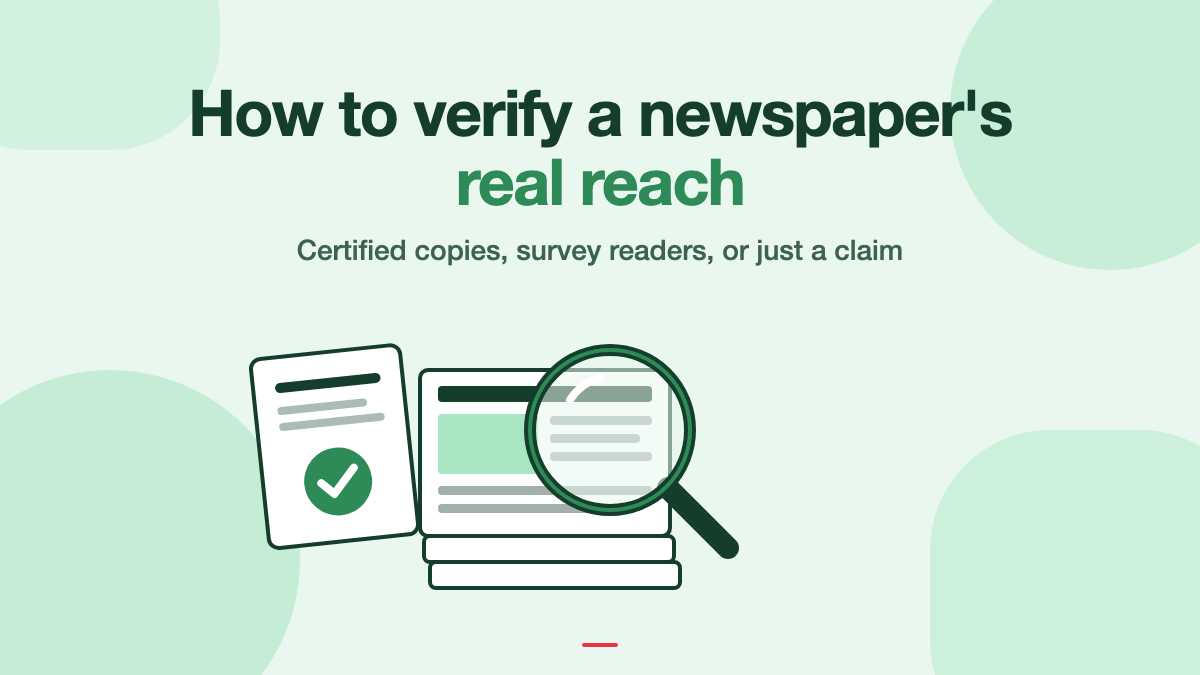
The Short Answer
Ask which number you were given. ABC certified circulation counts audited copies sold, every six months, and can be broken down by district and town. IRS readership estimates people reading, and its latest edition is from 2019. Anything else is a claim. For an insert campaign, verify copies in your own localities, not a city-wide reach figure.
Key Takeaways
- There are three kinds of reach number in Indian print: ABC certified circulation (copies), IRS readership (people), and publisher or supplier claims (anything else). A figure that does not say which one it is should be treated as a claim.
- ABC, a not-for-profit body set up in 1948, certifies the circulation of its member publications for six-month audit periods, January to June and July to December. Free copies do not count as qualifying sales.
- The Indian Readership Survey (IRS) from the Media Research Users Council (MRUC) last published data for 2019 Q4. As of September 2026, MRUC has released no newer survey, so any “current readership” figure needs a source and a year.
- ABC also certifies an Area Breakdown Statement showing distribution by state, district and town. That is the right document for checking a paper’s strength in your part of the city.
- Insert buyers pay per copy inserted (A2 ₹2.00, A4 ₹1.50, A5 ₹1.20 all-inclusive, GST extra, 50,000-copy minimum), so the number to verify is copies in your chosen localities, and the proof is the delivery report afterwards.
Why do reach numbers for the same paper disagree?
Because they measure different things. A media kit might say “10 lakh readers”, an agency might quote “3 lakh copies”, and the ABC certificate might show a lower figure again. All three can be honest and still describe different quantities.
- Circulation counts copies. ABC’s version is audited and excludes copies that do not meet its qualifying criteria.
- Readership counts people. Several people usually read one household copy, so readership is usually well above circulation.
- Print order counts copies printed, which includes copies that come back unsold and copies given away.
- Reach claims can combine any of these, sometimes adding e-paper or website audiences on top.
| ABC circulation | IRS readership | Supplier or publisher claim | |
|---|---|---|---|
| Counts | Copies sold (qualifying sales) | People reading | Varies: copies, readers, print order, digital |
| Measured by | Audit of the publisher’s records | Household survey by MRUC | The party quoting it |
| How recent | Six-month audit periods | Latest is 2019 Q4 | Often undated |
| Smallest area | Town and district (Area Breakdown Statement) | Region and town class | Whatever is quoted |
| Best used for | Checking a paper’s strength in your area | Which language and title your audience reads | A starting point for questions |
Our guide to whether newspaper ads still work in India sets out why readership is the right number for sizing the opportunity and the wrong one for sizing a campaign. This post is the practical follow-up: how to check the number you were actually quoted.
What does an ABC circulation figure actually certify?
The Audit Bureau of Circulations certifies circulation for member publications over six-month audit periods. Empanelled auditors examine the publisher’s printing, distribution, financial and production records. The headline figure is the average qualifying sales per publishing day for that period.
A few details from ABC’s own audit guide matter to an advertiser:
- Qualifying sales exclude free copies. Voucher, exchange and complimentary copies are not counted as qualifying sales.
- Bulk institutional sales are capped. Copies sold in bulk to organisations count as qualifying sales only up to 20% of the total.
- The certificate has two parts. Part A carries qualifying sales. Part B shows non-qualifying copies, and ABC’s rules say Part B figures are for information and must not be added to certified figures in publicity.
- Regional claims must use regional figures. If a publisher claims strength in a town, district or state, ABC requires the claim to use the certified figure for that area from the Area Breakdown Statement, not the paper’s total circulation.
Two limits to keep in mind. ABC audits members only, so a paper that is not a member simply has no ABC figure; that is not proof of a bad paper, but it does mean its numbers are unaudited. And ABC’s smallest unit is the town. It does not tell you how many copies reach a particular colony or pin code.
What does IRS readership tell you, and how old is it?
The Indian Readership Survey is a large household survey run by MRUC. It estimates how many people read each publication and describes who they are: age, income, town class, language. IRS 2019 Q4 recorded about 425 million newspaper readers in India.
That remains the latest industry-wide readership data. The survey was suspended in 2020, and although MRUC approved a restart in principle in 2024, its website lists no release after 2019 as of September 2026. So:
- IRS is useful for who reads what: which language, which title, which age group in a region.
- IRS is not useful as a current copy count, and it was never designed to be one.
If a supplier quotes a 2026 readership figure, ask where it came from. If the answer is IRS, it is a 2019 number. If it is the publisher’s own study, treat it as a claim until you have seen the method. Our comparison of Times of India, Hindustan Times and regional dailies shows how IRS data is best used: to compare titles, not to count copies.
Which reach claims should make you cautious?
In our experience, these are the patterns worth questioning:
- A readership figure presented as a copy count. “10 lakh readers” does not mean 10 lakh copies.
- An all-edition total quoted for one city. A multi-edition paper’s national circulation says nothing about your edition.
- No audit period. A certified figure always belongs to a period. A figure with no period attached cannot be checked.
- Print, e-paper and web added together. An insert only travels with printed copies.
- “Number one” with no area and period. ABC’s own rules require claims like this to name the area and use certified figures for it.
None of these means the paper is weak. They mean the number cannot yet be relied on for planning.
How do you check a number you have been quoted?
Work through five steps before you book.
- Ask what kind of number it is. Circulation, readership, print order or a claim. Then ask for the source and the period.
- Check the ABC certificate. Confirm the title is an ABC member, the audit period is one of the most recent two, and you are reading Part A qualifying sales for the right edition. Published figures and member information are on the ABC website.
- Narrow it to your area. Ask the publisher or your agency for the edition’s Area Breakdown Statement and read the town and district rows that match your catchment.
- Use IRS only for audience fit. Check which language and title your target households read, remembering the data is from 2019.
- For inserts, ask for copies by locality. City-level certified circulation is a sanity check. What you are actually buying is a number of copies in specific vendor rounds, which is the level our pin-code targeting guide and how newspaper distribution works in Indian cities explain.
Why is verification different for inserts than for display ads?
Because you pay for different things. A display ad is sold on the whole edition’s circulation, so an inflated reach figure inflates the price. An insert is sold per copy inserted, so the price is tied to a physical count.
That protects you from paying for readers who do not exist, but it moves the question. The risk for an insert buyer is not a wrong readership number; it is copies placed in the wrong localities, or fewer copies delivered than booked. That is why we plan inserts at the level of vendor rounds and localities, and why every campaign we run comes with a distribution certificate and an area-wise delivery report.
What should you ask a supplier before booking?
- Which edition, and what is its latest ABC certified circulation (Part A), for which audit period?
- What does the Area Breakdown Statement show for the towns or districts I care about?
- How many copies will go to each locality or pin code in my plan?
- What proof of delivery will I receive after the drop, and at what level of detail?
A good supplier answers all four without hesitation. Our guide to negotiating insertion rates covers the commercial side of the same conversation, and how it works describes our own booking process.
Readership sizes the opportunity, certified circulation checks the paper, and locality copy counts are what you actually buy.
Want copy counts, not a reach claim?
Get a free quote. We respond within two hours with newspaper options, area-wise copy numbers and pricing for your city and format.
Get Free Quote