The Short Answer
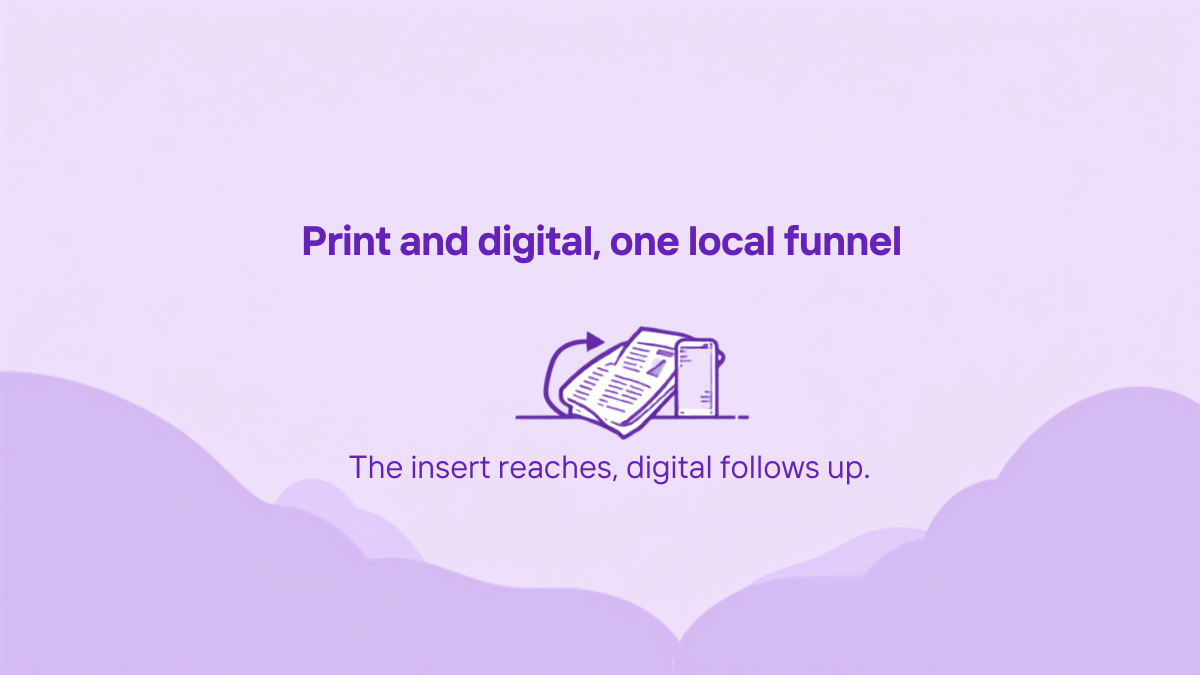
Run the newspaper insert first, then let digital catch the people it moved. The insert creates a demand spike across a defined set of pin codes, and search, WhatsApp and retargeting ads convert the share of that audience who did not act on day one. Print buys the reach, digital buys the follow-up.
Key Takeaways
- Print and digital are not rival budgets. The insert creates the demand, digital harvests the part of it that does not convert on the morning it lands.
- Sequence matters: the drop day is day zero, and your digital layer should already be live before the papers go out.
- A 50,000-copy A5 drop costs about ₹60,000 plus GST, which makes the print half of a full funnel campaign easy to budget against a fixed digital spend.
- Match the digital targeting to the drop geography. Retargeting the whole city undoes the pin-code precision you paid for in print.
- The honest measurement question is not which channel got the credit, but whether the dropped areas beat the areas you held back.
Most local advertisers run print and digital as separate budgets, defended by separate people, judged against separate reports. That framing is the problem. The two media fail in opposite ways, which is exactly why they belong in one plan rather than two.
This guide sets out the order to run them in, how to split the budget, how to stop the digital half leaking outside your drop area, and how to measure the whole thing without pretending attribution is solved.
What does a full funnel local campaign actually mean?
A full funnel local campaign is one where a single offer is carried by more than one medium, in a deliberate order, across the same geography. In an Indian city that usually means a newspaper insert doing the reach, and digital doing the recall and the conversion.
The reason the combination works is that the two halves fail in opposite ways. Print reaches households that never see your ads, including the members of the household who do not scroll, but it gives you one shot on one morning and no way to speak again to someone who was interested and busy. Digital can speak again endlessly, but only to people it can already identify, which means people who searched, clicked or visited. Bolted together in the right order, each one covers the other's gap.
The Indian Readership Survey 2019, published by the Media Research Users Council and still the last full industry-wide readership study, recorded roughly 425 million newspaper readers in India. Successive EY-FICCI media and entertainment reports show print holding a far larger share of ad spend in India than in almost any comparable market. That is the reach half. The follow-up half is whatever platforms your customers already use.
Why should the newspaper insert come first?
Because the insert is the only part of the plan that reaches people who have given you no signal at all.
Digital retargeting needs a seed audience. Before anyone has visited your site, scanned your code or messaged your number, there is nothing to retarget. Most local businesses solve this by paying for cold prospecting where the targeting is loose and the local inventory is thin. The insert solves it differently: on one morning it enters every subscribing household in the pin codes you chose, and it produces a burst of branded searches, direct visits and scans that digital can then work with.
- Day minus 7. Landing page live, WhatsApp number staffed, tracking in place, retargeting pixel firing. The digital layer must exist before the paper lands, not after.
- Day minus 2 to day zero. Turn on a small branded search campaign covering your own name and the offer. This is cheap, and it catches the people who read the insert and then typed the name instead of scanning.
- Day zero. The drop. Choose the day deliberately, since the day of the week changes how long the paper stays in the house.
- Day 1 to day 14. Retarget everyone the drop produced: page visitors, scanners, message starters, form abandoners. This window is where most of the second-order conversions come from.
- Day 15 onwards. Decide whether to re-drop the same beats or extend to new ones, using what the first wave told you.
Day selection is not a detail, and we set out the reasoning in our post on the best days for newspaper insertions. Reversing the whole sequence is the common mistake: running digital first and print later means paying to build an audience the insert would have handed you.
How much should you budget for each half?
Start from the print side, because it has a floor and digital does not.
| Format | Typical full funnel use | All-inclusive rate* |
|---|---|---|
| A5 (glossy art paper, 90 GSM) | Offer-led drops, coupons, service businesses | from ₹1.20 per copy |
| A4 (glossy art paper, 90 GSM) | Premium brands, clinics, showrooms | from ₹1.50 per copy |
| A2 (newsprint) | Launches and large offers needing maximum canvas | from ₹2.00 per copy |
*Includes printing, insertion and transport. GST extra. Minimum order 50,000 copies. City-wise rates are on our pricing page.
A 50,000-copy A5 drop costs about ₹60,000 plus GST, or ₹1,200 per 1,000 households. That is your fixed, known number. The digital half is then sized to cover the same households for the two weeks after the drop, which is a much smaller number than a permanent always-on budget because you are only funding a short, dense window. Current rates for every city are on our pricing page.
- Do not fund the digital layer by shrinking the drop below 50,000 copies. Below the floor the per-copy rate rises, so you lose reach faster than you gain follow-up.
- Keep the retargeting window short and well funded rather than long and thin. Interest generated by a piece of paper decays, so the same money spent across fourteen days beats spreading it across ninety.
The reasoning behind the copy floor is in our post on the newspaper insertion minimum order.
How do you keep digital targeting inside the drop area?
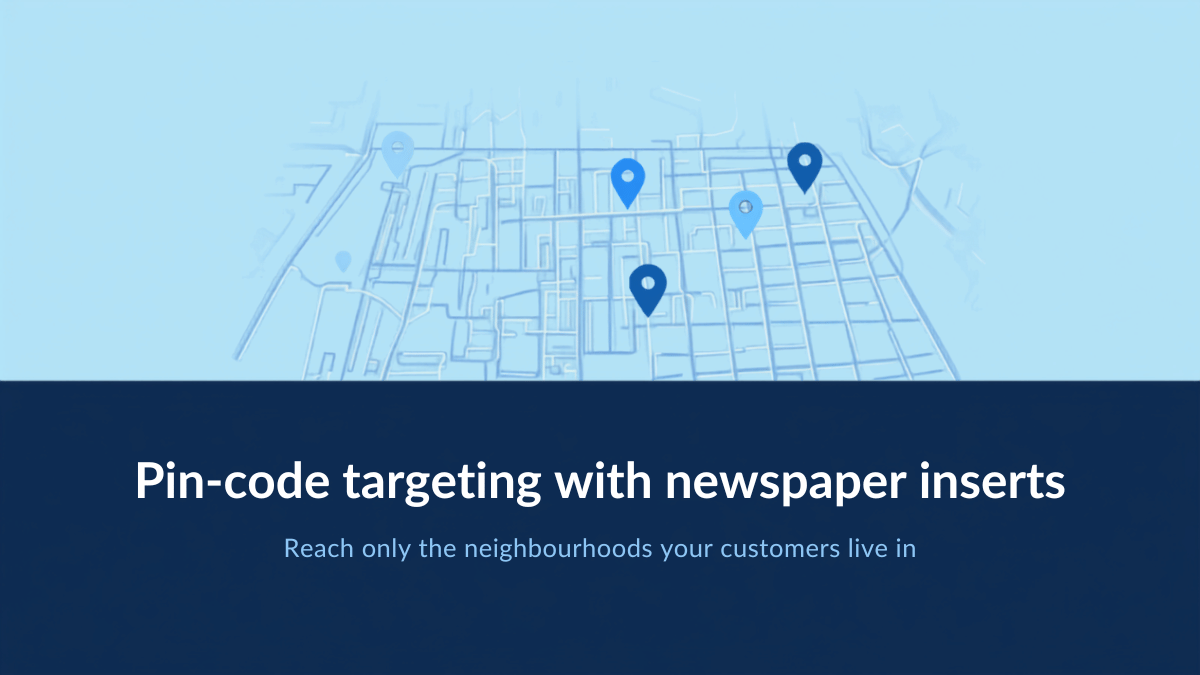
This is where most full funnel plans quietly leak money. You buy print by vendor beat and pin code, then hand the digital half a city-wide radius and pay to reach households the insert never touched. Newspapers in Indian cities distribute through vendor networks organised by locality, so insertions can be specified by pin code and by beat rather than by whole edition. The mechanics are set out in our post on hyperlocal pin-code targeting, and your digital layer should inherit exactly that geography.
- Restrict location targeting on paid campaigns to the same pin codes, not the city.
- Build retargeting audiences only from traffic that arrived through the print-specific landing page or code, so you are not re-serving ads to unrelated visitors.
- If you run a second drop, keep the same geography for the first two waves. Changing both the area and the creative at once leaves you unable to say which change moved the number.
- Where the platform allows a radius rather than a pin code list, set it from the actual drop cluster, not from your office address.
What should the insert ask people to do?
One thing, and something a phone can do in five seconds from the dining table.
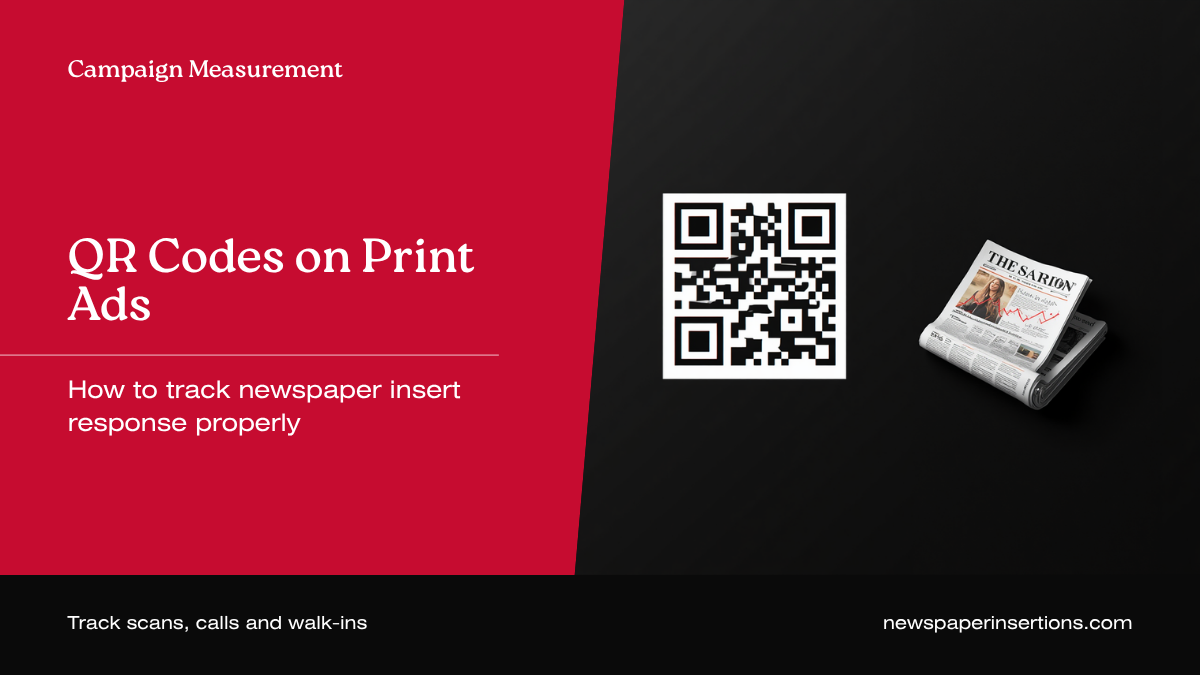
- A QR code that opens a page or chat you control, with a tracking parameter so scans are attributable and retargetable.
- A WhatsApp number that a human answers. For most local categories this converts better than asking people to install anything.
- A short branded search prompt, which quietly feeds the branded campaign you turned on before the drop.
- A print-only offer code with an expiry, so redemption tells you the drop worked even for people who never touched a digital surface.
Resist putting four calls to action on one sheet. A leaflet carrying a QR code, a phone number, a website, a map and three social handles converts worse than one with a single clear next step, because the reader has to make a decision before acting. Our guide to designing inserts people keep covers what survives the first ten seconds.
How do you measure a campaign that runs on two channels?
Attribution across print and digital is genuinely hard, and most of the confident-sounding answers are wrong. Four things hold up.
Measure the campaign, not the channel. The useful question is whether the pin codes you dropped into performed better than comparable pin codes you did not. Hold back one or two similar localities from the drop, run the same digital layer everywhere, and compare. That comparison survives scrutiny in a way a last-click report never does.
Instrument the print side properly. Unique codes per drop zone, a QR destination you control, and a phone number that appears only on print. The full method, including the mistakes that make QR tracking useless, is in our guide to tracking insert response with QR codes.
Watch branded search volume around the drop date. A clean, sharp rise in people searching your name in the days after a drop is one of the most honest signals you will get, and it costs nothing to observe.
What goes wrong with full funnel local campaigns?
- Digital goes live after the drop. The spike arrives, there is nothing to catch it, and the budget then chases an audience that has cooled.
- City-wide retargeting on a pin-code drop. You pay twice for reach you already bought, and once for reach you did not.
- The insert points at a platform listing instead of a page you own, so there is no pixel, no audience and no second conversation.
- A different offer in print and on the landing page. The reader arrives, does not recognise the deal, and leaves.
- Judging the campaign in 48 hours, when the retargeting window is where the second half of the response lives.
- No holdout, which turns every post-campaign discussion into an argument about which channel deserves credit.
The bottom line
Print and digital stop competing the moment you give them different jobs. The newspaper insert buys physical reach into households you cannot otherwise identify, at about ₹1.20 to ₹2.00 per household all-inclusive. Digital then does the one thing paper cannot, which is speak a second and third time to the people the paper moved. Run them in that order, over the same pin codes, in a tight window, and measure with a holdout rather than an attribution argument. The end-to-end print process is set out in how it works.
Planning the print half around digital you already run?
Send us your pin codes and we will come back with newspapers, vendor beats, and copy counts for that exact footprint.
Get Free Quote