The Short Answer
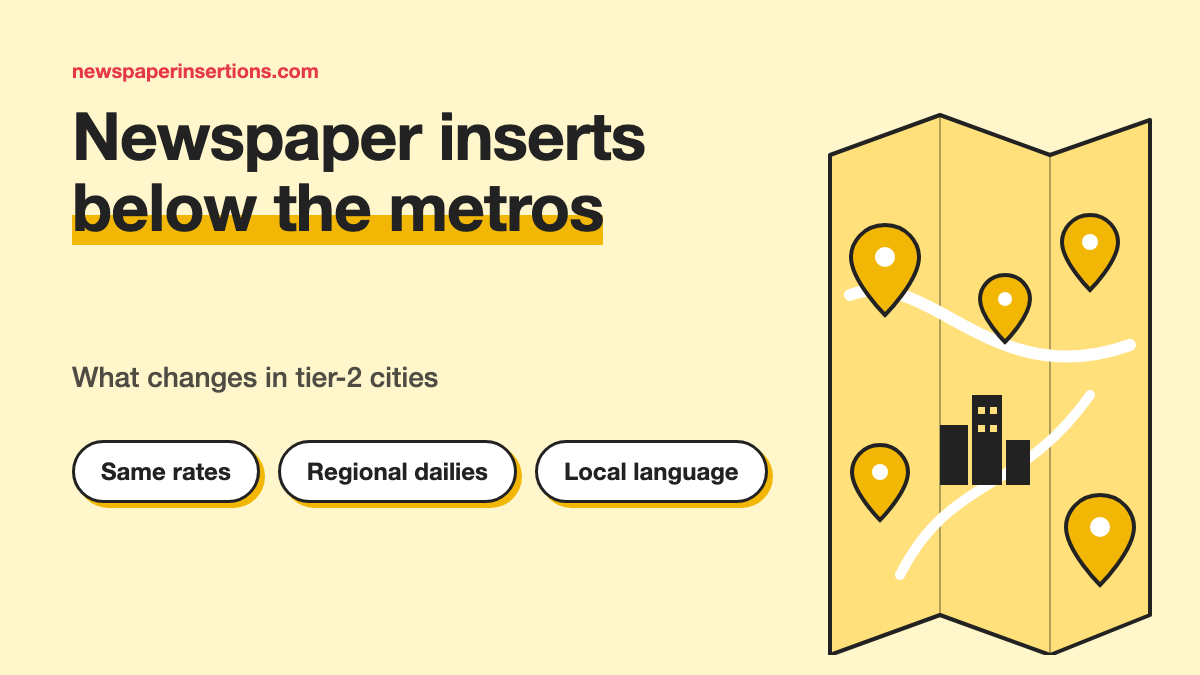
The price does not change. Our per-copy rates and the 50,000-copy minimum are the same in Indore as in Mumbai. What changes is everything around the price: the regional daily is the market, 50,000 copies covers far more of the city, artwork must be in the local language, logistics may add a day, and local calendars shape the drop date.
Key Takeaways
- Rates are the same nationwide: A2 ₹2.00, A4 ₹1.50 and A5 ₹1.20 per copy, all-inclusive of printing, insertion and transport, GST extra, minimum 50,000 copies per city.
- "Tier-2" has no single official definition. The most common reference is the government's HRA classification, where eight cities are "X" (the metros) and cities such as Jaipur, Lucknow, Indore, Nagpur and Coimbatore are "Y".
- In most tier-2 cities the regional-language daily is the newspaper market. In IRS 2019 Q4, Dainik Jagran and Dainik Bhaskar were India's two most-read dailies, ahead of every English title.
- 50,000 copies with one leading daily covers four to eight pin codes in a metro, but a much larger share of a tier-2 city, because each locality takes fewer copies. In a smaller tier-2 city it can come close to citywide coverage for the chosen papers.
- Language, phone-first response, local festivals and market days, and an extra day for logistics are the practical differences we plan for across 30+ cities.
What counts as a tier-2 city?
There is no statute that defines it. Marketers usually borrow the government's classification for House Rent Allowance under the 7th Central Pay Commission. It puts eight cities in category X: Delhi, Mumbai, Kolkata, Chennai, Bengaluru, Hyderabad, Ahmedabad and Pune. Category Y is the next band of large cities, which includes most state capitals and big industrial or trading centres.
For insertion planning the label matters less than two facts about the city: which newspaper the households actually read, and how many copies that paper puts into each locality. The rest of this post is about how those two facts shift once you leave the metros. Of the 30 cities on our city list, more than half are what most planners would call tier-2, from Indore and Lucknow to Coimbatore and Guwahati.
Is newspaper insertion cheaper in tier-2 cities?
No. Our rates on the pricing page are the same in every city we cover: A2 at ₹2.00, A4 at ₹1.50 and A5 at ₹1.20 per copy at 90 GSM, including printing, insertion and transport to the distribution point. GST is extra, and the minimum is 50,000 copies per city.
So a 50,000-copy A5 run costs ₹60,000 plus GST in Nashik, exactly as it does in Mumbai. Our GST guide explains what the tax adds and who can claim it back.
What does differ is what those 50,000 copies buy. In a metro they are a slice of a very large city. In a tier-2 city the same copies can be a meaningful share of all the households that take a newspaper. That is why the cost of market coverage is usually better below the metros, even though the cost per copy is identical.
Which newspaper should you use in a tier-2 city?
Almost always the leading regional-language daily, sometimes two of them.
The Indian Readership Survey (IRS 2019 Q4, published by the Media Research Users Council) ranked Dainik Jagran and Dainik Bhaskar first and second by total readership nationally, both Hindi, ahead of every English daily. That national picture is driven by exactly the cities this post is about. In Indore or Bhopal the choice is typically between Dainik Bhaskar, Nai Duniya, Dainik Jagran and Patrika. In Nashik it is the Marathi dailies. In Coimbatore it is the Tamil dailies.
English editions exist in most tier-2 cities, but they are usually the second paper in a smaller set of homes. Our comparison of English vs vernacular newspapers for inserts sets out when an English paper still earns a place, for example a premium clinic or a school targeting professional households in two or three specific localities.
How much of a tier-2 city do 50,000 copies cover?
A lot more than in a metro. With one leading daily, 50,000 copies typically covers four to eight pin codes in a metro. In a tier-2 city each locality takes fewer copies, so the same order spreads over many more localities. For a smaller tier-2 city, 50,000 copies split across the two leading dailies can come close to citywide coverage for those papers.
That changes how you plan:
- You can afford to be broader. A showroom in a metro has to pick its best pin codes. The same showroom in a tier-2 city can often cover its whole catchment in one drop.
- The district comes into play. Editions in these cities are dispatched to the surrounding district as well, as we explain in how newspaper distribution works. If your customers drive in from nearby towns, which is common for hospitals, coaching institutes, jewellers and auto dealers, those towns can be part of the same campaign.
- Repeats matter more than reach. Once one drop covers the catchment, the next rupee is better spent on a second drop two or three weeks later than on stretching into areas your customers do not come from.
What changes in the artwork?
The language, first. An insert travelling inside a Hindi, Marathi, Gujarati or Tamil paper should be written in that language. A bilingual layout, with the headline and offer in the local language and the brand name and phone number in both scripts, is a sensible middle path.
Three things we check on every regional-language file:
- Script and fonts. Conjuncts and vowel signs can break when a design built in English software is exported. Proof a printed sample, not just the PDF, and have a native reader check it.
- The call to action. In our experience across tier-2 campaigns, a clearly printed mobile number and a WhatsApp prompt tend to do more work than a website address. Keep the QR code, but do not make it the only route. Our guide to tracking response with QR codes covers how to use both.
- Local landmarks. "Opposite the bus stand" or "near the district court" is how people find you in many tier-2 cities. Put the landmark next to the address.
The artwork checklist covers sizes, bleed and file formats, which do not change by city.
Does the timeline change?
Sometimes by a day. Where the print run is produced in one city and trucked to another, add transit time before the insertion date. Our seven-day campaign timeline is a good base; for a tier-2 city fed from a print location elsewhere, plan on the longer end of it.
The calendar matters more than the clock. Local festivals, weekly market days and regional holidays shape when households shop, and they differ from state to state. We cover this in the best days for newspaper insertions. A drop two days before a local festival will usually do more than one timed to a national holiday that the city does not treat as its own.
How do you run several tier-2 cities together?
As one campaign with city-level decisions. The minimum is 50,000 copies per city, so a three-city Uttar Pradesh plan, for example Lucknow, Kanpur and Varanasi, is 1,50,000 copies. At ₹1.20 per copy for A5 that is ₹1,80,000 plus GST.
What stays the same across the cities: the offer, the design system and the tracking. What changes: the newspaper in each city, the language version if the cities span states, and the drop date if a local event falls in the window. Our guide to franchise and multi-city campaigns covers coordination in more detail.
What should you check before booking a tier-2 campaign?
- The leading daily, or two, by ABC-certified circulation in your district and town.
- The localities and nearby towns your customers actually come from.
- A local-language version of the artwork, proofed on paper by a native reader.
- A phone or WhatsApp route to respond, plus a QR code or coupon code per city.
- The local festival and market-day calendar for the drop window.
- One extra day in the timeline if printing happens in another city.
- The distribution certificate and area-wise report you will receive afterwards.
Planning a campaign outside the metros?
Tell us the city, the localities and nearby towns you want to reach. We suggest the dailies and send a quote at the same rates as any metro.
Request a quote