The Short Answer
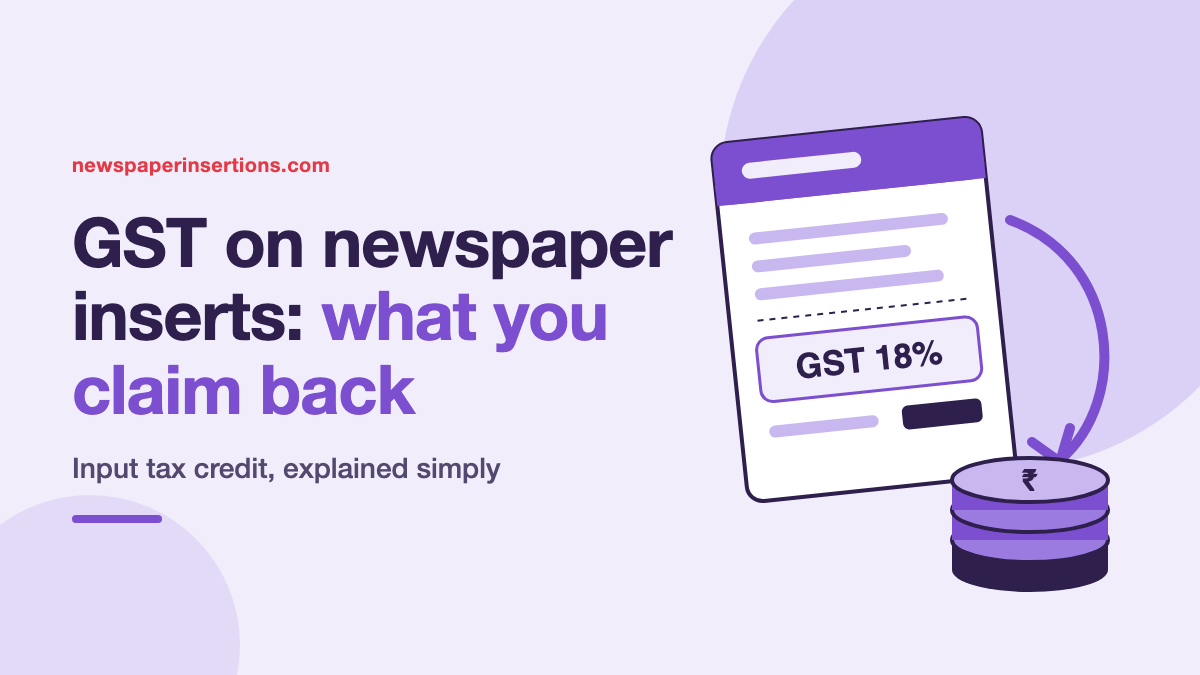
An insertion campaign, where the agency prints your artwork on its own paper, inserts it and transports it, is normally invoiced as a service at 18% GST, on top of the per-copy rate. A GST-registered business whose own sales are taxable can usually claim all of that back as input tax credit. Exempt, composition and no-credit businesses cannot, so for them GST is a real cost.
Key Takeaways
- Our per-copy rates (A2 ₹2.00, A4 ₹1.50, A5 ₹1.20, all-inclusive of printing, insertion and transport, 50,000-copy minimum) are quoted before GST. GST is added on the invoice.
- The job is a composite service. CBIC Circular 11/11/2017-GST treats printing of content supplied by the customer as a printing service, and the Daman and Diu appellate advance ruling in Temple Packaging (2022) applied that to pamphlets and leaflets at 18%.
- The 5% rate you may have heard about is for selling advertisement space in print media, meaning space on the newspaper's own pages. An insert does not buy page space, so do not budget on 5% unless your invoice actually says so.
- Input tax credit on advertising is not blocked under Section 17(5) of the CGST Act. A registered business making taxable sales can usually set the full GST off against its output tax.
- Businesses that cannot claim: composition taxpayers, most standalone restaurants (5% without credit), residential real estate on the 1% or 5% no-credit scheme, and those with exempt income such as most schools and hospitals.
- Credit has conditions: a proper tax invoice with your GSTIN, the invoice showing in your GSTR-2B, payment to the supplier within 180 days, and a claim no later than 30 November after the financial year ends.
Is GST included in the newspaper insertion rate?
No. Every rate on our pricing page is a pre-tax, all-inclusive rate. "All-inclusive" means it covers printing, physical insertion into the newspaper and transport to the distribution point. It does not include GST, which is added on the invoice.
That is the norm across the trade, and it is the first thing to check when you compare quotes. A quote that looks ₹0.20 per copy cheaper may simply be the same price with GST shown separately in one and folded in by the other. Ask every supplier the same question: "Is this rate before or after GST, and at what GST rate?"
What GST rate applies to a newspaper insertion campaign?
For the usual job, 18%. Here is why, in plain terms.
An insertion campaign bundles several things: printing your design on the printer's paper, inserting the printed sheets into the newspaper overnight, and moving the bundles to the depots. Under GST, when several supplies are naturally bundled and sold together, the whole bundle is taxed at the rate of its principal supply. Nobody buys the transport or the insertion on its own; the core of what you are paying for is your printed message reaching homes.
On the printing part, CBIC Circular 11/11/2017-GST says that where the content belongs to the customer and the printer only uses its own paper and ink, the principal supply is the printing service. Printing services fall under SAC 9989. In the Temple Packaging case (Appellate Authority for Advance Ruling, Daman and Diu, 2022), the authority upheld that printing pamphlets and leaflets with the customer's content is a supply of service at 18%, not a supply of printed goods.
The GST rate changes that took effect on 22 September 2025 cut rates on many goods, but advertising services and commercial printing services stayed at 18%.
Why not 5%?
Notification 11/2017-Central Tax (Rate) gives a concessional 5% rate to "selling of space for advertisement in print media". That is the rate newspapers charge when you book a display ad on their pages. An insert is a separate loose sheet that travels with the paper; you are not buying space on a page. Treating an insert campaign as a 5% print-media space sale is not a safe assumption, and if a quote shows 5% on an insert job, ask the supplier to explain the classification before you rely on it.
How much is the GST on a typical campaign?
The arithmetic is simple, and it is worth doing before the budget is signed off. At 18%:
| Campaign | Pre-GST cost | GST at 18% | Invoice total |
|---|---|---|---|
| 50,000 A5 copies at ₹1.20 | ₹60,000 | ₹10,800 | ₹70,800 |
| 50,000 A4 copies at ₹1.50 | ₹75,000 | ₹13,500 | ₹88,500 |
| 1,00,000 A4 copies at ₹1.50 | ₹1,50,000 | ₹27,000 | ₹1,77,000 |
| 1,50,000 A2 copies at ₹2.00 | ₹3,00,000 | ₹54,000 | ₹3,54,000 |
Per-copy rates include printing, insertion and transport. A4 and A5 at 90 GSM.
Whether that GST column is a cost or a pass-through depends entirely on your own GST position, which the next two sections cover. The minimum order explainer sets out why the rates start at 50,000 copies.
Can you claim input tax credit on newspaper insertions?
Usually yes, if you are GST-registered and what you sell is taxable.
Section 16 of the CGST Act allows credit on inputs and input services used in the course of business. Section 17(5) lists the credits that are blocked, such as motor vehicles, food and beverages, and goods given away as gifts. Advertising and printing services are not on that list. An insert that promotes your business is a business input service.
In practice that means a registered retailer, coaching institute, clinic that charges taxable fees, or B2B supplier running the ₹1,77,000 campaign above claims the ₹27,000 back against the GST it collects on its own sales. Its real cost is ₹1,50,000.
What conditions must you meet to claim the credit?
- A valid tax invoice in your GSTIN. The invoice must name your registered business, not a proprietor's personal name or a sister company.
- The invoice must appear in your GSTR-2B. Section 16(2)(aa) allows credit only where the supplier has reported the invoice. If it is missing from your GSTR-2B, raise it with the supplier before you file.
- The service must have been received. For an insert campaign, the distribution certificate and delivery report are your record that it was. Our guide to what a distribution certificate proves explains what to keep.
- Pay within 180 days. If you do not pay the supplier within 180 days of the invoice date, the credit has to be reversed until you do.
- Claim on time. Section 16(4) sets the last date as 30 November following the end of the financial year, or the date you file your annual return, if earlier. A campaign invoiced in October 2026 must be claimed by 30 November 2027.
CGST and SGST, or IGST?
For services supplied to a registered business, the place of supply is generally the recipient's location. If the supplier is registered in the same state as your GSTIN, the invoice splits the 18% into 9% CGST and 9% SGST. If the states differ, it shows 18% IGST. Either way the credit is available; it just sits in a different ledger. This matters for multi-city campaigns: if different franchisees hold separate GSTINs, ask for each city's invoice in the GSTIN that will actually claim the credit.
Who cannot claim the GST back?
For some advertisers the 18% is simply part of the cost. Budget on the invoice total, not the pre-GST figure.
- Composition taxpayers. Businesses under the composition scheme pay a flat rate on turnover and cannot claim input tax credit at all.
- Most standalone restaurants and cloud kitchens. Restaurant service outside specified premises is taxed at 5% without input tax credit. Our restaurant and cloud kitchen guide works through the per-order arithmetic; add 18% to the media line when you run it.
- Residential real estate on the no-credit scheme. Since April 2019, residential projects pay 1% (affordable) or 5% (other) without input tax credit. A developer on that scheme cannot claim the GST on launch inserts. Our launch vs possession-ready post has the campaign budgets.
- Businesses with exempt income. Most school education and most healthcare services are exempt. Section 17(2) blocks credit to the extent inputs are used for exempt supplies. A school promoting admissions usually bears the full GST; a coaching institute charging GST on its fees usually does not. See our schools and coaching institutes guide.
- Unregistered businesses. No GSTIN, no credit.
What if your business is part taxable, part exempt?
Rule 42 of the CGST Rules requires common credits to be split in proportion to taxable and exempt turnover. A hospital that also runs a taxable pharmacy, for example, would claim only the taxable share. This is where your accountant earns their fee.
How should you budget for GST on a campaign?
From what we see across 500+ campaigns in 30+ cities since 2020, the budgeting mistake is rarely the rate. It is who signed off the number. A marketing manager approves ₹1,50,000, finance receives an invoice for ₹1,77,000, and the difference becomes an argument. Three habits prevent it:
- Approve two numbers. Put the pre-GST cost and the invoice total on the same approval line, so nobody is surprised.
- State the GSTIN at booking. Give the billing name, address and GSTIN before printing starts. Invoices re-issued later to fix a name or GSTIN delay your credit.
- Check the rate on the quote. A proper quote states the GST rate. If it says only "GST extra", ask which rate and why.
When you compare suppliers, compare invoice totals at the same GST rate. Our post on how to negotiate insertion rates covers the parts of the price that are genuinely negotiable; GST is not one of them.
Does GST change the format decision?
Not the choice itself, but it changes the stakes. For a business that can claim credit, the effective cost of a 50,000-copy A4 campaign is ₹75,000. For a school that cannot, it is ₹88,500. If you are in the second group and the budget is tight, an A5 insert at ₹70,800 including GST may be the better fit.
This post explains how GST generally applies to insertion campaigns. It is not tax advice. Confirm your own position with your chartered accountant.
Get a quote with the GST line spelled out
Tell us the format, copies and cities. We send the pre-GST cost, the GST rate and the invoice total, so finance signs off on the right number.
Request a quote