The Short Answer
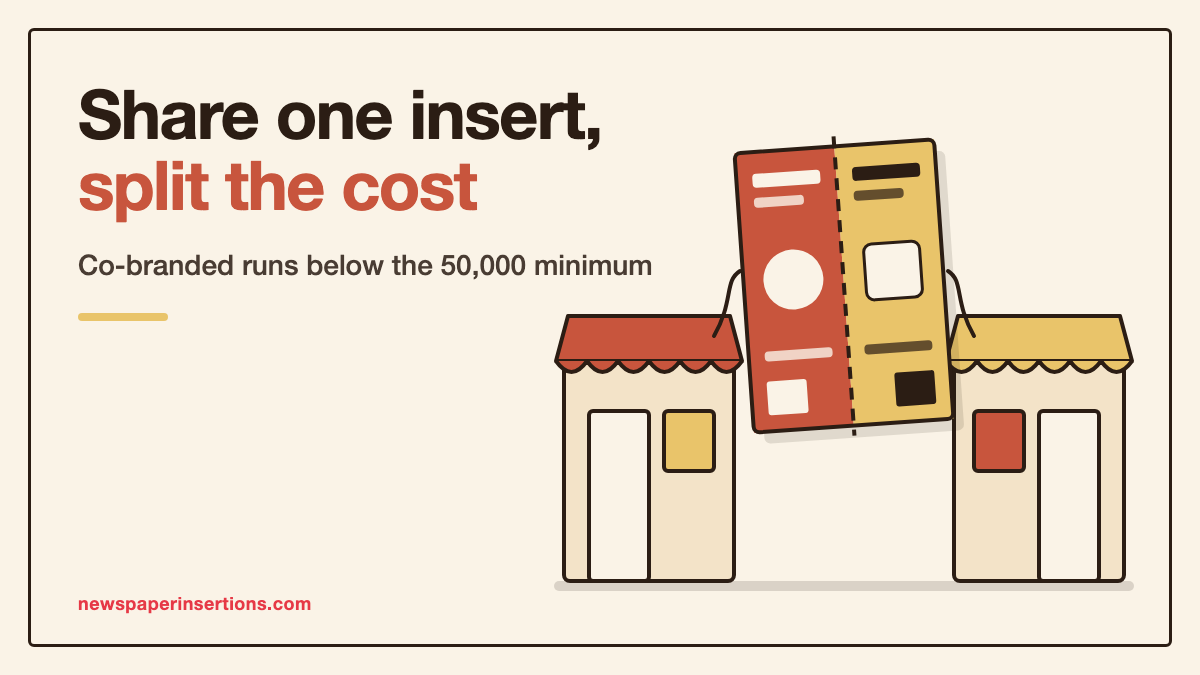
If 50,000 copies is more than one small business needs, two non-competing businesses in the same catchment can share a single co-branded insert: one sheet, one brand per side, one booking at the published rate. At A5 (₹1.20 per copy, GST extra) that is ₹60,000 for the run, or ₹30,000 each, with both brands reaching all 50,000 households.
Key Takeaways
- The minimum order is 50,000 copies for A2, A4 and A5. Below that, printing and insertion still happen, but the per-copy rate rises because fixed costs land on fewer sheets.
- A co-branded insert keeps the run at 50,000 copies and splits the bill instead. Every insert we run is printed on both sides, so two brands can each own a full side.
- Split at the published rate, 50,000 A5 copies cost ₹30,000 per partner, 50,000 A4 copies ₹37,500 per partner and 50,000 A2 copies ₹50,000 per partner, all before 18% GST.
- The partner matters more than the saving: pick a business that serves the same households, does not compete with you, and can approve artwork as fast as you can.
- Give each partner its own phone number, QR code or coupon code so each can measure its own response. A shared sheet with one shared contact line is a dispute waiting to happen.
- Put the split in writing before artwork starts: who books, who holds the invoice, who owns which side, and what happens if one partner pulls out.
One of the most common first-call questions we hear is some version of: we are a small shop, 50,000 copies is more than we need, can we do less? The honest answer has more than one part. You can run fewer copies at a higher per-copy rate. Or you can keep the full 50,000-copy run and share it with another business. This article is about the second option, because most small advertisers have never been told it exists.
Why is there a 50,000-copy floor in the first place?
Three costs inside the per-copy rate all have a fixed part. Offset printing needs plates and a make-ready before the first good sheet, newspapers and their distribution networks handle inserts in area-sized lots, and a vehicle to the distribution point costs the same half-empty. At around 50,000 copies those fixed parts become small enough that we can honestly promise A2 at ₹2.00, A4 at ₹1.50 and A5 at ₹1.20 per copy, all-inclusive of printing, insertion and transport, GST extra. We explain the economics in detail in our guide to why 50,000 copies is the minimum order.
The floor is not a refusal. Smaller runs can still be printed and inserted; they simply cost more per copy. That leaves a small advertiser with three real choices: pay the higher per-copy rate on a smaller run, save up for a full solo run, or share one full run with a partner.
What is a co-branded newspaper insert?
A co-branded insert is a single printed sheet that carries two businesses, usually one on each side. It is booked, printed, inserted and delivered exactly like any other insert. The newspaper vendor does not know or care that two brands are on it; the household receives one flyer inside the morning paper.
The simplest layout is one brand per side. Every insert format we run (A2 on 45 GSM newsprint, A4 and A5 on 90 GSM glossy art paper) is printed in full colour on both sides, so each partner gets a complete, uninterrupted face. The alternative is a split front, where both brands share the front and the back carries a joint offer or a map. That works for tightly linked businesses, such as a gym and a nutrition store in the same building, but for most pairs the side-each layout is cleaner and easier to agree on.
What does each partner actually pay?
At the published rates, the arithmetic is straightforward:
| Format | Cost of 50,000 copies | Each of two partners | Each of three partners |
|---|---|---|---|
| A5, 90 GSM glossy | ₹60,000 | ₹30,000 | Not advised |
| A4, 90 GSM glossy | ₹75,000 | ₹37,500 | Not advised |
| A2, 45 GSM newsprint | ₹1,00,000 | ₹50,000 | ₹33,333 |
All figures before 18% GST. Rates include printing, insertion and transport. Higher GSM on A4 and A5 costs more. Current city-wise rates are on our pricing page.
The key point is that each partner still reaches all 50,000 households, not 25,000. A small business that could only fund ₹30,000 would otherwise be choosing between a much smaller sub-floor run at a higher per-copy price and not running at all. Sharing buys full reach at half the entry price.
Three partners on one sheet is possible on A2, which has room for three clearly separated panels. On A5 and A4 we advise against it: a 14.8 cm by 21 cm A5 sheet split three ways leaves each brand a panel too small to carry a headline, an offer and a contact line legibly.
Who makes a good co-branding partner?
The partner matters more than the saving. A bad match halves your cost and also halves your attention. In our experience across 500+ campaigns since 2020, the inserts that pull response are the ones with one clear offer aimed at one clear household, and a co-branded sheet has to protect that. Four tests help.
- Same catchment. Both businesses must want the same pin codes. A clinic serving one locality and a furniture store drawing from the whole city do not share a delivery area, so one of them pays for households it does not want. Our guide to pin-code targeting with newspaper editions shows how areas map to vendor rounds.
- Same customer, different purchase. The best pairs serve the same family for different needs: a school and a stationery shop, a paediatric clinic and a children’s clothing store, a new residential project and a home interiors studio, a restaurant and a sweet shop at festival time.
- No competition, even partial. Two coaching centres for different exams still compete for the same parent’s attention and budget. Two restaurants with different cuisines still compete for the same dinner. If a reader could reasonably choose one instead of the other, do not share.
- Similar brand level. A premium jeweller and a discount grocery sale on the same sheet pull each other in opposite directions. Match tone and price band, or the sheet reads as confused.
A useful shortcut is to look at who already sits next to you: the other shops in your complex, members of your local market association, or suppliers who sell to your customers. They already share your catchment and usually your customer.
How do you keep a shared insert fair and trackable?
The most common way a shared run goes wrong is not the printing; it is measurement. If both brands print the same shop-front phone number or a single joint QR code, neither partner can tell which calls were theirs, and the next conversation is about who benefited more.
Give each side its own response mechanism: a separate phone number, a separate QR code pointing to its own page, and ideally a separate coupon code. That way each business can count its own responses against its own share of the cost and decide independently whether to repeat. Our guide to tracking insert response with QR codes covers how to set up codes that can be told apart.
Agree the rules of the sheet before anyone opens a design file:
- Which side is the front. The front gets looked at first. Either alternate on repeat runs, let the partner who takes the front pay a larger share, or use the split-front layout.
- Equal space and equal weight. Same size logo, same size headline, same colour treatment unless you agree otherwise.
- One approver per side, one final sign-off. Each partner approves its own side; one named person signs off the combined file. Slow approvals are the main reason shared runs miss a booked drop date.
- Offers that do not conflict. If one side says “flat 30% off” and the other says “no discounts, premium quality”, the sheet argues with itself.
The general design rules still apply to each side: one headline, one offer, one call to action. Our guide on designing an insert people actually keep is written for a single brand, and each half of a shared sheet should pass it on its own.
Who books the run, and how does the invoice work?
The simplest structure is that one partner books the campaign and holds the invoice, and the other reimburses its share under a short written agreement. That keeps a single point of contact for artwork, the drop date and the proof of delivery.
GST needs a little thought. Insertion campaigns are normally invoiced as a service at 18% GST, and a GST-registered business can usually claim that back as input tax credit, but only on an invoice in its own name. If both partners are registered and want to claim credit, ask at the quote stage whether the booking can be invoiced in two parts, one to each business. If one partner simply reimburses the other, confirm the treatment with your own chartered accountant. Our explainer on GST on newspaper insertion campaigns sets out the rate and the credit rules in more detail, but this is a question for your CA, not for a blog post.
The written agreement does not need to be long. It should cover:
- the format, copies, areas and drop date
- each partner’s share of the cost including GST, and when it is paid
- which side belongs to whom, and who approves what
- what happens if one partner withdraws after booking (usually: they still owe their share, or they find a replacement partner)
- who receives and shares the distribution certificate after the drop
When is a sub-floor solo run the better choice?
Sharing is not always right. There are three situations where paying the higher per-copy rate on a smaller solo run, or waiting, is the better call.
When your message needs the whole sheet. A property launch with a floor plan, a price table and a site map, or a school admission insert with courses, fees and a form, will not fit on half of an A5. For those, a solo A4 or A2 insert is the right product. If the budget is not there yet, it is usually better to wait a month and run properly than to squeeze the message.
When you cannot find a genuine partner. A forced partnership with a business that does not share your customer produces a weak sheet for both. A smaller solo run at a higher per-copy price, concentrated in your best two or three localities, can be the more honest option. Ask us for the per-copy rate at your quantity; current rates for every city are on our pricing page.
When timing does not line up. A festival offer, a store opening or an admission deadline sets your drop date. If your partner’s best date is a month away, one of you is advertising at the wrong time.
It is also worth knowing what else a small budget can buy. Our guide to what ₹1 lakh buys you in print compares a solo 50,000-copy A5 run with other ways to spend a similar amount, and our comparison of newspaper insertion vs door-to-door pamphlet distribution covers the channel small shops most often weigh against inserts.
What results should each partner expect?
Honest expectations help keep a partnership together. Across the campaigns we have measured since 2020, inserts with a clear offer and a clear call to action typically draw direct response from 0.5% to 2% of copies. On a shared sheet each brand has half the space, so it is reasonable to plan conservatively and assume each side performs toward the lower end of that range unless its offer is particularly strong.
50,000
households reached by each partner, not 25,000
One co-branded run
₹30,000
per partner for a shared A5 run, GST extra
Published rate, split two ways
0.5–2%
typical direct response on inserts with a clear offer
The Mediaverse campaign data, 2020 onward
Even at the low end, 0.5% of 50,000 copies is 250 responses from a single morning. If those responses split evenly, each partner still sees around 125 calls, scans or walk-ins for ₹30,000 plus GST on A5. That is enough to judge whether the channel works for your business, which a much smaller solo test often is not, because the response count is too low to read.
Readership context supports the channel for small local businesses. The Indian Readership Survey (IRS 2019 Q4, published by the Media Research Users Council) recorded around 425 million newspaper readers in India, and the EY-FICCI media and entertainment reports continue to track print as a large segment with its strongest base in regional-language markets, which is where many small businesses operate. A shared insert lets a business that could not fund a solo run get into that channel at half the entry price. Our city pages list the newspapers and areas available in each of the 30+ cities we cover.
Found a partner for a shared insert?
Tell us both businesses, the localities you want and your preferred drop date. We will suggest the format and send a quote for one co-branded run.
Request a quote