The Short Answer
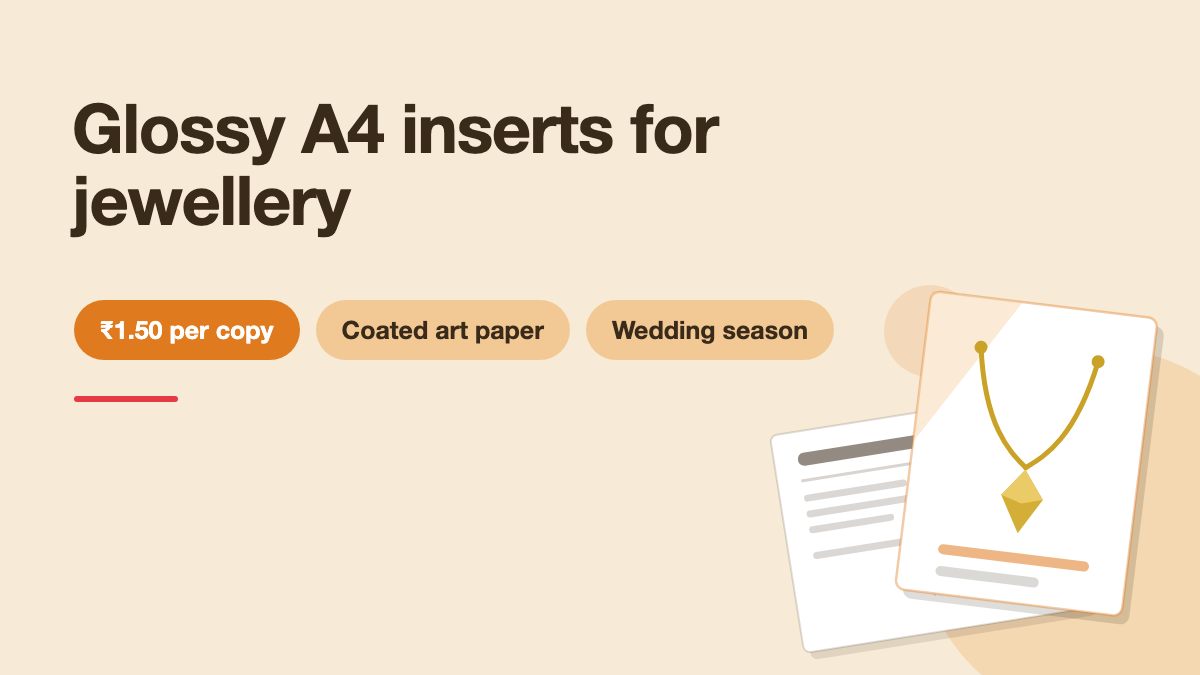
Glossy A4 inserts cost ₹1.50 per copy all-inclusive, against ₹2.00 for larger A2 newsprint. For jewellery and premium retail the smaller coated sheet wins, because newsprint cannot reproduce gold, diamonds or silk. Buy the showroom’s catchment pin codes rather than the whole city, insert two to three days before the buying date, and measure qualified walk-ins rather than response percentage.
Key Takeaways
- Glossy A4 on 90 GSM coated art paper costs ₹1.50 per copy all-inclusive; A2 newsprint costs ₹2.00 and prints photographs far worse.
- Timing beats every other variable in this category: insert two to three days before the buying date, not on it, and book festive slots four to six weeks early.
- A 50,000-copy glossy A4 campaign costs ₹75,000 plus GST, an amount a single bridal purchase can exceed.
- Buy the showroom’s catchment pin codes rather than the full city edition; existing billing addresses beat any media plan.
- Measure qualified walk-ins and cost per walk-in, not response percentage: high-ticket categories sit at the lower end of the 0.5% to 2% response band we observe.
Glossy A4 inserts cost ₹1.50 per copy all-inclusive, against ₹2.00 for a much larger A2 newsprint sheet. For jewellery showrooms and premium retail, that smaller, heavier, better-printed sheet reliably does more work. This is the playbook we use for that category: when to run, what to print, which editions to buy, and how to judge the result when a single sale can pay for the whole campaign.
Why does glossy A4 work so well for jewellery and premium retail?
Because the product is the advertisement. Gold, diamonds, silk, watches and furniture all sell on how they look, and newsprint destroys exactly that. A2 newsprint is absorbent and uncoated, so fine detail goes soft, deep reds turn brick, and gold reproduces as a flat mustard. On 90 GSM coated art paper the same photograph holds its highlights, and a necklace looks like a necklace.
There is a second, quieter reason. A premium buyer reads the paper for the price of the piece, not for a discount. A glossy sheet signals that the advertiser spent money on the advertisement, which is a proxy for spending money on the product. We have watched showroom owners test the same artwork on newsprint and on art paper in consecutive weeks, and the glossy run is the one the family keeps on the table until the weekend.
Format economics matter here too. Our A2 vs A4 vs A5 format guide works through the full trade-off at each price point, and the paper and GSM guide explains why 90 GSM coated stock behaves differently from newsprint in a printing press. For this category the decision is usually settled before budget enters the room: if the photograph has to carry the sale, it has to be printed on coated paper. Full specifications are on our A4 insertion service page.
When should a jewellery showroom actually run inserts?
Jewellery demand in India is calendar-driven to an unusual degree, so timing beats almost every other variable.
The two windows that matter most are the wedding season and the festive run from Navratri through Dhanteras and Diwali. Dhanteras in particular concentrates a large share of annual gold buying into roughly forty-eight hours. Premium retail outside jewellery follows a similar shape: Akshaya Tritiya, the festive quarter, and the wedding months.
- Insert two to three days before the buying date, not on it. Families shortlist showrooms first and visit later. A Dhanteras insert delivered on Dhanteras arrives after the decision.
- Book the slot four to six weeks early. Festive insertion capacity in a metro sells out, and the vendor network is the bottleneck, not the printing.
- Run twice rather than once. One insertion tells a household you exist; the second, timed closer to the date, is the one that produces a walk-in.
Our festival season insertion planning guide covers the deadlines and demand spikes in detail, including why booking late costs you the edition you wanted rather than just the price.
What does a jewellery insert campaign cost?
₹1.50
per copy, glossy A4 all-inclusive
The Mediaverse 2026 rate card
50,000
minimum order, set by vendor area blocks
₹75,000
entry-level campaign cost, GST extra
Glossy A4 inserts are ₹1.50 per copy, all-inclusive of printing, insertion and transport, with GST extra. The minimum order is 50,000 copies, which exists because newspaper vendor networks distribute in full area blocks and cannot economically split below that.
| Scope | Copies | All-inclusive cost* |
|---|---|---|
| Single edition, one date | 50,000 | ₹75,000 |
| Two editions, or two dates | 1,00,000 | ₹1,50,000 |
| Multi-city festive push | 2,00,000 | ₹3,00,000 |
*Printing, insertion and transport included; GST extra. City-wise rates are on the pricing page.
City-wise rates for every format sit on our pricing page, and the mechanics of how a booking turns into a doorstep delivery are on the how it works page.
Now put that against the category. This is where jewellery differs from nearly every other advertiser we handle. A restaurant needs volume of response to justify ₹75,000. A jewellery showroom with an average bridal purchase in the lakhs needs a very small number of walk-ins to break even, and sometimes one. That changes what you should optimise for: qualified walk-ins, not raw response count.
What should a premium retail insert actually say?
The most common mistake in this category is importing the discount language of mass retail. A 70% OFF starburst on a glossy jewellery insert reads as a clearance sale and damages the thing you paid extra to communicate.
- One hero photograph, printed large. A single piece shot well beats a grid of twelve thumbnails.
- A reason to visit now, framed as value rather than desperation: waived making charges on a collection, a festive exchange rate on old gold, a booking amount that locks today’s rate, or a private preview by appointment.
- Trust signals stated plainly. BIS hallmarking with the six-digit HUID on gold jewellery, certification for diamonds, transparent making charges, and a clear buyback or exchange policy. In this category trust is the offer.
- The showroom address, a map cue, and parking. Premium buyers travel to a showroom deliberately, so tell them exactly where to arrive.
- A phone number and a QR code together. Older buyers call, younger buyers scan.
Keep claims accurate. Hallmarking and pricing statements on a printed insert are commitments, and a showroom that prints a rate it will not honour loses far more than the campaign cost. Our guide to designing an insert people keep covers the layout side of this in more depth.
How do you choose editions and pin codes for an affluent audience?
This is where most of the wasted money in premium retail print hides. A jewellery showroom does not need a whole city. It needs the twelve to twenty pin codes from which people actually drive to its showroom. Newspapers distribute through area-wise vendor networks, which is precisely why insertions can be bought by locality rather than by full edition. Our pin-code targeting guide sets out how that selection is made in practice.
- Buy the catchment, not the city. Map where your existing billing addresses come from, then buy those pin codes. Existing customer data beats any media plan.
- Pick the paper the affluent household actually takes. In jewellery hubs like Jaipur, Hyderabad and Coimbatore, the strongest regional daily frequently beats the largest English daily for this audience. Decide by household, not by brand prestige.
- Verify the reach number you were quoted. Book against audited circulation, not a claimed figure. ABC certifies circulation; IRS 2019, the last industry-wide readership study, measured readership. They are different numbers, and a quoted reach that matches neither deserves a question.
How do you measure it when one sale pays for the campaign?
Percentage response is the wrong headline metric for this category. Track these instead:
- Walk-ins attributed to the insert. Ask at the counter and log it. It is low-tech and it works.
- Cost per qualified walk-in. ₹75,000 against thirty genuine walk-ins is ₹2,500 per walk-in, which for a category with lakh-level basket sizes is usually defensible.
- Revenue against campaign cost, measured over the full buying window rather than the insertion day. Jewellery decisions take weeks.
- Scans and calls, via a QR code and a dedicated number, so digital follow-up can continue after the paper is thrown away.
A QR code is worth the space it takes. Our QR tracking guide explains how to build one that actually reports, and print plus digital retargeting together consistently outperforms either alone.
The bottom line
For jewellery and premium retail, glossy A4 at ₹1.50 per copy is not the expensive option. It is the correct one, because the photograph is doing the selling and newsprint cannot print a photograph that sells gold. Buy the catchment rather than the city, insert two to three days ahead of the buying date, lead with one piece and one honest reason to visit, and measure walk-ins and revenue rather than response percentage. In a category where a single bridal purchase can exceed the entire cost of a 50,000-copy campaign, the discipline that matters is targeting and timing, not chasing the lowest per-copy rate.
Planning a festive or wedding season campaign?
Get a free quote. We respond within two hours with newspaper options, pin-code reach estimates, and glossy A4 pricing for your city.
Get Free Quote