The Short Answer
A home-services business, such as pest control, AC and appliance servicing, deep cleaning, laundry or packers and movers, is hired on the day something goes wrong, and that day is rarely the day the paper arrives. The insert that works is the one the household keeps: a sturdy A5 card with one service, a first-visit price, a phone number and the localities you reach, dropped into the pin codes your technicians can serve, timed to each service's season. At ₹1.20 per copy, 50,000 copies cost ₹60,000 plus GST.
Key Takeaways
- Home services are need-triggered. The leak, the termites, the AC that will not cool or the transfer letter arrive on their own schedule, so the sheet has to survive on the fridge door or in the drawer until the need does.
- Each service has its own season: pest control after the monsoon, geyser and heater servicing with the first cold week, AC servicing in February and March before the heat, deep cleaning in the three weeks before Diwali, and house moves around the change of school year.
- Fill the run from the pin codes your technicians can reach within the response time you print, not from the whole city.
- The sheet that gets kept carries one service and its first-visit price largest, a phone and WhatsApp number, the localities served, the hours, a licence or registration number where the law requires one, and a reason to call this month.
- Fifty thousand A5 copies cost ₹60,000 plus GST. On the general 0.5 to 2 percent response band we observe, that is 250 to 1,000 enquiries, or ₹60 to ₹240 per enquiry, and an annual maintenance contract turns one call into several paid visits.
Why do home services suit newspaper inserts?
Most category guides on this blog deal with a purchase the household plans: a car, a flat, a sofa, a Diwali gift box. Home services work the other way round. Nobody plans to call the pest control company. They call when they find termite tracks on the cupboard, and they call whichever number is closest to hand. Three traits follow from that, and each favours the insert.
The customer is at home, and so is the problem. A newspaper is read in the house the service will be carried out in. Our monsoon insertion guide makes the point for waterproofing and pest control in the rains: the leak is in the room while they read. The same holds all year for a dripping tap, a geyser that takes forever to heat or a sofa that needs cleaning before guests arrive.
The service area is a set of pin codes. A technician on a two-wheeler covers a limited area in a working day, and a company that promises a same-day or next-day visit can only honour it within that area. A newspaper vendor network delivers by pin code, which is why our pin-code targeting guide lists home services among the businesses that gain most from choosing localities rather than a whole edition.
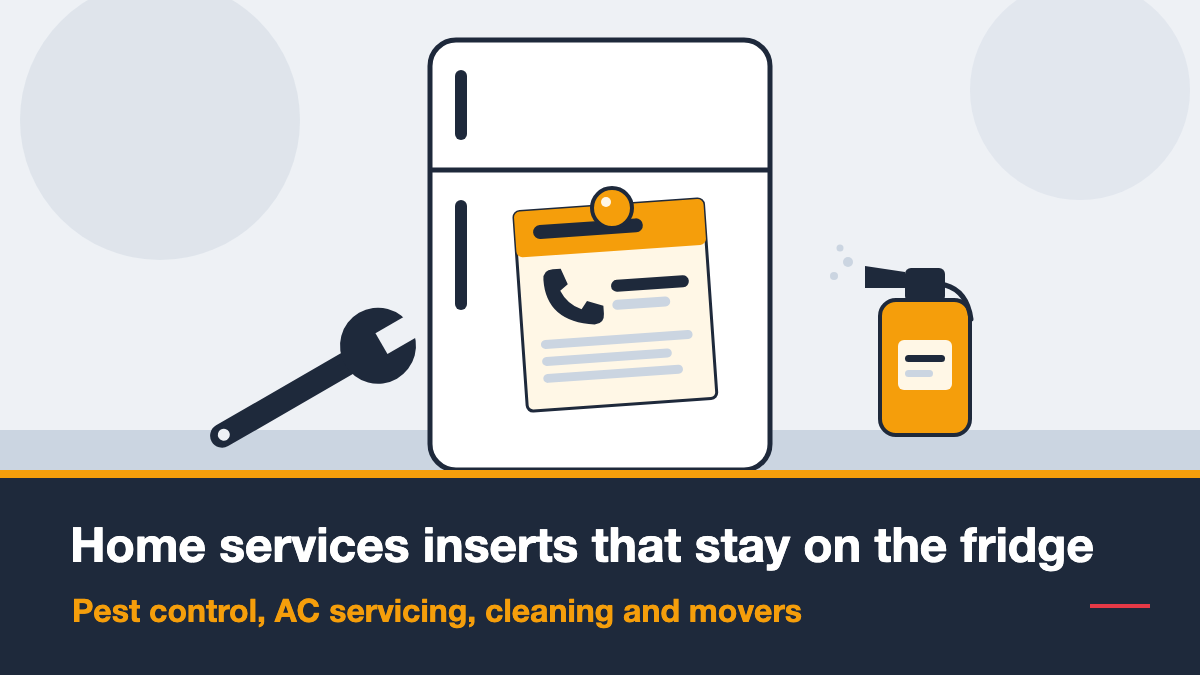
The sheet can wait for the need. A social post is gone in a second. A printed card with a number on it goes on the fridge, into the drawer with the warranty cards, or under the phone. Our guide to designing an insert people keep explains what earns that place, and for home services it is the whole game: the drop morning brings some calls, but much of the value arrives on the day weeks later when the AC stops cooling and the household looks for the card.
Across the campaigns we have run since 2020 in 30+ cities, the service sheets that paid for themselves were the plainest ones in the bundle: one service, one price, one number, printed large enough to read from across the kitchen.
Which home services suit an insert, and when should each drop?
Every trade has its own calendar. A combined "we do everything" sheet dropped once a year wastes most of it.
Pest control: after the monsoon, and before the festival clean. Damp months bring insects, and termite and cockroach problems show up as the rains end. In north and west India that points to a drop in September or October; in Chennai and the northeast monsoon belt, December and January. A second, smaller drop before Diwali catches households that want the house treated before the festival clean. Name the pest on the sheet: "Termites? Free inspection, treatment priced per square foot" outperforms a list of ten insects.
Geyser, heater, chimney and water purifier servicing: the first cold week. In north India the geyser is switched on in the second half of November and the first faults appear within days. A Saturday 21 or Sunday 22 November 2026 drop, two weeks after Diwali on Sunday 8 November, lands as households discover them. Kitchen chimney cleaning and water purifier filter changes sit naturally on the same card, because the same technician can do all three in one visit.
AC servicing: before the heat, not during it. Our electronics and appliance retailer guide puts the AC buying decision in March in north and west India and February in the south. Servicing runs just ahead of it. A drop on Saturday 20 or 27 February 2027 in the south, and Saturday 6 or Sunday 7 March 2027 in the north and west, catches households before the first hot week, when technicians still have slots and the company can offer a pre-season price. A sheet dropped in the middle of May reaches households that already have a technician booked or are waiting a week for one.
Deep cleaning: the three weeks before Diwali. Festival cleaning is the biggest single window for home and sofa cleaning, and it is booked early. If you are reading this on 31 October 2026, this year's window has closed for a new campaign: a drop needs about a week of lead time, and the remaining days before Sunday 8 November are the most crowded insert mornings of the year. Plan for 2027, when Diwali falls on Friday 29 October and the drop belongs on Saturday 9 or Sunday 10 October. Our festival-season planning guide covers how far ahead the festival mornings fill.
Packers and movers: around the school-year change. Families with children tend to move between the end of one school year and the start of the next, and transfers in government, banking and the armed services cluster around the same months. A drop in March, with a second in late May, catches both. This is also the category where households are most wary, so trust lines on the sheet matter more than the price.
Laundry, dry cleaning and ironing: steady, with a wedding-season lift. A neighbourhood laundry or a pickup-and-delivery service is a weekly repeat purchase, closer to a grocery than to a repair. It suits a coupon-led A5 drop every quarter, with an extra one before the wedding season that opens around Dev Uthani Ekadashi on Friday 20 November 2026, when silk, sherwanis and lehengas need care.
Our guide to how often to repeat a newspaper insertion explains why a service business gains more from three well-timed drops a year than from one large one.
Which pin codes should a home-services business cover?
The 50,000-copy minimum per run is large for a single-branch service company, so the run has to be built around the area your team can actually serve.
- Start from your response promise. If the sheet says "technician within 24 hours", list the pin codes your technicians can reach within 24 hours on a normal working day, and fill the run from those outward. A call from outside that area is a lead you cannot honour, and an unhappy household remembers the name on the card. Our minimum order guide explains how the floor is counted per run.
- Favour independent houses and older apartments for repair trades. Plumbing, electrical, waterproofing and pest control work concentrate where the owner, not a society maintenance desk, is responsible for the building. Newer gated societies often have a resident facility team, which makes them weaker for repair trades and stronger for cleaning, laundry and AC servicing.
- A multi-branch company splits the run by branch. Give each branch its own pin codes and its own number on the sheet, so the call lands with the team nearest the house. Our franchise and multi-city campaign guide covers one artwork with localised panels.
- Small trades can share a run. A plumber, an electrician, a pest control operator and a laundry are not competitors, and four of them can split a 50,000-copy A4 sheet into four panels as a neighbourhood home-services directory. Our guide to shared and co-branded insert runs explains how to split the cost without losing the pin-code precision.
Edition choice follows the person who calls. In most households that is whoever runs the house day to day, which in Lucknow, Jaipur or Indore usually means the Hindi daily, and in Pune or Ahmedabad often the Marathi or Gujarati one. A premium cleaning or AC AMC service aimed at apartment owners in Bangalore, Mumbai or Delhi can lean on the English edition. Our English versus vernacular guide covers splitting a run between the two.
What should a home-services sheet carry?
In order of size:
- The service and its first-visit price, largest. "AC service, ₹499 per unit." "Free termite inspection, treatment priced per square foot." "Sofa cleaning, priced per seat." These are examples of the form, not quoted market rates; print your own. A sheet without a price makes the household call three companies to find one.
- The phone number, then the WhatsApp number, both large. Print them big enough to read from across the room, because that is where the card will be when it is needed. A separate number for this campaign also makes it measurable.
- The localities served, by name. Ten or fifteen locality names tell the reader at once whether you will come to them, and save your call centre from enquiries you cannot serve.
- What the visit includes. Gas top-up extra or included, chemical used, warranty on the treatment, number of rooms covered, packing material in the moving quote. Itemising is what turns an enquiry into a booking without an argument at the door.
- A reason to call this month. A pre-season price that ends on a stated date, a free inspection, or an annual maintenance contract at a stated price. Without one, the card waits for a breakdown; with one, some households book now.
- Trust lines. The registered business name, a physical address, the GST number and the hours. For pest control, the licence number. These lines matter because Indian households have learned to be wary of service numbers found at random, and a card with an address and a registration looks like a business that will still exist next month.
Then the legal lines that keep the sheet out of trouble:
- Pest control needs a licence, and the sheet should show it. Commercial pest control operations require a licence under the Insecticides Act, 1968 and the Insecticides Rules, 1971, issued by the state's licensing authority. Print the number. Claims such as "odourless" or "100 percent safe for children and pets" are claims the Advertising Standards Council of India's code requires you to be able to substantiate; if you cannot, describe the chemical and the precautions instead.
- Never imply you are a brand's authorised service centre unless you are. An independent repairer may say it services a brand's appliances; it may not use the brand's logo or call itself the brand's service centre. That is a trade mark problem under the Trade Marks Act, 1999 and a misleading claim under the Central Consumer Protection Authority's 2022 guidelines.
- State every discount's conditions. The same CCPA 2022 guidelines require the conditions of any "free", "up to" or limited-period offer to be stated with the offer. "Free inspection" must mean free, and "₹499 per AC" must say if gas or parts are extra.
- Movers should not borrow approvals. If you hold an approval a bank or employer recognises, print it; if you do not, do not suggest it. In a category where households fear losing their belongings, a claim found to be false costs more than the campaign.
Our insert artwork checklist covers the file specifications.
Which format and paper suit a home-services sheet?
- A5 at ₹1.20 per copy is the natural format. One service, one price and one number fit comfortably, and a half-sheet is the size that goes on a fridge door. Choose heavier stock, 130 GSM rather than 90, so it stays flat for months. See the A5 insertion service page for the specification, and our GSM and paper types guide for what heavier stock does.
- A4 at ₹1.50 per copy suits a company with three or four services and a price for each, the shared four-trade directory described above, or a mover who needs room for a sample quote. See the A4 insertion service page.
- A2 newsprint at ₹2.00 per copy rarely fits. Newsprint yellows and tears on a fridge door within days, which defeats the purpose. The exception is a large company launching in a new city with a long list of services, where our A2 versus A4 versus A5 guide and the A2 insertion service page apply.
What does a home-services campaign cost, and what response can it bring?
The all-inclusive rates on our pricing page cover printing, insertion and transport: A2 at ₹2.00, A4 at ₹1.50 and A5 at ₹1.20 per copy, with a 50,000-copy minimum per run and GST extra. One A5 drop of 50,000 copies costs ₹60,000 plus GST. A three-drop year, for example post-monsoon pest control, winter geyser servicing and pre-summer AC servicing, costs ₹1,80,000 plus GST. Four trades sharing an A4 directory pay ₹75,000 plus GST between them, or ₹18,750 each.
No response benchmark for home services is published in India, and we do not have one to offer. The general band we observe across campaigns with a clear offer is 0.5 to 2 percent of inserted copies producing a direct response. For a home-services sheet the response is a call or WhatsApp enquiry, and because the card is kept, it keeps arriving for weeks after the drop. The planning scenarios for one 50,000-copy A5 drop are:
| Response | Enquiries from the sheet | Cost per enquiry |
|---|---|---|
| 0.5 percent | 250 | ₹240 |
| 1 percent | 500 | ₹120 |
| 2 percent | 1,000 | ₹60 |
Scenarios on the agency's general 0.5 to 2 percent response band; not a category benchmark. Count enquiries for at least 60 to 90 days after the drop.
The enquiry is only the start of the arithmetic. A household that books an AC service at ₹499 for two units, likes the technician and signs a ₹1,500 annual maintenance contract for two more visits has turned one call into three paid visits and a contact for next year. A pest control customer on a quarterly contract is four visits. Our cost per lead calculation guide walks through measuring the campaign against the year's revenue from the customer rather than the first bill. Those contract figures are illustrations of the method, not quoted prices; use your own.
How do you measure response to a home-services insert?
Home services are easy to measure, because every customer calls first.
- Give the campaign its own number. A separate phone or WhatsApp number printed only on the insert gives a clean count. Our missed call and WhatsApp response guide covers setting one up so no call goes unanswered.
- Ask every caller one question. "Where did you find our number?" Write the answer in the booking register. It costs nothing and separates the insert from search and word of mouth.
- Print a code on the card. "Mention code WIN22 for the winter price" tells you which drop and which pin-code cluster the call came from. Our coupon inserts guide covers coding by area.
- Add a QR code for booking. A QR that opens a WhatsApp booking message records when and where the card was scanned. Our QR tracking guide explains attributing scans to the insert.
- Keep counting. Most advertisers stop counting a week after the drop. For a kept card, measure monthly for three months and compare each month with the same month last year.
- Check delivery first. Before judging the response, confirm the copies reached the pin codes booked. Our guide to the newspaper insert distribution certificate explains what it should show.
What goes wrong with home-services inserts?
- The everything sheet. Twenty services in small type with no prices. The reader cannot find the one they need, and nothing on it is worth keeping.
- A number too small to read across the kitchen. The card is consulted on the day of the breakdown from wherever it sits. If the number is not the largest thing on it after the service, it has failed its one job.
- Promising a response time the team cannot keep. "Technician in 2 hours" across 50,000 households fills the week on Monday and disappoints by Wednesday. Print the promise you can keep in your busiest week.
- Covering pin codes you cannot serve. A whole-city drop for a team based in one corner of it produces calls you have to refuse.
- Dropping in the middle of the rush. AC servicing in May and deep cleaning in Diwali week reach households that already booked. Drop before the rush, when your slots are free and the reader is still deciding.
- Newsprint for a card that must last. A thin A2 sheet does not survive on a fridge. Pay the small premium for stiffer A5 stock.
- Borrowed authority. A brand's logo you are not authorised to use, an approval you do not hold, or a safety claim you cannot prove. Each one is a legal risk and a reason for the household not to call twice.
Our common newspaper insertion mistakes guide covers the errors shared by every category; these seven are the ones home services add. Our comparison of newspaper insertion versus door-to-door pamphlet distribution covers when a gated society's delivery rules make one or the other the better route.
Home-services insert checklist
- Pick the season for each service: September to October for pest control (December to January in Chennai), Saturday 21 or Sunday 22 November 2026 for geyser and heater servicing in the north, late February 2027 in the south and early March 2027 in the north and west for AC servicing, early October for pre-Diwali deep cleaning, March and late May for movers.
- List the pin codes your technicians can reach within the response time you print, and fill the run from those outward.
- Print one service and its first-visit price largest, the phone and WhatsApp numbers next, the localities served, what the visit includes, a dated reason to call, and the business name, address, GST number and any licence number.
- State every offer's conditions, claim no authorisation you do not hold, and print only safety claims you can substantiate.
- Choose A5 on stiff stock for a single service, A4 for several services or a shared directory.
- Give the campaign its own number or code and count enquiries monthly for three months.
Current rates are on our pricing page, and city pages such as Hyderabad, Chennai and Chandigarh list the editions and localities we cover.
Planning a season for your pest control, servicing or cleaning business?
Get a free quote with the pin codes your technicians can reach, the regional-language editions that reach the person who calls, and the cost per copy for a stiff A5 card or a shared A4 directory. We respond within two hours.
Get Free Quote