The Short Answer
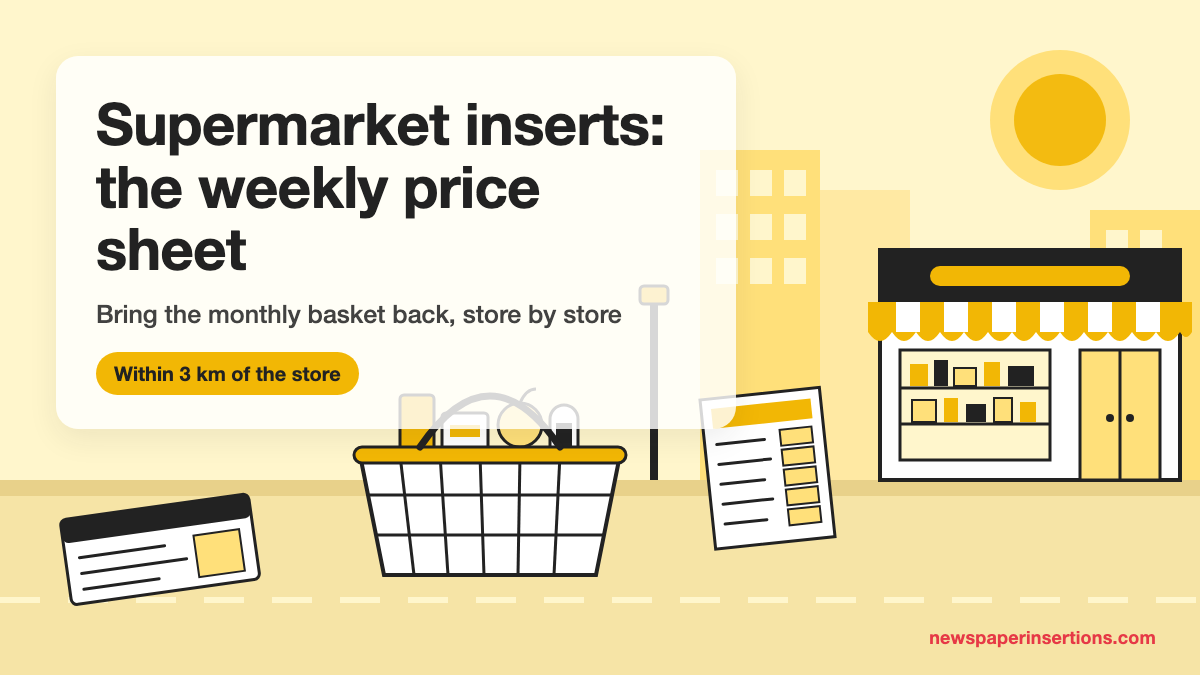
A supermarket lives on the weekly and month-start basket, and a price sheet in the morning newspaper is the oldest way to win it. Print 40 to 80 everyday items with MRP and offer price, drop 50,000 copies into the pin codes within 3 km of the store on the Friday before a shopping weekend, and count bills. At ₹2.00 per copy for A2 newsprint, that is ₹1,00,000 plus GST per drop.
Key Takeaways
- Grocery is a repeat, price-led, short-distance purchase. The household decides where to shop this week by comparing prices on things it already buys, and it rarely travels more than 3 km to do so. That is the profile of a newspaper insert at its best.
- The two shopping peaks are the first week of the month, when salaries land and the monthly stock-up happens, and the weekend. A Friday drop ahead of the first weekend of the month catches both.
- The sheet that works is a price list, not a brand poster: 40 to 80 items, MRP and offer price side by side, the per-kg or per-litre price on staples, the offer dates and a cut-out coupon or "show this sheet" line.
- A2 newsprint at ₹2.00 per copy is the natural format for a long price list; glossy A4 at ₹1.50 suits a festive hamper or a new-store sheet; A5 at ₹1.20 works as a single-coupon reminder.
- Fifty thousand A2 copies cost ₹1,00,000 plus GST. On the 0.5 to 2 percent response band we observe across campaigns with a clear offer, that is 250 to 1,000 bills per drop, or ₹100 to ₹400 per bill before the basket value and repeat visits are counted.
Why do supermarkets and grocery chains suit newspaper inserts?
Most of the categories on this blog sell something a household buys once or twice a year. Grocery is the opposite, and the difference favours the insert in three ways.
It is bought every week. A family shops for groceries four to eight times a month, and the question each time is not whether to buy but where. A medium that lands on the breakfast table on a specific morning, with a specific store's prices on it, answers that question at the moment it is asked. Our guide to the best days for newspaper insertions explains why a weekend morning drop is read as a household and why that matters for a purchase the whole house consumes.
It is decided on price. Nobody chooses a supermarket for its brand story. The household compares the price of atta, oil, rice, sugar, milk, detergent and a few branded items it buys every month, and goes where the basket is cheapest this week. A printed sheet of prices is the only local medium that lets the household make that comparison at home, with the kitchen cupboard in view.
It is a short-distance purchase. Our store-opening guide gives the rule of thumb we use across categories: groceries and pharmacies draw from 2 to 3 km, apparel and electronics from 5 to 8, furniture and vehicles from 10 or more. A supermarket's whole customer base lives inside a few pin codes, which is exactly the unit a newspaper vendor network delivers to. Our pin-code targeting guide lists supermarkets among the businesses that gain most from pin-code targeting for that reason.
Across the campaigns we have run since 2020 in 30+ cities, grocery sheets behave differently from almost every other category in one respect: the response is counted in bills on the same weekend, not in enquiries over a fortnight. That makes them one of the easiest campaigns to judge honestly, and one of the easiest to repeat.
When should a supermarket drop a price sheet?
The grocery calendar has two rhythms, and the insert should follow both.
The first week of the month. Salaried households stock up on staples in the first seven to ten days after pay day, and the monthly basket is the biggest bill of the month. A sheet dropped on the Friday before the first weekend of the month, with staples priced on it, reaches the household while the monthly list is being written. In our experience this is the single strongest drop of the month for a supermarket, and the one most worth repeating every month.
The weekend top-up. Fresh produce, bakery, dairy and the week's branded items are bought on Saturday or Sunday. A Friday or Saturday morning drop with a weekend-only price on eight to twelve items brings the top-up basket in. Our guide to how often to repeat a newspaper insertion covers why a fortnightly or monthly rhythm into the same pin codes builds recognition in a way a single drop cannot, and grocery is the category where that rhythm is most natural.
The festive stock-up. The fortnight before Diwali is the largest grocery fortnight of the year: dry fruits, sweets, ghee, oil, flour, gifting packs and cleaning products all peak. Dhanteras 2026 falls on Friday 6 November and Diwali on Sunday 8 November, so the stock-up sheet belongs in the house between Friday 30 October and Thursday 5 November. Our festival-season planning guide sets out the full calendar, and our Christmas to Republic Day window guide covers the smaller Christmas, New Year and Sankranti peaks that follow.
Check the load on the drop day. Grocery sheets compete with every other retailer's weekend offer. Our guide to how many inserts share your delivery day explains how to ask the vendor network about the load on a given morning. A Thursday or Friday drop is often cleaner than a Saturday drop in the fortnight before Diwali.
Which pin codes and editions should a grocery insert cover?
The 50,000-copy minimum is large for a single store with a 3 km catchment, so the plan has to be made at the level of the chain, not the outlet.
- One store. Rank the pin codes within 3 km by household density and by the ease of carrying a full basket home: the localities a household can reach on foot, by two-wheeler or by auto with four bags. In a dense city, 3 km around a single store can hold more than 50,000 newspaper-reading households, so fill the run from the nearest pin codes outward and stop. Our minimum order guide explains how the 50,000-copy floor works and why it is counted per run.
- A chain with three to eight stores in one city. Split the run into one catchment per store, each with its own pin codes and its own store address on the sheet. One artwork, one print run, several localised drops. Our franchise and multi-city campaign guide covers how to keep the artwork shared and the address panel local.
- A new store. The opening sheet should go wider than the steady-state ring, to 5 km, because the household has not yet put the store on its map. After the first month, pull the ring back to 3 km and repeat monthly.
Edition choice follows the person who writes the shopping list. In most Indian households that is a woman reading the regional-language daily, so a grocery sheet in Lucknow or Jaipur belongs in the Hindi dailies, in Chennai in the Tamil dailies, and in Ahmedabad in the Gujarati ones. A gourmet or imported-foods store in a premium locality of Mumbai or Bangalore is the exception that belongs in the English edition. Our English versus vernacular guide covers how to split a run between the two, and our regional-language copy guide covers why the item names on the sheet should be the ones the shopper uses, not the ones on the pack.
What should the supermarket price sheet actually carry?
The grocery sheets that bring the basket back are price lists with a store address on them. The sheet should carry, in this order of size:
- The offer dates, largest. "Friday 30 October to Sunday 1 November." A price without a date is a price the household will check next month. Print the day names.
- Twelve to twenty hero items with MRP and offer price side by side. Atta, rice, oil, sugar, dal, tea, detergent, milk and a few branded items the household recognises. The MRP next to the offer price is what makes the saving visible. The Legal Metrology (Packaged Commodities) Rules, 2011 require the MRP on every pre-packaged item and prohibit selling above it, so the MRP on the sheet should be the one printed on the pack, not a round number.
- The per-kg or per-litre price on staples. Shoppers compare loose rice at one price per kg with a 10 kg bag at another, and the sheet should do the arithmetic for them. A unit price on every staple is also the easiest way to be honest about a pack-size change.
- The rest of the list in small type. Forty to sixty further items in a grid, grouped the way the store is laid out: staples, oils, dairy, personal care, home care, snacks, beverages. This is the half of the sheet that lives on the fridge for the week.
- The stock line. "Offer valid while stocks last, minimum 200 units per store" or the equivalent. The Central Consumer Protection Authority's 2022 guidelines on misleading advertisements treat an advertised price that the store cannot supply in reasonable quantity as a bait advertisement and require any limit on quantity to be stated, so print it.
- The coupon or the "show this sheet" line. "₹100 off a bill of ₹1,500 with this coupon" or "show this sheet for the weekend price." This is the line that makes the insert countable, and it is covered below. Our coupon inserts guide explains why grocery and personal care, bought often, give a coupon more chances to be used than any one-time purchase.
- The store address with a landmark, hours and the home-delivery line. "Next to the bus depot, 8 am to 10 pm, free delivery within 2 km on bills above ₹1,000, WhatsApp order line." If the chain has several stores, each drop's sheet carries its own store panel.
Our guide to designing an insert people keep covers the layout rules; for a grocery sheet the test is whether the household can find the price of oil in three seconds and the store's address in five.
Which format and paper suit a grocery sheet?
- A2 newsprint at ₹2.00 per copy is the natural grocery format. Folded to A4 it opens into a four-page price list with room for 60 to 100 items, which is what a monthly stock-up sheet needs. Newsprint is also the right paper for it: the sheet is meant to be read, marked and thrown away in a week, not kept. See the A2 insertion service page for the specification, and our A2 versus A4 versus A5 guide for how readers treat the three sizes.
- Glossy A4 at ₹1.50 per copy suits a festive gifting and hamper sheet, a new-store opening, or a premium store with twenty hero items that want to be pictured. See the A4 insertion service page.
- A5 at ₹1.20 per copy works as a single-coupon reminder in the week after the A2 drop, or for a small store with eight prices and one coupon. See the A5 insertion service page.
Our GSM and paper types guide covers why a grocery sheet does not need art paper and why the saving should go into more copies, not heavier paper.
Should FMCG brands share the cost of a retailer's sheet?
Yes, and this is the one category where the sharing is routine. A supermarket's price sheet is a shelf in print, and the brands on that shelf have every reason to pay for their panel on it.
- Brand-funded panels. Four to eight brands take a panel each on the retailer's sheet, in exchange for a featured price on their pack. The retailer books the run, owns the artwork and keeps the address panel; the brands fund most of the print. Our shared and co-branded insert guide explains how the invoice and the artwork sign-off work when several parties share one run.
- Launch panels. A new pack or a new brand entering a city often buys the lead panel on the sheet, because a featured price in a known store does more for trial than a brand-only insert. Our FMCG and D2C brand launch guide covers the launch side of that arrangement.
- The rule that keeps it honest. The retailer must be able to supply every featured pack at the featured price for the dates printed. A brand panel on a sheet is a bait advertisement the moment the store runs out on Saturday morning, and the household blames the store, not the brand.
What does a supermarket insert campaign cost, and what response can it bring?
The all-inclusive rates on our pricing page cover printing, insertion and transport: A2 at ₹2.00, A4 at ₹1.50 and A5 at ₹1.20 per copy, with a 50,000-copy minimum per run and GST extra. One A2 drop of 50,000 copies therefore costs ₹1,00,000 plus GST; a monthly rhythm of one A2 stock-up sheet and one A5 coupon reminder costs ₹1,60,000 plus GST per month.
No grocery-specific response benchmark is published in India, and we do not have one to offer. What we can offer is the general band we observe across campaigns with a clear, dated offer: 0.5 to 2 percent of inserted copies produce a direct response, and coupon-led and discount-led inserts for groceries and other frequent purchases sit at the top of that band. For a supermarket the response is a bill, so the planning scenarios per 50,000-copy A2 drop are:
| Response | Bills with the sheet or coupon | Cost per bill |
|---|---|---|
| 0.5 percent | 250 | ₹400 |
| 1 percent | 500 | ₹200 |
| 2 percent | 1,000 | ₹100 |
Scenarios on the agency's general 0.5 to 2 percent response band; not a grocery-specific benchmark.
Cost per bill is the wrong number to stop at. A monthly stock-up bill runs into thousands of rupees, and a household that switches its monthly basket to a store keeps it there for months. Our cost per lead calculation guide walks through why the first bill understates the return for any business whose customers come back, and grocery is the clearest case of that.
How do you measure response to a grocery insert?
A supermarket can count the response to an insert more exactly than almost any other advertiser, because every customer passes a till.
- Count the coupons. A cut-out coupon redeemed at billing is counted at the end of the weekend. Print a different coupon code on each store's sheet so the drops can be compared store by store.
- Count the "show this sheet" bills. Where there is no coupon, the till operator keys a code when the shopper shows the sheet. It is less exact than a coupon, but it costs nothing to set up.
- Compare the weekend's bills with the previous weekend's. The simplest honest measure: bill count and average bill on the drop weekend against the same weekend of the previous month, store by store. Any lift above the normal week-to-week variation is the insert's.
- Ask for the pin code at billing. One question at the till on the drop weekend tells the store which localities responded and which to drop from next month's ring.
- Put a QR code on the sheet. A QR that opens the WhatsApp order line or the loyalty sign-up gives the store a list it can message before the next drop. Our QR tracking guide covers how to set the code up so the scan is attributed to the insert, and our missed call and WhatsApp response guide covers routing the orders that follow.
- Ask for the distribution certificate. Confirm the copies went into the pin codes that were booked before the weekend's bills are read. Our guide to the newspaper insert distribution certificate explains what the certificate should show.
What goes wrong with grocery price sheets?
The failures we see in this category are specific to it.
- Stock-outs on the hero items. The sheet brings the household in on Saturday morning for oil at a featured price, and the oil is gone by eleven. The household leaves with nothing and remembers the store as the one that ran out. Stock the hero items for the full offer period before the run is booked.
- Prices that do not match the shelf. A sheet printed ten days ahead with a price the supplier then changed. Every price on the sheet should be confirmed against the shelf on the morning of the drop, and the till should honour the printed price for the dates printed regardless.
- No dates. A price list without an offer period is a reference the household files for later. Print the dates largest.
- Spending the run city-wide. Fifty thousand copies across a metro are a rounding error. The same copies into the 2 to 3 km ring around each store are a visible lift in Saturday's bill count.
- Dropping once. A grocery household switches stores slowly. One sheet brings a trial basket; a monthly sheet brings the monthly basket. Budget for the rhythm, not for the drop.
Our common newspaper insertion mistakes guide covers the errors shared across categories; the five above are the ones grocery adds.
Supermarket price-sheet checklist
- Pick the drop: the Friday before the first weekend of the month, the Friday before a shopping weekend, or the fortnight before Diwali (30 October to 5 November in 2026).
- Rank the pin codes within 3 km of each store by household density and ease of carrying a basket home, and fill 50,000 copies per run from the nearest outward; split a chain's run into one catchment per store.
- Print the offer dates largest, twelve to twenty hero items with MRP and offer price side by side, the per-kg or per-litre price on staples, and the rest of the list in a grid grouped as the store is laid out.
- Print the stock line with a minimum quantity, and confirm every price against the shelf on the morning of the drop.
- Put a coupon or "show this sheet" line, a QR to the WhatsApp order line, the store address with a landmark, hours and the delivery radius on the sheet.
- Choose A2 newsprint for the stock-up sheet, glossy A4 for a festive or opening sheet, A5 for a coupon reminder.
- Count coupons and bills on the drop weekend against the previous month's same weekend, ask for pin codes at the till, and repeat monthly into the pin codes that responded.
Current rates for your city are on our pricing page, and city pages such as Hyderabad, Pune and Kolkata list the editions and localities we cover.
Planning a monthly price sheet for your stores?
Get a free quote with the pin codes within 3 km of each store, the regional-language editions that reach the household's shopper and the cost per copy for A2 newsprint, glossy A4 or an A5 coupon. We respond within two hours.
Get Free Quote