The Short Answer
A sweet shop makes more in the ten days before Diwali than in most whole months, and the orders that matter most, the gift boxes, are decided at home a week early. Print a pictured catalogue of three to five boxes with the price and weight of each, a pre-booking line and a pickup date, drop glossy A4 copies into the pin codes within 3 km of the counter on the weekend before Dhanteras, and count bookings. At ₹1.50 per copy, 50,000 copies cost ₹75,000 plus GST.
Key Takeaways
- Festive sweets, dry fruits and bakery hampers are an immediate-consumption category: the household buys in the last four days before the festival, but it decides which shop and which box a week earlier, at home. An insert in that week shapes the decision; an insert on the festival day arrives after it.
- The 2026 window runs from Dhanteras on Friday 6 November to Bhai Dooj on Wednesday 11 November, with Diwali on Sunday 8 November. The gifting drop belongs on Friday 30 October or Saturday 31 October, and a reminder drop on Thursday 5 November. Bakeries get a second season at Christmas, and sweet shops a third in the wedding months.
- A counter shop draws walk-in trade from 2 to 3 km, but gift orders come from two further sources: households sending boxes across the city and offices ordering in bulk. The run should be split between the home ring and the office pin codes.
- The sheet that pre-books orders is a priced catalogue, not a festive greeting: three to five boxes pictured, the net weight and price of each, the last date to book, the pickup or delivery slot, a WhatsApp order line and the shop's address with a landmark.
- Fifty thousand glossy A4 copies cost ₹75,000 plus GST. On the 0.5 to 2 percent response band we observe across campaigns with a clear, dated offer, that is 250 to 1,000 orders, or ₹75 to ₹300 per order before the order value and the walk-in trade the sheet also brings are counted.
Why do sweet shops and bakeries suit newspaper inserts at Diwali?
Most of the categories on this blog sell something a household buys once or twice a year after a long comparison. Festive sweets and gifting are the opposite in two ways and the same in a third, and all three favour the insert.
The purchase is customary and dated. Nobody wonders whether to buy sweets for Diwali. The questions are which shop, which box, how many and by when, and every household in the city asks them in the same ten days. Our festival-season planning guide places sweets, food and last-minute gifting among the immediate-consumption categories that buy in the last four to two days before a festival, and explains why festival buying in India is customary rather than impulsive.
The decision is made at home, before the rush. A box of kaju katli is bought at the counter on the day, but the eight boxes for relatives and the forty for the office are decided at the dining table the weekend before, usually by comparing a few shops' prices and weights. That is a household, printed, side-by-side comparison, which is the job a newspaper insert does better than any other local medium. Our guide to the best days for newspaper insertions explains why weekend morning reading is household reading.
The catchment is short, like grocery. Our wedding-season post puts sweet shops with salons, clinics and tailors among the trades that draw from 2 to 3 km, and lists sweets and dry fruits among the spends that rise with every wedding date. A sweet shop's whole walk-in trade lives in a handful of pin codes, which is exactly the unit a newspaper vendor network delivers to. The pin-code targeting guide covers how that unit works.
Across the campaigns we have run since 2020 in 30+ cities, the festive sweet and gifting sheets that paid for themselves shared one trait: they asked for a booking, not a visit. A sheet that says "visit us this Diwali" competes with every shop in the locality. A sheet that says "book your boxes by Tuesday for Friday pickup" turns the reader into an order before the counter rush begins.
When should a sweet shop or bakery drop the insert?
The gifting calendar has three seasons, and the drops are different for each.
The Diwali gifting week. In 2026 Dhanteras falls on Friday 6 November, Diwali on Sunday 8 November and Bhai Dooj on Wednesday 11 November. Gift boxes are exchanged from Dhanteras through Bhai Dooj, so the decision week is the one before: Friday 30 October to Thursday 5 November. The main drop belongs on Friday 30 or Saturday 31 October, when the household reads together and the pre-booking window is still open. A second, smaller drop on Thursday 5 November, the day before Dhanteras, catches the walk-in buyer with a "boxes ready, no waiting" message. Our festival guide notes that gifting and sweets ride the Diwali sheet and that Bhai Dooj needs no separate drop, and we agree.
If you are reading this on publication day. This post goes live on Thursday 29 October 2026. A Saturday 31 October drop is possible only if artwork is approved within a day and the vendor network has space, which in metro editions it may not; our seven-day campaign timeline shows the minimum lead each step needs. The honest advice is to book the Thursday 5 November reminder drop now, plan the full gifting sheet for Christmas or the wedding months, and put the 2027 Diwali drop in the diary for early October next year.
Chhath in the east. Patna, Ranchi and the eastern Uttar Pradesh editions treat Chhath, Sunday 15 November in 2026, as the peak rather than Diwali. Sweet shops in those cities should plan the gifting sheet for the weekend before Chhath. Our Hindi dailies guide covers the editions that matter there.
Christmas and New Year for bakeries. Plum cake, cookies and hamper orders peak in the week before Friday 25 December, and corporate hampers are booked earlier still. The Christmas to Republic Day window guide covers which week each category buys in; for a bakery the drop belongs on the weekend of 19 and 20 December, with hamper pre-booking as the headline.
Wedding orders. A wedding household orders sweets and dry fruits by the tray and the kilogram for the engagement, the mehendi and the return gifts, and it orders two to three weeks before the date. Our wedding-season post lists the November to February muhurat clusters; a sweet shop near a banquet hall or a wedding-garment market can run a priced per-kilogram sheet into the surrounding pin codes a fortnight before each cluster.
Check the load on the drop day. The weekend before Dhanteras is one of the most crowded insert mornings of the year. Our guide to how many inserts share your newspaper delivery day explains how to ask the vendor network about the load, and why a Friday drop is often cleaner than a Saturday one in that fortnight.
Which pin codes should a sweet shop or bakery cover?
The 50,000-copy minimum is large for a single counter with a 3 km catchment, so the run has to be built from three audiences, not one.
- The home ring, first. Rank the pin codes within 3 km of the counter by household density and by the route a family takes to the shop. In a dense city, 3 km around a single shop can hold more than 50,000 newspaper-reading households, so fill the run from the nearest pin codes outward. Our minimum order guide explains how the 50,000-copy floor is counted per run.
- The office pin codes, second. Corporate Diwali gifting is ordered by an office manager or a small-business owner, and it is the largest single order a sweet shop takes all year. Reserve 10,000 to 15,000 copies for the pin codes with offices, markets and industrial estates within delivery distance, and give the sheet a visible bulk-order panel. Our B2B and trade audiences guide covers how to reach a business owner through the paper that reaches the home.
- The chain with several counters. A sweet-shop chain with four to eight outlets in one city should split the run into one ring per counter, each with its own address panel and pickup point on the sheet, so the booking lands at the counter nearest the buyer. Our franchise and multi-city campaign guide covers how to keep one artwork and localise the address.
Edition choice follows the person who writes the gift list. In most households that is a woman reading the regional-language daily, so a sweet shop in Lucknow, Indore or Jaipur belongs in the Hindi dailies, and in Kolkata, where the sweet-shop trade is a civic institution, in the Bengali dailies. A premium dry-fruit or patisserie brand in a high-income locality of Mumbai, Delhi or Bangalore is the exception that belongs in the English edition. Our English versus vernacular guide covers how to split a run between the two.
What should the gifting sheet carry?
The sheets that pre-book orders are catalogues with a deadline on them. In order of size:
- The last date to book, largest. "Book by Tuesday 3 November for Dhanteras pickup." A gifting sheet without a booking date is a greeting card the household admires and forgets.
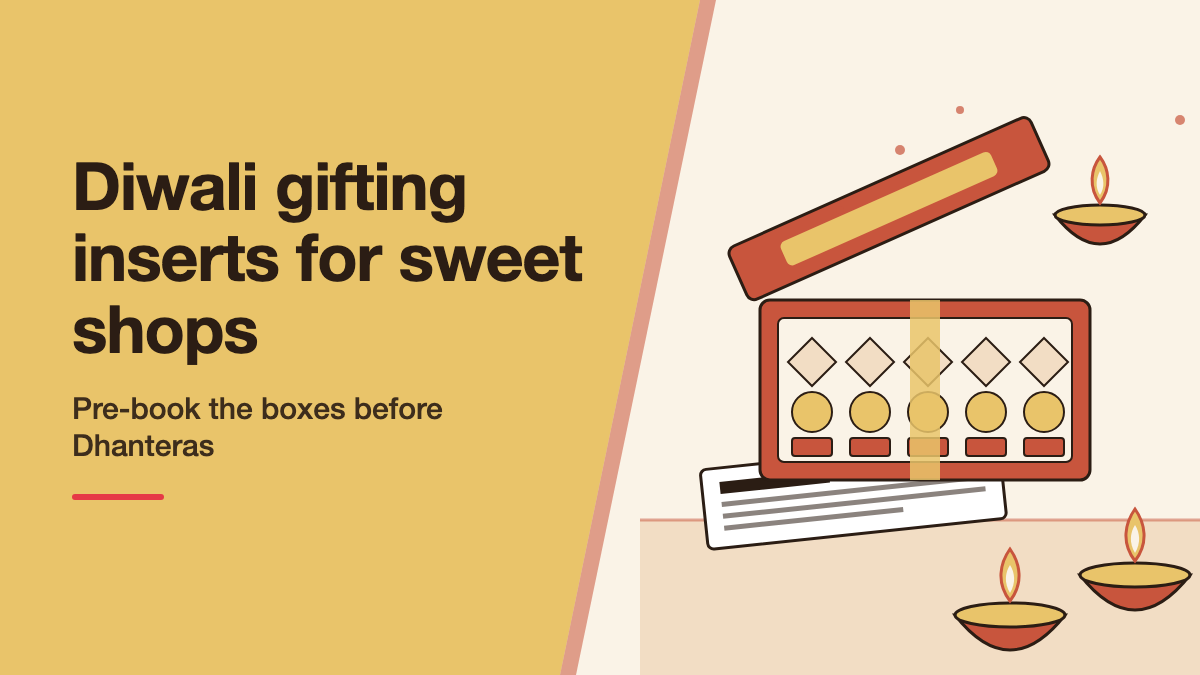
- Three to five boxes, pictured, with net weight and price. A 500 g assorted box, a 1 kg kaju-and-pista box, a dry-fruit tray, a bakery hamper. The weight next to the price is what lets the household compare shops honestly, and for a pre-packaged box it is also the law: the Legal Metrology (Packaged Commodities) Rules, 2011 require the net quantity and the maximum retail price on every pre-packaged commodity, and prohibit selling above the declared MRP.
- The per-kilogram price on the loose sweets. Households buying for the home still buy by weight, and the per-kg price on six to eight favourites is what brings the walk-in trade in alongside the gift orders.
- The bulk-order panel. "Orders of 25 boxes and above: custom sleeve, free delivery within the city, GST invoice." Print the WhatsApp number for bulk orders separately from the counter number so the office enquiry is not lost in the rush.
- The freshness and shelf-life line. The Food Safety and Standards Authority of India has required since 1 October 2020 that shops display the best-before date on loose, non-packaged sweets on the tray or container, and packaged boxes carry a date under the labelling regulations in any case. Saying on the sheet how long each box keeps, and that the boxes are made to order for the pickup date, turns a compliance line into a reason to pre-book.
- The pickup and delivery slots. "Pickup from Thursday 5 November, 10 am to 9 pm; home delivery within 3 km on orders above ₹1,500." A buyer who knows the box is ready for collection on a stated day does not need to queue.
- The address with a landmark, hours and the festival-week timing. Diwali week hours are longer than normal hours; print them.
If the sheet carries a discount, the Central Consumer Protection Authority's 2022 guidelines on misleading advertisements require the conditions attached to any "up to" or festive offer to be stated with the offer, and treat a price the shop cannot supply in reasonable quantity as a bait advertisement. A booking deadline and a per-box stock line keep the sheet on the right side of both.
Our guide to designing an insert people keep covers the layout rules; for a gifting sheet the test is whether the household can find the price of the 1 kg box in three seconds and the booking date in five.
Which format and paper suit a gifting sheet?
- Glossy A4 at ₹1.50 per copy is the natural format. Gift boxes sell on appearance, and a pictured catalogue of four or five boxes on glossy stock is kept on the fridge or the office desk through the booking week. See the A4 insertion service page for the specification, and our glossy A4 guide for jewellery and premium retail for why premium categories justify the stock.
- A5 at ₹1.20 per copy suits the Thursday reminder drop, a single-counter shop with three boxes and a booking line, or a bakery's Christmas hamper card. See the A5 insertion service page.
- A2 newsprint at ₹2.00 per copy rarely fits this category. A sweet shop does not need a sixty-item price list, and newsprint does not flatter a picture of a mithai box. The exception is a wedding-season per-kilogram sheet for a large traditional shop, where the long list matters more than the picture. Our A2 versus A4 versus A5 guide covers how readers treat the three sizes.
Our GSM and paper types guide explains why A4 and A5 inserts run on 90 to 130 GSM glossy art paper while A2 runs on newsprint, and what heavier stock adds to the rate.
What does a sweet-shop gifting campaign cost, and what response can it bring?
The all-inclusive rates on our pricing page cover printing, insertion and transport: A2 at ₹2.00, A4 at ₹1.50 and A5 at ₹1.20 per copy, with a 50,000-copy minimum per run and GST extra. One glossy A4 gifting drop of 50,000 copies therefore costs ₹75,000 plus GST, and the two-drop Diwali plan, a glossy A4 catalogue on the weekend before Dhanteras and an A5 reminder on the Thursday, costs ₹1,35,000 plus GST.
No response benchmark for festive sweets or gifting is published in India, and we do not have one to offer. What we can offer is the general band we observe across campaigns with a clear, dated offer: 0.5 to 2 percent of inserted copies produce a direct response, and dated, deadline-led offers for frequent purchases sit towards the top of it. For a sweet shop the response is a booked order, so the planning scenarios for one 50,000-copy glossy A4 drop are:
| Response | Orders booked from the sheet | Cost per order |
|---|---|---|
| 0.5 percent | 250 | ₹300 |
| 1 percent | 500 | ₹150 |
| 2 percent | 1,000 | ₹75 |
Scenarios on the agency's general 0.5 to 2 percent response band; not a category benchmark.
Cost per order is the wrong number to stop at. A household gift order runs to several boxes, an office order to dozens, and the same sheet brings walk-in trade that no booking line captures. Our cost per lead calculation guide walks through why the first order understates the return for any business whose customers come back, and a sweet shop's Diwali buyer comes back at Holi, Raksha Bandhan and every wedding.
How do you measure response to a gifting insert?
A sweet shop can count the response more exactly than most advertisers, because every gift order is booked by name.
- Count the pre-bookings by source. Ask every booking, at the counter or on WhatsApp, how the customer heard. Print a booking code on the sheet, and a different code on the office-area sheet, so the home ring and the office pin codes can be compared.
- Count the "show this sheet" bills. Where there is no coupon, a till code when the buyer shows the sheet costs nothing to set up. Our coupon inserts guide covers how to design a coupon that gets cut out and what redemption to expect.
- Route the bulk orders through one number. A dedicated WhatsApp line for orders of 25 boxes and above gives a clean count of the corporate response and a list to message before Christmas and next Diwali. Our missed call and WhatsApp response guide covers setting the line up so no enquiry waits unanswered in the busiest week of the year.
- Put a QR code on the sheet. A QR that opens the catalogue and the order form on WhatsApp gives the shop a list, and tells it which pin codes scanned. Our QR tracking guide covers how to attribute the scan to the insert.
- Compare Diwali week with last year's. The simplest honest measure: boxes sold and bookings taken in the ten days before Diwali against the same ten days last year, counter by counter. Any lift above the year's normal growth belongs to the campaign.
- Ask for the distribution certificate. Confirm the copies went into the pin codes that were booked before the bookings are read. Our guide to the newspaper insert distribution certificate explains what it should show.
What goes wrong with festive sweet and gifting inserts?
The failures we see in this category are specific to it.
- Dropping on Dhanteras. The sheet arrives the morning the boxes are being bought, after the household has already chosen a shop. The gifting drop belongs the weekend before; Dhanteras is for the reminder.
- A greeting instead of a catalogue. A full-page diya and "Happy Diwali from the family" with no prices, no weights and no booking date. It is pleasant, and it sells nothing the shop would not have sold anyway.
- No weight next to the price. A ₹799 box with no net weight invites the comparison the household makes anyway, against the shop that printed 500 g.
- Running out of the pictured box. The sheet brings forty office orders for the 1 kg assorted box and the shop can make twenty a day. Match the pictured boxes to what the kitchen can produce in the booking window, and print a booking deadline that protects it.
- Spending the run city-wide. Fifty thousand copies across a metro are a rounding error. The same copies into the 3 km ring and the office pin codes are a visible queue of bookings.
- Treating Diwali as the only season. A bakery that drops once in November misses Christmas; a sweet shop that drops once misses the wedding months and Holi. Budget for the calendar, not for one festival.
Our common newspaper insertion mistakes guide covers the errors shared across categories; the six above are the ones festive gifting adds.
Sweet-shop and bakery gifting checklist
- Pick the drop: Friday 30 or Saturday 31 October 2026 for the Diwali gifting catalogue, Thursday 5 November for the reminder, the weekend of 19 and 20 December for Christmas hampers, and a fortnight before each wedding cluster for per-kilogram sheets.
- Fill the run from the pin codes within 3 km of each counter outward, and reserve 10,000 to 15,000 copies for office and market pin codes with a bulk-order panel.
- Print the booking deadline largest, three to five boxes pictured with net weight and price, the per-kilogram price on loose favourites, the shelf-life line, the pickup and delivery slots, and the address with a landmark and festival-week hours.
- Give bulk orders their own WhatsApp number and print a booking code per sheet variant.
- Choose glossy A4 for the catalogue, A5 for the reminder; use A2 only for a long wedding-season price list.
- Confirm the kitchen can produce the pictured boxes in the booking window before the artwork is approved.
- Count bookings by code, bulk orders by line, and Diwali-week sales against last year, then message the list before Christmas and the next Diwali.
Current rates for your city are on our pricing page, and city pages such as Hyderabad, Ahmedabad and Pune list the editions and localities we cover.
Planning a festive gifting catalogue for your counters?
Get a free quote with the pin codes within 3 km of each counter, the office pin codes for bulk orders, the regional-language editions that reach the household's gift list and the cost per copy for glossy A4 or an A5 reminder. We respond within two hours.
Get Free Quote