The Short Answer
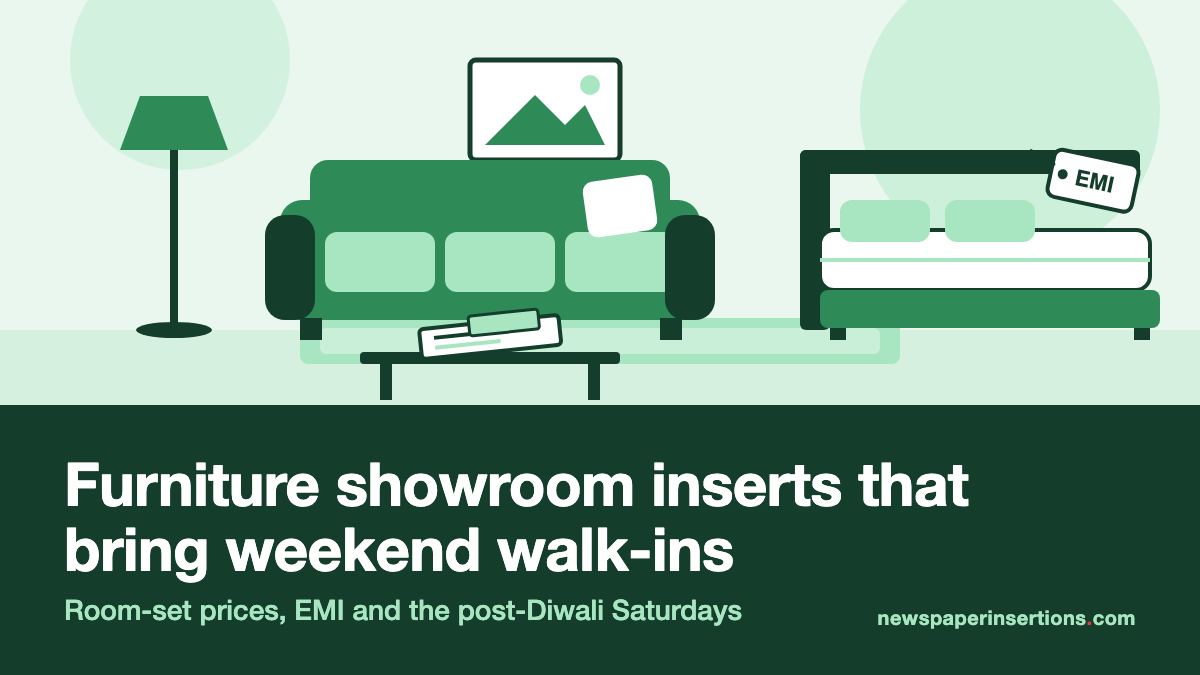
Furniture is a joint household decision made on a weekend visit, which is exactly how a newspaper insert is read. Print a full room set at one price, the EMI per month, the free-delivery radius and a WhatsApp number, drop glossy A4 copies into the pin codes within 10 km of the showroom on the Saturdays after Diwali and in the last fortnight before wedding dates, and measure walk-ins. At ₹1.50 per copy, 50,000 copies cost ₹75,000 plus GST.
Key Takeaways
- Furniture is bought by the household together, usually on a weekend showroom visit, after seeing a price. A weekend insert with real prices is the closest match any local medium offers to that behaviour.
- The strongest furniture windows are the Saturdays after Diwali (14, 21 and 28 November in 2026), the final two to three weeks before wedding dates, and the Republic Day sale weekends. Diwali week itself belongs to gold and electronics.
- A furniture showroom draws customers from 10 km or more, so plan the 50,000-copy minimum as a ring of pin codes ranked by new-flat possessions and family households, not as the nearest four localities.
- Print a two-room set at one number, a sofa, bed and dining price each, the EMI per month, the delivery and assembly promise with its radius, and the mattress trial or warranty terms. Leave the brand story for the showroom wall.
- At ₹1.50 per copy for glossy A4, 50,000 copies cost ₹75,000 plus GST. On the 0.5 to 2 percent response band we observe across campaigns with a clear offer, that is 250 to 1,000 enquiries, or ₹75 to ₹300 per enquiry before conversion.
Why do furniture and mattress buyers respond to newspaper inserts?
Three features of the purchase line up with how an insert is consumed.
It is decided jointly. A sofa, a bed, a dining set or a wardrobe is rarely bought by one person. The couple, and often the parents, agree on it together, and that conversation happens at home on a weekend morning, which is when the newspaper is read as a household. Our guide to the best days for newspaper insertions explains why weekend reading is household reading and why that matters for any purchase decided together.
It is bought on a visit. Almost nobody orders a ₹40,000 sofa from a leaflet. They shortlist from the leaflet and visit on Saturday or Sunday to sit on it. An insert that lists prices does the shortlisting; the showroom does the selling. The insert's only job is to put the showroom on the weekend's route, with a reason to go now.
It is a price-led category with high tickets. Households compare furniture on price far more than on brand, and a room set runs from ₹60,000 to several lakhs. A single converted visit pays for a large share of a 50,000-copy drop, which is why cost per enquiry matters less here than in low-ticket retail.
Across the campaigns we have run since 2020 in 30+ cities, furniture and interiors sit alongside real estate, schools and clinics among the categories that gain most from pin-code targeting, because the customer travels a known distance and the household address is the buying unit.
When should a furniture showroom drop an insert?
Furniture has its own calendar, and it is not the same as the electronics or jewellery calendar.
The Saturdays after Diwali. In the ten days before Diwali, the household budget goes to gold, electronics and clothing, and the paper is crowded with those offers. Furniture buying resumes once the festival is over, when the house has been cleaned and the family has seen what the old sofa looks like next to the new television. Diwali 2026 falls on Sunday 8 November, so the furniture window runs through Saturday 14, Saturday 21 and Saturday 28 November. Our festival-season planning guide sets out why the fortnight after Diwali is often the strongest fortnight of the year for property, vehicles and furniture, and why it is far easier to book than the week before.
The final fortnight before wedding dates. Furniture for the new couple's room, a dining set for the hosting family and a mattress for the guest room are bought in the last two to three weeks before the wedding, not months ahead. The wedding-season planning post lists the November to February muhurat clusters and shows where furniture and appliance stores sit among the trades that sell against them.
Christmas to Republic Day. Furniture and mattress showrooms can use the same two weekends in the second half of January that electronics chains use for Republic Day sales, and the Christmas and New Year weekends are strong for households buying before guests arrive. The December to January window guide covers which category buys in which week.
Possession weeks. The single most reliable furniture trigger is a family receiving keys to a new flat. A tower handing over 300 flats in a month is 300 households that each need a bed, a sofa and a dining set within weeks. Watch the possession schedules of projects in your catchment and drop into those pin codes in the possession month. Our launch versus possession-ready campaigns post describes how possession timing is announced and how to read it.
Spring festival dates. Gudi Padwa, Ugadi, Akshaya Tritiya and the start of the Bengali and Tamil new year are all traditional dates for buying for the home. The 2027 dates should be checked against a published panchang before the artwork is approved; regional observance can differ by a day.
Which pin codes should a furniture showroom target?
A furniture showroom draws from a wider ring than most retail. Our store-opening guide gives the rule of thumb: groceries and pharmacies draw from two to three kilometres, apparel and electronics from five to eight, and furniture, two-wheeler and appliance showrooms from ten or more. Because 50,000 copies rarely cover a full 10 km ring in a dense city, the copies have to be ranked, not scattered.
Rank the ring on three signals:
- New possessions in the last 12 months. Societies that handed over flats in the past year are still furnishing. A list of recently completed projects in the catchment is the best targeting input a furniture showroom can have.
- Family households, not bachelor pockets. A locality of paying-guest accommodation and one-room rentals buys mattresses, not dining sets. Pin codes with schools, parks and two-BHK and three-BHK stock buy full room sets.
- Road time to the showroom. Ten kilometres across a ring road is a different trip from ten kilometres through old-city traffic. Choose pin codes from which the showroom is a comfortable Saturday afternoon drive, because that is when the visit happens.
In practice that gives a 50,000-copy plan of six to ten pin codes, weighted toward the two or three with the most recent possessions. Our pin-code targeting guide explains how editions and vendor rounds map onto pin codes so the plan can actually be executed, and our guide to how newspaper distribution works covers the vendor-round layer underneath.
What should the furniture insert actually carry?
The furniture inserts that bring weekend walk-ins are catalogues with prices, not brand posters. The sheet should carry:
- One room set at one number. "Two-bedroom package: double bed, wardrobe, sofa set and four-seater dining, ₹1,29,000." A single figure for a furnished home is the headline most households are waiting to see, and it is what gets photographed and sent to the other spouse.
- Hero items priced individually. A three-seater sofa, a queen bed with storage, a six-seater dining set, a sliding wardrobe. Four to six items with a photo, the material in one line, and the price.
- The EMI per month. A ₹48,000 sofa reads as a big decision; "₹4,000 a month for 12 months" reads as a decision the family can make this weekend. Print the EMI the finance partner has actually approved, with its tenure, and state the processing fee if there is one.
- Delivery and assembly, with a radius. "Free delivery and assembly within 15 km, delivered within 7 days." Delivery cost and lead time are the two questions every furniture buyer asks, and answering them on the sheet removes a reason to postpone the visit.
- Mattress trial and warranty terms. A mattress is bought on trust: "100-night trial, 10-year warranty" on the sheet does more than any photo. State the exact terms your supplier honours, nothing more.
- Old-furniture pickup or exchange, if offered. Some chains offer a fixed credit against an old sofa or bed. If you do, print it as a number; if you do not, do not imply it.
- A WhatsApp number and a map line. "WhatsApp a photo of your room for a quote" is a route that suits furniture better than any form, and a two-line "how to reach us" with a landmark is the difference between a shortlist and a visit.
For the sheet itself, our design guide for inserts people keep covers the layout rules, and the artwork checklist covers bleed, sizes and file formats.
Which format and paper suit a furniture insert?
Furniture is photographed, and the photographs sell. That argues for glossy art paper, which reproduces fabric and wood grain far better than newsprint.
| Format | All-inclusive rate* | 50,000 copies | Best use for a furniture showroom |
|---|---|---|---|
| A4 glossy, 90 GSM | ₹1.50 per copy | ₹75,000 | Four to six hero items, one room-set price, the EMI line. The default for a single showroom. |
| A2 newsprint | ₹2.00 per copy | ₹1,00,000 | A 20 to 30 item catalogue for a large-format store or a clearance sale where readers compare many SKUs. |
| A5 glossy, 90 GSM | ₹1.20 per copy | ₹60,000 | A single mattress offer, or a possession-month "furnish your new flat" card for one society cluster. |
*Rates include printing, insertion and transport; GST extra; minimum order 50,000 copies. City-wise rates are on our pricing page.
For most single showrooms, glossy A4 is the right default: it holds six photographs and a price table without crowding. A big-box store with a long catalogue should look at A2 newsprint, accepting that wood and fabric reproduce flatter on newsprint. Our A2 vs A4 vs A5 guide works through the trade-off, and the GSM and paper guide covers why 90 GSM glossy is the standard for product photography.
What does a furniture insert campaign cost per walk-in?
Treat these as planning scenarios on the general response band we observe across campaigns with a clear, priced offer, not as a furniture-specific guarantee.
| Scenario | Copies | Cost (ex GST) | Enquiries at 0.5% | Enquiries at 2% | Cost per enquiry |
|---|---|---|---|---|---|
| A4 glossy, post-Diwali Saturday | 50,000 | ₹75,000 | 250 | 1,000 | ₹75 to ₹300 |
| A2 newsprint catalogue, clearance sale | 50,000 | ₹1,00,000 | 250 | 1,000 | ₹100 to ₹400 |
| A5 glossy, possession-month mattress card | 50,000 | ₹60,000 | 250 | 1,000 | ₹60 to ₹240 |
Printing, insertion and transport included; GST extra. The 0.5% to 2% band is the agency's general observation across campaigns with a clear call to action, not a furniture-specific benchmark.
An enquiry here is a WhatsApp message, a call or a walk-in with the sheet in hand. If one in five enquiries buys a ₹50,000 room set, the lowest scenario above produces 50 sales and ₹25 lakh of billing from a ₹75,000 drop. If only one in twenty buys, it is still ₹6 lakh. The arithmetic is forgiving because the ticket is large; the risk is not the response rate but a sheet without prices, which produces browsing rather than visits. Our cost per lead guide sets out how to run these numbers for your own showroom.
Two observations from campaigns in this category. First, response arrives over two weekends, not one: the household that reads the sheet on Saturday often visits the following weekend, so judge the drop after 14 days. Second, a second drop into the same pin codes three to four weeks later, with the room-set price unchanged, consistently adds visits from households that were not ready the first time. Our guide to how often to repeat a newspaper insertion covers the gap by category.
How should a showroom handle the response?
Furniture enquiries want to see things in their own room. Set up a WhatsApp Business number on the sheet with a greeting that asks for a room photo and the item of interest, and answer with the price, the EMI and the delivery date within an hour. Older buyers still call, so print a landline or a missed-call number alongside. Our guide to missed-call and WhatsApp response for print campaigns sets up both routes and shows how to log them against the drop.
On the floor, ask every weekend walk-in whether they came with the sheet, and keep the sheet's room-set price honoured for the stated period even if stock of a pictured fabric runs out. A household that drove 10 km for a printed price and finds it withdrawn does not return. Our guide to tracking insert response with QR codes covers the simplest way to tie a scan to a visit.
How does this differ from an electronics or appliance insert?
The two categories share the showroom, the EMI line and the festive calendar, but the timing and the sheet differ. Electronics peaks in the ten days before Dhanteras and sells on exchange value; furniture peaks on the Saturdays after Diwali and sells on room-set pricing and delivery. An appliance sheet is a price list of models; a furniture sheet is a set of rooms. A retailer who sells both should run them as two drops two weeks apart rather than one combined sheet, so each lands in its own window. Our electronics and appliance retailer guide covers the appliance side.
What do we actually observe in this category?
What we can say from our own campaigns since 2020, across 500+ runs in 30+ cities, without overstating it:
- Furniture and interiors inserts are planned the way real estate inserts are: by catchment and possession timing, not by newspaper brand.
- Sheets with a room-set price and an EMI line generate visits; sheets with a brand message and "visit our showroom" generate very few.
- Weekend drops outperform weekday drops in this category by a wide margin, and the Saturday edition is the preferred day because the visit happens the same afternoon or on Sunday.
- Response spreads over two weekends and a repeat drop adds visits, which is why we plan furniture campaigns as two drops a month apart rather than one large drop.
We do not have a furniture-specific response rate that we would publish as a benchmark; the 0.5 to 2 percent band above is the agency's general observation across categories with a clear offer, and a showroom should set its own baseline from the first drop.
Furniture showroom insert checklist
- Pick the window: a post-Diwali Saturday, the final fortnight before wedding dates, a Republic Day weekend or the possession month of a project in the ring.
- Rank six to ten pin codes within 10 km by recent possessions, family households and Saturday road time, and fill 50,000 copies from the top down.
- Print one room set at one price, four to six hero items with prices, the EMI per month with tenure, delivery and assembly with a radius and a lead time, and mattress trial and warranty terms.
- Print the qualifying line under any "up to" discount and show original and offer prices side by side.
- Put a WhatsApp number that asks for a room photo, a phone number, and a landmark-based map line on the sheet.
- Choose glossy A4 for a single showroom; A2 for a long catalogue; A5 for a single mattress or possession-month card.
- Judge the drop after 14 days, then repeat into the same pin codes three to four weeks later with the room-set price unchanged.
Current rates for your city are on our pricing page, and city pages such as Pune, Hyderabad and Ahmedabad list the editions and localities available.
Planning a post-Diwali or wedding-season furniture drop?
Get a free quote with the pin codes within 10 km of your showroom, the editions that cover them and the cost per copy for glossy A4 or A2 newsprint. We respond within two hours.
Get Free Quote