The Short Answer
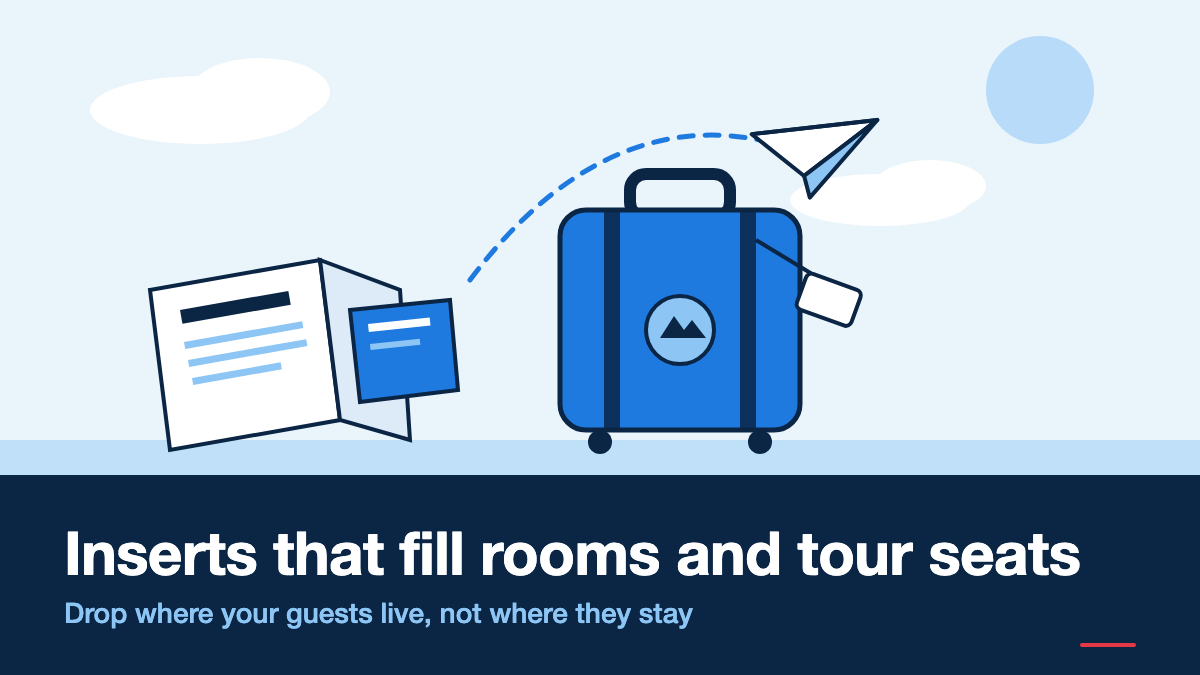
Newspaper inserts fill rooms and tour seats when they land in the city where travellers live, weeks before they book. A Goa resort drops in Pune and Mumbai, not Goa. A city hotel drops at home only for staycations, banquets and dining. Time each drop to the booking window and carry one dated package with a clear price.
Key Takeaways
- Travel is bought at home. Leisure hotels, resorts and tour operators should insert in the source cities their guests come from, not in the destination.
- City hotels have a second, local market: staycations, weekend brunches, banquets, New Year events and corporate meetings. That drop goes in the hotel's own city.
- Families plan holidays around school breaks and long weekends. The insert has to arrive in the booking window, weeks before the trip, not in the week of travel.
- One package, one date range, one price "from" a stated amount, and a booking number or QR code. A brochure of every room type rarely gets a call.
- Rates are A2 ₹2.00, A4 ₹1.50 and A5 ₹1.20 per copy, all-inclusive of printing, insertion and transport, GST extra, with a minimum of 50,000 copies per drop.
Who in travel and hospitality actually uses newspaper inserts?
Four kinds of business, each with a different reason:
- Leisure resorts and hill or beach hotels that depend on weekend and holiday traffic from one or two big cities a few hours away.
- Tour operators and travel agents selling group tours, pilgrimage circuits, family packages and international departures with fixed dates.
- City hotels selling to their own city: staycation packages, buffets and brunches, banquet and wedding bookings, New Year and festive events.
- Pilgrimage and senior-citizen tour specialists, whose buyers are the most loyal newspaper readers in the household.
What they share is a buyer who decides at home, often as a family, and often with the newspaper on the table. Across the 500+ insertion campaigns we have run since 2020 in 30+ Indian cities, the travel campaigns that worked were the ones that respected where and when that decision gets made.
Should a resort insert in its own city or in its guests' city?
In its guests' city, almost always. A beach resort in Goa does not need Goan households; it needs families in Pune, Mumbai and Bangalore who are deciding where to spend the Christmas break. A heritage hotel near Jaipur draws weekend guests from Delhi NCR. A Kerala houseboat or homestay operator sells to Bangalore and Chennai.
So the planning question is "where do our guests come from?" Answer it from your own data: the billing addresses or phone codes in last year's bookings, or the cities your online travel agent dashboard shows. Two source cities usually account for most leisure guests. Those two are where the drop goes. Our guide to hyperlocal pin code targeting shows how to narrow a big source city to the localities that match your price point, and the Mumbai, Pune and Delhi city pages list the editions available there.
The exception is the city hotel selling to its own city, covered below.
When should travel inserts drop?
In the booking window, which comes well before the travel window. Families plan around school holidays, long weekends and festivals, and the decision is usually made weeks ahead. The planning guidance we give is:
| Travel window | When families usually decide | Suggested drop window |
|---|---|---|
| Christmas and New Year break | Late October to November | Late October to mid-November |
| Summer school holidays (April to June) | February to March | February to early March |
| Puja, Dussehra and Diwali breaks | July to August | July to mid-August |
| Long weekends | Two to four weeks ahead | Three to four weeks ahead |
| Pilgrimage seasons (for example the Char Dham opening) | Two to three months ahead | Ten to twelve weeks ahead |
Planning ranges from our campaign work, not measured booking curves. Check them against your own enquiry log.
The month your phone starts ringing for a season is the month your drop should already be on the doorstep. For festival-linked travel, our festival season planning guide carries the verified 2026 dates. Right now, in mid-October, the Christmas and New Year drop is the one to book.
Repeat matters too. A family that sees a package once may file it; seeing it again ten to fourteen days later is often what turns it into a call. Our post on how often to repeat an insertion explains the spacing.
What should a hotel or tour insert say?
One trip, dated, priced, with a way to book. The most common fault we see in travel creative is the full brochure: every room category, the spa menu, a map and six photographs the size of stamps. A family looking at a sheet over breakfast needs much less:
- The package in one line. "3 nights, 2 adults and 2 children, breakfast and dinner included."
- The dates it is valid for. A date range creates urgency and stops calls about seasons you cannot honour.
- A price "from" a real amount, with what it includes and whether taxes are extra. Hidden extras discovered on the phone kill the booking and the reputation.
- One strong photograph of the view, the pool or the destination, printed large.
- How to book. A dedicated phone or WhatsApp number and a QR code to a booking page with a code unique to this drop.
- For tour operators: the departure dates, the group size, what is included (travel, stay, meals, guide) and the deposit needed to hold a seat.
Keep claims to what you can support. Travel advertising in India falls under the Advertising Standards Council of India (ASCI) code, so "best view in the hills" and invented star ratings are a risk; a real photograph and a clear price are more persuasive anyway. Our guide to designing an insert people keep covers layout, and the missed-call and WhatsApp response guide covers the booking line.
What can a city hotel sell to its own city?
A good deal, and this is where a hotel uses its home edition. Local households and businesses buy:
- Staycation packages for a weekend night with breakfast and pool access, often bought as gifts or for anniversaries.
- Buffets, Sunday brunches and festival menus, which overlap with what our restaurant and cloud kitchen guide covers.
- Banquets and weddings, booked months ahead. The wedding season guide sets out the venue booking window, which is three to six months before the dates.
- New Year's Eve and festive events, where a dated ticket price works well.
- Corporate meetings and day packages, which reach business owners through the paper they read at home.
For these, the catchment is the hotel's own city, weighted towards the localities whose residents already eat out and celebrate at that price point.
Which insert format suits travel and hospitality?
- An A4 glossy insert at ₹1.50 per copy is the usual choice. Travel sells on the photograph, and glossy stock prints a beach or a valley the way the reader hopes it will look.
- An A5 insert at ₹1.20 per copy suits a single offer: one staycation, one brunch, one dated tour departure.
- An A2 newsprint insert at ₹2.00 per copy suits a tour operator with a full season's departure calendar or several destinations on one sheet.
Our comparison of A2, A4 and A5 inserts goes deeper into paper and size.
What does a travel insert campaign cost?
Rates are the same in every city we serve, include printing, insertion and transport, exclude GST, and start at 50,000 copies per drop. A resort targeting two source cities with a follow-up in each might look like this:
| Drop | Format | Copies | Cost before GST |
|---|---|---|---|
| Source city 1, first drop | A4 glossy | 50,000 | ₹75,000 |
| Source city 2, first drop | A4 glossy | 50,000 | ₹75,000 |
| Source city 1, follow-up | A4 glossy | 50,000 | ₹75,000 |
| Source city 2, follow-up | A4 glossy | 50,000 | ₹75,000 |
| Total | 2,00,000 | ₹3,00,000 |
Rates include printing, insertion and transport. GST extra. Minimum 50,000 copies per drop.
A city hotel running one A5 staycation drop at home would spend ₹60,000 before GST. Current rates are on the pricing page, and the GST on insertion campaigns post explains the tax line. When the inserts go to cities other than where your artwork is approved, the multi-city campaign guide covers printing and approvals.
How do you tell whether the drop filled rooms?
Measure enquiries and bookings, not impressions. Use a phone or WhatsApp number used nowhere else, and a QR code with a drop-specific code. Then count three things: enquiries in the two to three weeks after each drop, bookings that came from those enquiries, and the revenue from those bookings compared with the drop's cost.
For planning, clients who measured direct response reported results that usually sat between 0.5% and 2% of copies for offers with a clear call to action. That band is ours, from our campaigns, not an industry study, and a resort package is a high-ticket purchase, so expect the lower end and judge it on cost per booking rather than response rate. Our guide to calculating insertion ROI and cost per lead shows the arithmetic.
What goes wrong with travel and hotel inserts?
- Dropping in the destination. The people who could stay at your resort do not live next to it.
- Dropping in the travel week. By then the family has booked elsewhere.
- No dates, no price. "Call for packages" asks the reader to do the work.
- A brochure instead of an offer. Too many photographs, none large enough to sell.
- Promises the property cannot keep. A price that turns out to exclude taxes, meals or children loses the booking and the review.
- No follow-up drop. One morning's paper reaches one morning's readers.
How long does it take to get a drop out?
About seven working days from final artwork to the doorstep, as set out in the seven-day insertion campaign timeline. For a source-city campaign the earlier deadline is yours: fix the package, the dates, the price and the booking line before the artwork goes to print. The how it works page covers the steps and the distribution certificate you receive afterwards.
Where do these observations come from?
From our own work: 500+ insertion campaigns in 30+ Indian cities since 2020, with response counted by clients through QR codes, dedicated numbers and WhatsApp. For how many households an edition reaches, rely on the Audit Bureau of Circulations (ABC) certified circulation for that centre and the Indian Readership Survey (IRS 2019, MRUC) for readership context. EY-FICCI media and entertainment reports track print advertising in India, the Ministry of Tourism's India Tourism Statistics publication tracks domestic travel, and the ASCI code governs claims in advertising.
Filling rooms or tour seats this season?
Tell us where your guests come from, the package and the dates. We will suggest the source-city localities, the format and the drop timing, and quote each drop.
Plan a travel drop